After the SLP Summit: Understanding AAC and Supporting Nonspeaking Communicators
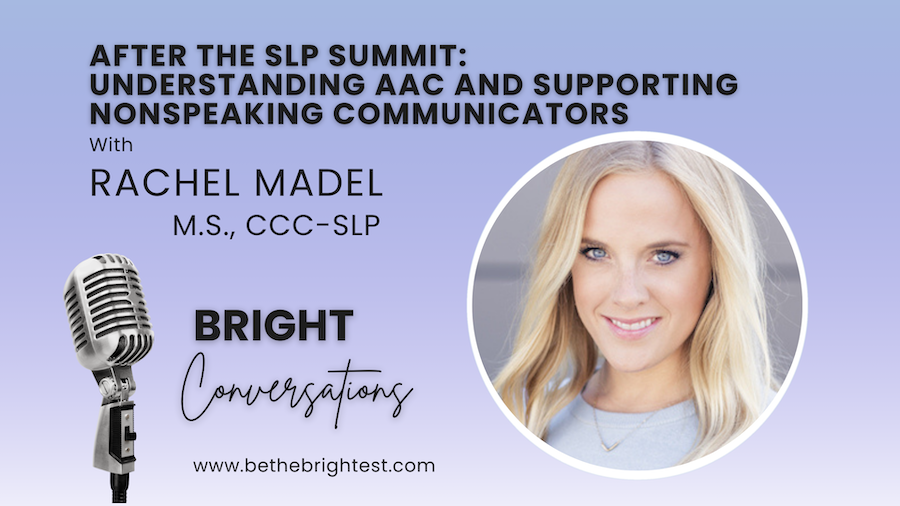
🎧 Bright Conversations – A Podcast by Bright Ideas Media
Join us for real, relevant conversations with industry leaders, past presenters, and change makers across the SLP and special education space.
📖 Read the Episode Transcript
Scroll down to read the full transcript from today’s episode.
▶️ Watch the Video
Click here to watch the full episode on our site
🎧 Listen on Your Favorite Platform
Listen on Spotify
Listen on Apple Podcasts
⭐ Want ASHA CEUs for this episode?
After watching or listening, head to our website to purchase the CEU add-on and earn professional development credit on your schedule:
Transcript of “After the SLP Summit: Understanding AAC and Supporting Nonspeaking Communicators” – Bright Conversations Podcast
Hi and welcome to another episode of Bright Conversations. I'm your host for today, Shontaye Glover Jones, and it is my pleasure to be talking with Rachel Madel, and we are talking all things AAC. If you are not familiar with AAC, AAC stands for Administrative Assistive Devices Communication, and we're going to be diving into all about how she got her start in AAC, you know, what you need to know, and a little bit even about her most recent feature with us bright ideas during the SLP Summit event that happened in January 2026. So Rachel, welcome to Bright Conversations. I'm excited that you're able to join us tonight.
Thank you so much, Shontaye. I'm excited to be here. So Rachel is a speech psychologist, and you know, I was reading a little bit about you prior to coming to the summit, and I follow you on Instagram, so I feel like I know a bit about your story, but it sounds like you kind of like gravitated right into AAC right away in your career, and I think you have an amazing story that you share that is similar to probably what a lot of people have encountered with meeting a student, so you want to tell us a little bit about how you got your start? Yeah, so I remember a funny story actually. Before I was a full-fledged speech language pathologist and I was in graduate school, I remember an initial observation going into a preschool, and I saw them using visual supports, like probably like a choice board or something like that, and I remember asking my clinical supervisor, like, "Wait, why is the SLP not just teaching them how to talk?" And I like chuckle at that now because I'm like, " Oh my gosh, like, how much I've learned and grown and like obviously what I teach and what I'm passionate about now." So yeah, I started off very early in my C.F.Y.
with a student who was non- speaking autistic, and I remember just like being in a daycare actually, he was in a daycare that I was seeing him in, and I had such a hard time just getting any type of like engagement, like he just kind of wanted to do his own thing. The teachers were just like, "We don't know what to do with him, like he's kind of running all around the class, like we kind of put him over here, but like he, then he's getting up, he's crawling on the furniture." And I remember my first kind of foot in the door was I got him engaged with this shape-sorter. He was really into the shape-s orter kind of looking at the shapes, and I thought to myself like, "Okay, like at least we're doing something here." Like, but I remember like he wasn't imitating, like I was trying all types of kind of verbal. He wasn't imitating signs, we're trying to do the sign for more. And then I'm like, "Okay , well, I have to do something," and so I'm like, "Well, what about visuals?" And so I started with, you know, little tech AAC, and that like was definitely a bridge.
And then as soon as I realized that AAC was going to be so powerful, I reached out, I got him an AAC assessment, worked alongside of an AAC specialist, and he just started making the most incredible progress with high tech AAC. He was he was young, he was four years old, and super like great, you know, initial kind of getting my feet wet with AAC, because he picked it up so quickly, and I was just like hooked after that. I was like, "Wow, like this is so cool, like the power of technology, you know, especially for kids that have no verbal speech. They're not, you know, able to imitate or they're not picking up signs ." And so my personality is like once I get super interested in a subject, I just go down rabbit holes. Like, I'm like deep diving, I'm like, "Let me get as much information as I can." Like, I'm so interested in learning about AAC, and you know, I started doing all types of research online, reaching out to, you know, clinicians that, you know, I had questions for, and I worked alongside of this, you know, AAC specialist in, you know, my first job, and you know, it just kind of sparked after that.
And as I kept learning more about it, I kept realizing, "Oh, I actually need to shift into doing more of this, and now I'm learning about this." And then of course, like fast forward, I eventually got asked to do a podcast on AAC, and caught talking with TAC, that's our podcast, I hosted with Chris Bouguet, and I remember getting asked at the time, "One, I didn't even know what a podcast was." I was like, "What's a podcast?" Two, like, I don't know enough about AAC to be a podcast host on an AAC podcast, but, you know, we talked about right before we started recording Chantay, like, lean in, like when you want to, you know, say no, or I'm not sure, like, I said, "Okay, like, let me try it. We'll see how it goes." And what an incredible journey it's been with that podcast, because I've had the great fortune to have so many incredible conversations with so many stakeholders in the world at AAC, you know, obviously clinicians, researchers, but the most important in my eyes is AAC users themselves, like, autistic adults who use AAC part-time, like, just amazing, incredible conversations that have really been weekly professional development for me. Every week, I'm, like, hopping on and recording and having a conversation about AAC, and it's just been such an incredible resource to me as a therapist, because as I learn something new, I, you know, shift the way that I'm thinking about something, and then I try something new, and it's just kind of this, like, beautiful unfolding of, you know, working with this population, and now, obviously, that's what I specialize in. I'm so passionate about helping this population, and I'm so passionate about teaching about it. Teaching other clinicians, I love the SLP Summit, like, what an amazing group of people I read all of my, all of the chat afterwards.
Oh, my gosh. Everyone loved you. It was amazing. It was so sweet, and I, like, I loved that session. That was, like, a brand new session that I've never presented before, so, yeah, it was, it was great.
Yeah, well, we were honored to have you, as you mentioned, the audience really, really loved you, and I think it's a topic, especially for school-based SLPs, that still leaves people feeling a little insecure about what to do, and then limited, because they don't have all the privileges and options as someone who 's working maybe in a private practice setting, because they're limited by bureaucracy, what their district will and won't allow. And so, I think having the ability to share this kind of information that's tailored to people who work in that setting was so impactful, and we really do appreciate you being a part of our Summit. There were lots of requests for, like, a part two, a part three, like, can't you go back? I know. It was so great.
But I wanted to, you kind of glossed right over it, but I do feel like it's a major milestone that you didn't mention with your podcast. Vanity metrics, they don't, they don't mean a lot to me. Like, I don't care about follower counts, but when you think about what it really means, it means, like, these people tuned in and your content resonated with them. So, recently, with your podcast, you guys hit a major milestone with the number of listeners and downloads. Yeah, we had, it was a couple of years ago, actually, we hit over a million downloads, and now we're, like, getting close to 2 million, which is so wild.
I mean, you do a podcast, Chante, like, you kind of, like, you record it and then you put it out into the world, but, like, to see that people are really listening, like, people are actually, like, downloading this and, you know, Chris and I, we get such amazing emails from people saying, like, parents saying, like, "Oh my gosh, like, I didn't realize that high-tech AAC would be, you know, would be a good solution for my son." And, like, now he's doing amazing, or SLPs, or, like, I had no idea, you know, how many students actually needed AAC, and, like, now there's, like, you know, 50 students in my district that now have access to AAC because, you know, of the things I learned on the podcast. And so, yeah, fantastic, incredible. And, like, you said, it's like, P.B. that you can access so easily, and it really does make a huge difference for so many different audiences from families and caregivers and AAC users. So, congratulations to you guys, because that's amazing.
Thank you so much, yes. It felt like such an awesome milestone. It is, it is. And I do want to talk because you kind of, we kind of open the door talking about presuming confidence. And I want to talk a little bit about that, especially in the world that we live in, where you can go anywhere, and you see toddlers on devices, you know?
But oftentimes, when it comes to people we think could be a candidate for AAC, we often think, like, "Oh, they're not ready yet." So, that child that you saw in the daycare, because he wasn't interacting immediately, it could have been presumed like he's not ready. He's not a candidate for any type of a high-tech device. But I think sometimes a lot of children are left out or not considered because of what we presume. So, let's talk a little bit about that. Yeah.
I mean, it's such a great topic. And during my full-day course, I spent the first, like, 30 to 45 minutes talking all about mindset, because that is one of the biggest roadblocks to success with AAC, is mindset of what's actually possible for this child. And so, you know, you already mentioned, there's so many limiting beliefs that we have sometimes consciously and sometimes unconsciously about what individuals with disabilities can do. And especially when it comes to technology, which many just SLPs, parents, are overwhelmed at technology in general. And so , we have this presumption that, you know, "Oh, this is too technical.
This is too advanced. This is too complex." And as speech-language pathologists, we really are the gatekeepers, if you will . Dana Nieder, she is an amazing mom to a young daughter now, actually, who's an AAC user. She 's a teenager now, I think. She was so passionate about advocating on behalf of her daughter, that she actually went back to school, became an SLP, and now, you know, works in this space.
But Dana Nieder talks about all of the gatekeepers that she met, which are speech-language pathologists that would not give her daughter access to high-tech robust AAC. And so, I always think about that. Like, you know, we have a choice to either be the professional that believes in a student's potential and puts the right types of technology and supports in front of them, and presumes that they can learn with enough time and the right support. Or conversely, like, we can just write it off and just say they're not ready, or it's too complex, or they're not old enough, or they don't have, you know, XYZ prerequisite. And, you know, in my clinical work, I've never met a student that wasn't ready.
I think we have to reframe that idea, because sometimes AAC does take a little bit of time, you know. We're introducing this new technology. Sometimes kids pick it up immediately, like, that first story I shared with one of my first AAC clients. But sometimes it takes a long time. And again, without the belief that this student will learn how to communicate, we're setting them up for failure before we even try.
We have to have that belief of potential in order to have any success. And so often, it's just like these kind of implicit biases that we have around people that have disabilities and children. And, you know, we're using all these things to make decisions. And ultimately, we're the ones that have the power to introduce these types of supports that can be life-changing for individuals. I agree with you.
I do think that in my experiences, I don't want to make a general statement for everyone. But in my experience when I did work in schools , I also found that the more insecure a therapist felt about his or her knowledge in AAC, the more likely they were going to say, "He's not ready," or, "She's not ready." They need more time. They need to work on pets, or they need a low-tech or no-tech option first. I felt like those two things were often very closely aligned. Absolutely.
I could not agree more. And I think that, you know, it is a field that is very intimidating. So I want to, like, just put that out there. AAC is a field that's constantly evolving. Technology is always improving.
And so the moment you learn one system really well, guess what? They have an update, and they have new features, and, you know, it 's constantly evolving. And so I do see that it can feel daunting and overwhelming. However, it's, like, getting started with what you know and just trying something and, again, believing that it's possible is such a great step in the right direction. And, you know, I never want to be the person that holds a student back.
And I feel like, unfortunately, if you think, like, they're just not ready yet, or they're too young, it's like those, unfortunately, the same ones are holding a student back. And, like, I generally, like, believe that if it's between the wrong AAC and I 'm putting that in air quotes, or no AAC, it's like, go with the wrong AAC, because eventually we can change the system or make it better. But if we have nothing, then we're just letting, you know, months and years go by where a student doesn't have access to communication. And, you know, I think what happens is SLPs feel like I'm not an AAC specialist . I can't do this assessment.
I don't know what to do. And then we don't do anything. And that's like the worst possible thing, right? So it's just like, stick with what you know, at least, know that you can go get more information about the things that you don't know or don't feel comfortable with, and just get started. And then figure it out as you go, find people who know more than you to help you.
And, you know, you're going to kind of keep learning as you go, becoming more confident as you go, and ultimately helping the students that you work with in the most impactful way. What would you say to someone who gets it and believes, like, I think that the student would benefit from AAC, but I don't know how to do the assessment. I don't have the equipment with me to even do trials. But I really feel like I want to fight for this for this student. What would you say to that clinician?
Any suggestions or recommendations? I mean, I would say definitely, like, low-tech AAC, or paper-based AAC is a good launching off point. You know, there's a lot of limitations, because there's a power to a high-tech speech generating device, meaning I feel like the auditory output of those devices really pull kids in. They're really interested. They're like, wow, I hit a button that had an image on it.
And it said something. I really believe that kids learn AAC through that kind of exchange of, I hit this button, I hear the word, I hit this button, I hear that word. And so I do think there's a power, but, you know, paper-based communication supports are valuable. And I use them with all of my clients. In addition to high-tech robust AAC, there's ways that we can support communication with just, you know, choice boards and core boards and visual supports.
So I'd say start there. And then when it comes to the high -tech piece, you know, a lot of these companies will give you, if you're an SLP with a license, they will give you a free version of their AAC system to trial. So if you have your own device , which I feel like a lot of people have their own devices now, it's pretty easy to get an iPad these days. So if you have your own device, just like download an app. And like even better, if you're like, wow, most of the kids, maybe you're in a preschool and most of the kids that are going to kindergarten, you know, in your area, lampboards for life is the AAC system that most kids are getting.
Kind of doing that extra legwork to try to set kids up for success. And then just pulling it out during your sessions. Like, I think there's this idea that like, we can't touch AAC until we have an AAC assessment. And it's like, no, just like get the device out, like model on it, see what happens. Yeah.
Even if a kid is going to get a full AAC assessment down the line, guess what, if you can talk to that AAC specialist and say, I've already tried lampboards for life, I've also tried pro loco to go. Here's what I'm seeing. Here's the questions that I have. It just makes the assessment process so much easier. And it's really hard as, you know, I'm an AAC specialist.
I do a lot of AAC assessments. If I have a student that has had some exposure to AAC, it makes my job way easier than if I'm meeting a kid that's never touched it, never been introduced to it. And so I would say, you know, introducing it to the student and then also having conversations with families and, you know, teams about it, because you can start demonstrating the need. If you pull out your general pro loco to go or touch chat and you just start modeling something that's motivating for the student to communicate about during your general speech therapy sessions, you can go to the teacher and the parents and say like, hey, I've been using these visual supports. I've been using this, you know, device in my sessions.
I use them with all the kids that I work with as a way to support communication. And he's doing amazing. Like, come in and watch me for five minutes or I can send a video or, you know, like it just gets kids going. And then we can refine as we go. But it's like, I think people are so afraid to get started.
And they're like, I can't do that. Like, it's not in their IEP. It's like, it's just visual supports, right? Yeah. But I do think people look at it that way.
The same way you would look at starting, you know, um, I don't know, their language therapy, their general therapy that you feel like, first we have to do an evaluation and have goals as opposed to like, nope, you can try it. It's okay to trial it out. And then as you mentioned, you have data because now you can show that this child seems to gravitate toward more towards this style or this, this particular app. And you can show that there's an interest is a desire. So everything that you would need to prove later on when that evaluation happens, you're starting to collect all that information before you even get to the evaluation session.
So I love that you highlighted that. It's so important for people to know. Totally. And it's just, I think it's like coming from like an AAC specialist, it like gives SLPs that maybe don't consider themselves AAC specialists or experts, like the permission to get started. It's like, yeah, just get started.
Like you don't have to be perfect. Like just, you know, another professional can come in and work alongside of you to answer your questions and, you know, to do a formalized assessment, you know, obviously, if you're in a district. But I can't tell you how valuable it is when I walk into a situation where AAC has already been introduced and I can get so much information from that clinician and the parents. And it just, it sets kids further down the path. And that is just ultimately what we want for our students is to set them up with the supports and get them, you know, making progress as soon as possible.
For sure. And it does help to get families and caregivers on board too when they can see like, oh my goodness, I had no idea that these were the things that my child was capable of or no one ever gave them the opportunity to communicate in this format before. Look at what you opened up. So yeah, I totally hear what you're saying. And I think it's great that you're giving everyone permission to try it.
Just try it. But what that said, you know, when you're, when you're trying a device, sometimes you could feel, it could feel daunting if right away you don't feel like it clicks and there's that success that you experienced with the child you talked about earlier. And this is something that we talked about a little bit. We heard you speak about during the summit where you're always expecting the correct response and how it's okay if that's not what you get. And maybe we should again shift our mindset when it comes to thinking about what we expect back from AAC users.
So let's talk a little bit more about that too. Yeah, I mean, that was the whole kind of topic of my talk was how do we honor intent for communication? And, you know, it's funny because when we think about a baby who's learning language for the first time, like they say da. And we automatically jump in and we're like, daddy, you said daddy. And it's just like, it could have been a random da.
But over time, we just attribute meaning to what that da meant. And it has meaning over time. It's the same thing when kids are introduced to AAC. You have to imagine that most kids that are being introduced to AAC, they either have no verbal speech or very minimal verbal speech. That's one of the reasons that AAC can be so powerful.
So they haven't had that stage of exploring and babbling and really trying to understand what is this in front of me and how do I use it and what does it mean? And I think the one of the problems is if we think about a student who's being introduced to AAC and we are assessing success, quote unquote, by how accurate they are with the device. Again, especially after we haven't done a really great job of modeling language, we haven't given lots of motivating situations with repetition where a student can communicate something that has meaning for them. If we don't see accuracy right off the bat, we just assume like, oh, they're not ready or this isn't the right system. We have all of these kind of assumptions that we make.
AAC is not working, again, air quotes. If we shift our perspective to thinking about what students are communicating and even before that, the fact that a student is touching a device, of course, if they use direct selection, after touching a device and initiating, that's a win. Like, how do we reframe what we look at as success? And I think that especially in an initial session when I'm putting a device in front of a student for the very first time, I'm like, wow, look, they just hit a word. And you have to know that anyone else in the room during that assessment, hopefully it's, you know, paraeducators, if you're in the classroom or teachers, if you're working, you know, with families at home, it's parents, it's nannies.
You know, the way that we frame success as SLPs helps the entire team feel good about what we're doing. Meaning, if I'm like, wow, did you see that? Like, he just hit open all by himself. Even if open wasn't necessarily the "right" word in the context, if I 'm excited that he just touched the device and initiated something with me, then all of a sudden, parents and paraeducators teachers are like, oh, great, like, okay, he's doing good. Okay.
I'm like, they 're really looking to us as SLPs to, like, understand, like, what does progress look like? What is success here? That's true. That's a really good point that you're bringing up because everyone does look at us to decide, like, what matters. And we do have the ability to shape what's a huge milestone or what's progress.
So if we are excited about the smallest motions, you know, the smallest actions that does set the tone for what everyone else will be feeling successful about, and then their desire and motivation to keep helping and supporting this particular child or client to keep going with AAC. So I think that that's, like, so powerful. What you said, even though it seems small, but we do have that power within our role. Absolutely. And I think one of the most important things you can do as an SLP, who is on a team for a student that has complex communication needs, is really being an amazing cheerleader to the little small wins that we see.
Because, you know, with this population, sometimes progress is slow, and it's the small little baby steps in the right direction. And if we are not celebrating those and amplifying those, then the team feels like this isn't working. Our therapy is not working. The AAC is not working. Like, we get to this, like, very negative place versus if we're like, oh my gosh, like, he just said, go on his own.
Like, we've been modeling that for the last months. Like, he just did it. And like, we're sending, you know, a quick little video message to the team, or we're popping into the classroom and, like, getting excited with the teacher and the paraprofessional. You know, that excitement is contagious. And it's like that momentum you really need in these types of cases , because progress can feel slow and people can feel like they're doing hard work modeling and they're not seeing the fruits of their labor.
And so when we highlight those small wins, it just gives that team encouragement to keep going. And I'm like, he said, go, like, practice that while I'm gone. When do you think is a good time? You could practice modeling that. Okay, before recess, great.
Like, I'm so excited. Like, and then we come back and they're like, he said, go. And I'm like, you did amazing. Like, keep it up. It's like, I really think you have to bring a passion and energy to create momentum in these cases.
And like I said, it can be contagious. All of a sudden people are like, yeah, he said, go. And like, everyone's excited. And we do it already for our speaking clients. We just need to adapt that mindset for when we're using AAC as well.
But we often celebrate the smallest of wins, because they're so huge to us. So now you've heard it, you have permission to do the same. Make sure you're carrying that through and motivating the whole team. The more that everyone buys in, the more successful your clients and your students will become. Exactly.
Yeah, fantastic. That was really, really good stuff that you mentioned there. And so, okay, we talked a little bit about modeling and how important that is. And I think that what I'm hearing too is the importance of you engaging other people to do the modeling as well. It can't all rest on just the SLP.
So how do you get the other folks on the team to recognize the importance of it? So you don't walk in the room and realize like the AAC hasn't, the vice hasn't been on all day. They've been waiting for me to show up. Yep. It's such a great question, because I feel like that's like, you know, most of the people listening to this podcast or SLPs, and it's like the SLPs like bought in usually to AAC.
They're like, okay, yes, AAC. But it's like, how do we get everybody else on board? Like, how do we get like, the big players on the team who need to do the heavy lifting, aka the modeling on the device? How do we get them bought in? You know, in my clinical work, I own a private practice in Los Angeles, and I am doing mostly coaching at this point.
I mean, I have a team of therapists who are doing direct service, but the best way to make progress with a student with complex communication needs and AAC user is to train the circle of support around them. And that's what I do in my clinical work. So, you know, even if you're working in the schools and you don't necessarily have the capacity or the minutes to do, you know, full-fledged coaching sessions, the way that I would in, you know, my clinical work, everyone has time for coaching moments. It's like, we all have time to like pull that teacher aside for five minutes or that para educator into our session and ask the right questions. I think helping communication partners set goals for themselves.
So, like, let's use the example of, you know, modeling go in the classroom, right? I would walk into the classroom, pull the teacher aside, be so excited that the students say , go in my session and say, like, when do you think a good time to model that word would be in your everyday, you know, classroom activities? And they're like, well, I don't really know, like, maybe recess or maybe, you know, there's this bubble machine that all the kids are really liking. And like, maybe we could do it that. And so you're like brainstorming and collaborating with, you know, communication partner, say, awesome, like, do you know where that word is on the device?
And it's like, okay, like, here's the device. Yeah, here it is. So, like, let me show you what that would look like. And I'm like, okay, ready, set, go. And I go on the device, right?
I'm like, perfect. Like, okay, so you're going to model it during the bubble activity. Awesome. Like, I'll check back in next week. And so, you know, what I did there is one, I looped in a communication partner.
It's not me going and being like, practice , go, practice as much as you can. I'll see you next week, right? Which, you know, inadvertently, we end up doing as SLPs. We end up coming into a classroom and telling people what to do and then like booking it to our next session. One extra step is just like asking the right questions.
When do you think a good time would be? How many times this week do you think you could do that? What I'm really doing is I'm helping a communication partner get really clear on one specific thing that they're going to do. And I think, again, we try to encourage our communication partners to kind of model all the words all the time. And we hear these things said, but that leaves communication partners feeling like, I don't know where to start.
I don't know what words to model. And so if you can help a communication partner get very clear on one routine with one word or phrase that's super motivating and they feel like they can do that, that sparks change. And all of a sudden they come back and they're like, I modeled it. And like, he imitated it. Amazing.
Or like, I modeled it. And then I realized maybe a better word would be, you know, bubbles, you know, it sparks these like small little conversations. Again, it doesn't have to be a whole session. It can be five minutes. But all of a sudden we're getting that buy in because we're spending just a little bit of extra time asking the right questions and helping to guide a communication partner.
Oftentimes communication partners want to do it. They just don't know how. And then it's like this overwhelm because we haven't been as specific as possible with what word, what phrase, what routine, how many times, I mean, like, we write smart goals for IEPs. It's the same thing, like make it specific, make it measurable, like, make sure there's no room for error in like what a communication partner could and should be doing to help support this student. So I think just taking a little bit of extra time to have those conversations, those coaching moments can be incredibly powerful.
And that feels so doable. The example you just gave, it feels like, oh, I can handle that. Like, and I know it won't take much more time for me for what I have to do prior to my next session. And it feels like for the educator, it's straightforward. It's pretty simple.
I 'm not asking you to create something new. I'm asking you to incorporate this in whatever you're already doing. So it feels like mutually beneficial for all parties involved. So you will hopefully get more buy in and more comfort and support around the whole idea. So yeah, I like , that's a fantastic example.
I also was thinking in preparing for today, I was thinking about a few , maybe like two years ago, we had hosted an AAC conference through Bright Ideas. And I wanted to get different aspects of the whole process involved in this conference. And one thing that we talked about, Karina Sei-Chao, she's an SLP, also on the West Coast. I want to say in California, she talked about equity in AAC and how, you know, everything is not the same for everyone. And there are some systemic barriers that some people face when it comes to getting access to a device or even an assessment or intervention.
So have you experienced any of that in your work? And is there anything that you can speak to on that particular topic? Yeah, I mean, I think that so often families come to me in my practice because they've been denied by their school district, which is so unfortunate. But you know, I think that families don't even realize kind of how many rights they have. And if they get denied, you know, there's a whole kind of process that can happen in a district to help get devices in the hands of kids.
And that means funding the device. So as SLP is kind of doing this work, I mean, you know, if you're in a district, obviously you have some type of access to usually some type of technology. I have met, I do a lot of speaking events all over the country, and I've met a lot of people that like raise their hand during one of my talks and they're like, I, you know, we don't have that access. We are our district, our admins are, you know, blocking that. And so I recognize that there's real roadblocks to change.
But I also think that, again, if you can start small, and that's where like just getting your own iPad that has a speech generating device an app on it, you know, getting started to show the power, I think can change if, again, you have issues with kind of admin blocking or budget issues. You know, once people see it, and they see the power of it, and it's like, first the student didn't have any communication, now look what we're doing in our sessions, like look at him go. It's like people need like that personal like story almost to attach to. It's really easy for admins and districts to be like, we don't have that budget or like, this is our process. But when you make it human, you make it real, like you anchor into a specific story, which by the way, one of my favorite ways to kind of get buying and teach about AAC is like make it personal, like share a clinical story.
I mean, when I did the summit, like I was sharing stories in my own clinical work. We all have amazing stories in our clinical work, and we don't think about them until something sparks us and like , oh yeah, I had a case like this once. Think about all your stories and how powerful they can be. And so circling back, I feel like if you have barriers in your district around how to get devices in the hands of kids, showing at a small scale that eventually can be a big scale of the power, the need, right? Pointing to other people that have done it well, other districts, I think would be my best recommendation, because it's kind of hard.
I do a lot of IP advocacy in my work in private practice. And I'm like, how is this kid accessing their curriculum? Like they don't have communication. So like I come in and I'm like asking the right questions to the team. I'm like, okay, so how are they supposed to respond to those questions?
Like they don't have, okay, they have maybe like one sign for more. Like, okay, so it's like, again, asking the right questions can help reveal the need. So I think from the school district angle, I understand it's kind of like, you don't want to go into an IP meeting with your special ed director, where you're like, you know, advocating in a way. Exactly. But like, you know, I've had so many SLPs, like, I'm really struggling in my district with my admin and these things.
My best piece of information to share would be to talk to the parents, like talk to the parents, because districts won't do anything until they have a like upset parent that's like, I'm demanding this for my child, but parents don't know. Parents don't know. So having that conversation, I think, can be really powerful because ultimately so many of these kids, like they can't access learning because they don't have communication. And so like we have, we have technology that can support their access. And so making that case, I think can be really powerful and having a conversation with families specifically, I think can be really powerful.
I agree with you. The importance of empowering parents and caregivers, they often don't know what their rights are. They often don't know, if you mentioned how, how is the student accessing the curriculum, that's not something that's going to be within the average parents repertoire to say, to bring up. At home, they 're going to be thinking like, well, you know, is my child communicating with their friends? How are they expressing themselves to the teachers and the school staff without it?
But on a broader level, in general, the entire curriculum, their entire school day, how are they managing all their needs without having some way to communicate them? And so once you can have those conversations with families and caregivers and give them the kind of like the battery in their back, like listen, you know , this is something that you can fight for. You can have these conversations with the case managers . It helps. It helps to get them the wheel moving a little bit more.
So SLPs in power, as much as you can, encourage the families to get involved in those conversations too. And the more that we're able to educate them, the more they're able to advocate for themselves and for their families and for their children, for sure. Yeah, yeah. And it's not easy. You know, I don't want to cross over any of this and say that it's easy.
And I know, I can't imagine the struggle that might be for you as a clinician who really sees the need and you're passionate about this for your student. But you also, you have to maintain your job and your relationships with your admin. So I totally understand the duality and the complexity of the situation. Yeah, totally. I mean, I think that's where like, kind of a late tech AC, paper based AC, we get kids going with that and we're like, this is limiting though.
Like this is not like as robust as they need, can also be a good foot in the door. But yeah, I don't want to downplay the real challenges and barriers there are because they exist. I think it just takes a little bit of extra maneuvering and strategy to kind of get around them. Yeah, yeah. And we're pretty skilled at that figuring out how to make things happen with a little bit of maneuvering and strategizing with all the key players.
Oh, really, totally. So we touched on this a little bit, but let's just chat before I have to let you go. Because I could probably ask you questions all day, but I want to talk a little bit about stim ming because I've seen in my experience too, where on TikTok, I've been seeing this a lot lately too. And it's so like, I love it because I see a child that's in the car with their parent and like the child just picked up the kid from school and the child keeps hitting McDonald's McDonald's McDonald's McDonald's McDonald's and the parent is in driver's seat like unbelievable. I can't take this like he's forgiven him this device, but you're kind of overlooking the fact that your kid is telling you something, mom.
Totally. Now they finally have access to the real words that are powerful, like McDonald's. So, you know, some in that context, it was pretty clear what the intent and the message probably was. But sometimes we don't know and it looks like it could just be stimming, but that's important too. And you talked about that recently with us.
So, can you share a little bit more about how you view stimming when it comes to giving a child device? Yeah. I mean, I think that ultimately, we know that stimming serves a purpose, right? Like, and we don't always know exactly what it is. So, it could just be, you know, I really want you to hear me.
Like, you're not, you're, I'm not a McDonald yet. So, I'm going to keep saying McDonald's until I'm there, right? Yeah. It could be that I really like the way this sounds. I've, I don't know if I shared it at the summit, but like, my favorite word is puddle.
I don't know why I like it . I love the way it sounds. I love saying it. You know, it could be regulatory. Like, we talk with autistic adults who use AAC, and there are certain words and phrases that help calm them down when they hit, when they hear them.
And so, you know, zooming out, and I feel like so often we just treat stimming as like, oh, they're just stimming, or like, they're not using the device functionally. Like , we hear that kind of thrown around a lot. And like, human beings always are doing something with a purpose. Like, it's not random. It could just be that they love the way it sounds, and they're like, like, you know, pinging all over the device, and it, they like all these different words.
But, you know, my point in my session at LCP Summit was, how do we get curious about why this is going on? And I shared lots of examples in that talk about how we thought it was one thing, and then once we got more context and information, like, wow, actually, he was just teaching himself the entire device. Like, he knows where every word is now. You know, I think when we lead with curiosity, and we assume that there's a purpose, and we just need to kind of get more information as to what's going on, then we will be, you know, surprised and delighted at what we find. And, you know, opposite of that, obviously, it's just like, they're stimming on the device, take it away, right?
And it's just like, well, there's no curiosity there, there's no learning. And we also like fail to mention that many autistic individuals, they say the same words and phrases over and over again. Like, so if a verbal autistic child has that ability, then a student using AAC should have that ability. And yes, it's disruptive. And yes, it can be annoying .
And yes, like, it can feel like so many reasons why we wanted to stop. But at the end of the day, like, thank goodness that this kid now can tell mom McDonald's. It's like, we forget that, like, we took a kid that wasn't able to access communication, and now they are. And even though it doesn 't look as clean as we want it to, like, it doesn't devalue the fact that they are communicating. The other thing I like to think about is, you know, communication starts with an idea, we have ideation, then we find language, and then we execute a motor plan.
And so for our AAC users, they're thinking an idea, finding a language, and executing a motor plan with their hand. And if their brain keeps thinking McDonald's and their hand keeps thinking McDonald's, the moment we interrupt that process, we take away the ability to have the motor plan. Let's say we, like, you know, hide the word or take the device away. Like, how frustrating would it be to, like, not be able to complete that full circle of communication? So I always like to think about that, too, is just, like, for whatever reason, if that brain keeps pulling the word McDonald's, like, guess what?
Like, they should have the ability to execute the motor plan. Of course, we can do some teaching around it where it's like, I heard you say McDonald's, you want to go to McDonald's? Like, we have learning opportunities to expand language. You know, we have opportunities to create social stories around, like, right now, like, we're in the library, we have to be quiet, like, we're not talking right now, right? Like, there's so many different ways that we can approach it.
There's also, again, like, regulation benefits to kids regulating themselves through stimming. And so I think that's an important thing to think about. I actually did an amazing, first was a social media series, but now we have a whole resource on stimming with Laura Hayes. I saw her present at a conference called AAC in the Cloud, and she presented all on, like, the different types of stimming and what to think about and how to kind of think through that lens. And so that's a resource that 's available on my website, like, a free resource.
So we can link to that in the show notes, but it's, yeah, it's really important that we get more curious, and we start thinking about, like, why? Like, why is this happening? How is there potential benefit to the student? And then, like, anything else, how do we teach students? Like, how do we teach them, like, what to do and not to do?
And how do we find replacements? If we can, or expanding language, like, there's lots of opportunities to kind of build off of this, instead of just, like, trying to just, like, you know, diminish it or, like, stop it altogether. Yeah. You, you are just, like, such a wealth of information. You can feel how passionate you are about this.
And as you were talking, like, there were just so many, like, major moments that were happening and key ideas that came up. I was thinking when you were talking about, um, hiding a button when someone's stim ming it. And I was visualizing someone taking their hand and covering a speaker's mouth. That's almost what you're doing when you decide to hide a button. But I've never thought about it that way.
But that's essentially what you're saying to them. And I love what you said. It might not look the way you expected it to or as clean as you wanted it to, but you shouldn't devalue that person's attempt at communicating. Yep. Exactly.
It's like, we just need to, like, reframe it. Like, that's, like, a lot of what I teach is just like, how do I think about this in a different way? Yeah. Yeah. And so much about our field right now is about reframing and rethinking the way that we look at things.
And we shouldn't exclude AAC from that either. Totally. I want to make sure I have enough time for you to let people know how they can follow you, how they can connect with you, where they can learn more about what you do. And you mentioned at least one resource. But I know you have a pretty big library of free resources that are available.
So go. Yes. Yes. Yes. So my website, rachelmedal.com, you can go sign up for my email list, which gives you access to our freebie vault.
We are constantly updating it. There's so many resources in there, all, you know, to support mostly SOPs, but also parents in AAC. You know, I have the podcast talking with tech, our website's talking with tech.org. Seven years of podcast content on there, completely free resource might feel overwhelming. I'd say if you're going to listen to the podcast, start with the AAC user episodes.
They're the most powerful. And there's no better way to learn about AAC than to learn from someone with a lived experience. And so I'm super excited about all of those episodes. I also sell resources on my website, teachers pay teachers, boom learning. We definitely had a boom during the pandemic.
I was like, okay, let's make digital resources now. So we have a lot of those. And I use them in my own clinical work, all about core words and, you know, thinking through the lens of emergent communicator. It's a lot of the population that I work with. And then lastly, just I have courses.
So I have a course, AAC ally. I have a treatment edition, which is currently out, but I'm launching a brand new assessment edition. So, you know, we talked in the beginning about how I want to empower SLPs. Every SLP, you can learn about AAC. I can teach you about my, you know, AAC assessment process.
You don't have to be an AAC specialist to start trialing AAC. And that course, essentially, is going to be a complete guide as to how to do an AAC assessment. If you're not an AAC specialist, I definitely think even if you are an AAC specialist, I might have some novel kind of unique ideas that I use in my own clinical work . And I'd say the best thing about the courses that I have are the case studies. I have a lot of videos of my sessions.
I'm just so grateful to all the families who have given me permission to record and to share for such amazing educational purposes. And so my goal with those courses is how do I help clinicians who are doing professional development, taking this course? How do I help them pause the video, look at a video again and again and think about all of these observations that we're noticing. Like, what questions would you ask a communication partner? You know, what do you notice about this student to really try to integrate?
Because I feel like we talk theory oft entimes in professional development. And while we do need to ground in some type of theory and explanation, we also need to think about things through like a critical thinking clinical lens. And I think that myself and my team who helps me kind of do all the backend stuff, I think we've done a good job at really creating professional development that helps kind of bridge the gap between like, here's the theory and here's what I actually can do tomorrow. And so yeah, I'm really excited. It's not completely done yet, but I'm hoping it will be done very soon and it will be out in the world.
So if you sign up for the freebie vault, then you'll know for sure when it comes out. And I think that's it. Other than you can follow me on social media at Rachel Madele SLP. We do a lot of stuff on Instagram and Facebook. Yes, all really, really good stuff.
And we will for sure make sure we include all the links to all of that stuff in our show notes. Before I let you go, I have to ask what makes you feel hopeful right now about where AAC is and where it's going? I like there's never been a greater time to like be harnessing technology for communication. It's like one of my favorite things is that we I can now follow autistic AAC users on Instagram and learn from them. You know, I can find professional development.
I can reach out to other people who I know know more than me and ask questions. And so I'm hopeful about how accessible AAC feels now more than it ever has. How many people are excited to learn about it? How many, you know, resources there are available to learn about it? And again, I think being able to connect with with people who have a lived experience is so powerful and has taught me so much about the work that I do.
And so I think that's what makes me the most hopeful is that like it feels like the more I am out there in the world. I'm like seeing AAC. I'm hearing people talk about it. And I'm learning how to integrate all of those things in my own clinical work and to be the best possible clinician I can be. You're doing amazing work.
And we are so grateful for all that you pour back into us, the rest of the field. And you know, as you were talking about making it accessible, I know one thing that has excited me was seeing all the changes that have happened with skin color and different voices, voice options to for that feedback and how that makes families feel like more connected to the device because it sounds and it looks like the user. So that's all like amazing stuff. And we are so thankful to have you and appreciate your time today being a part of this conversation. Thank you for joining us for Bright Conversations.
And I can mention if you want to find out anything more about Rachel, we will include everything in the show notes. And if you love this conversation and want to hear more, feel free to please subscribe and we'll be back with another conversation soon. Thanks, Rachel. Thank you so much, Shontaye.
About Bright Ideas
At Bright Ideas Media, we empower educators, speech-language pathologists, and special education professionals with actionable knowledge and engaging learning experiences. We make professional development easy, insightful, and impactful—so you can apply what you learn right away!
💡 Want to keep learning? Explore 150+ hours of live and on-demand courses designed for professionals like you. See all available courses → Click Here
Recommended Courses for You
Here are some courses you might love based on what you’re reading:
📌 From Evaluation to Implementation: Next Steps in AAC
📌 Unlocking the Power of Gestalt Language Processing
Join Our Email List
Sign up to be the first to know about new events, course launches, exclusive discounts, and practical insights to support your professional growth.
Thank you for subscribing!
Have a great day!