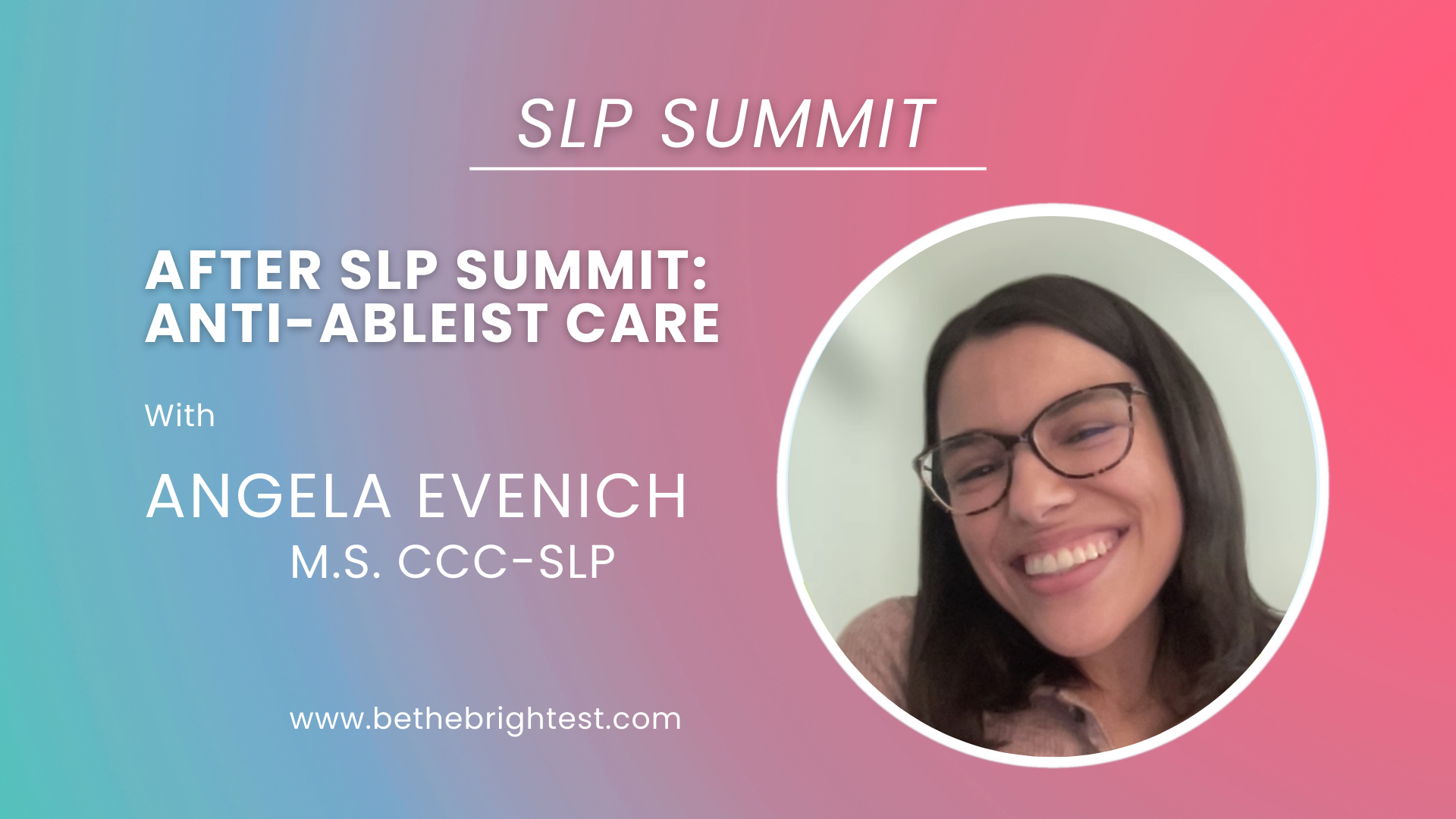
After the Summit: Anti-Ableist
🎧 Bright Conversations – A Podcast by Bright Ideas Media
Join us for real, relevant conversations with industry leaders, past presenters, and change makers across the SLP and special education space.
📖 Read the Episode Transcript
Scroll down to read the full transcript from today’s episode.
▶️ Watch the Video
Click here to watch the full episode on our site
🎧 Listen on Your Favorite Platform
Listen on Spotify
Listen on Apple Podcasts
⭐ Want ASHA CEUs for this episode?
After watching or listening, head to our website to purchase the CEU add-on and earn professional development credit on your schedule:
Transcript of “After SLP Summit: Anti-Ableist” – Bright Conversations Podcast
Hi! And welcome to another episode of bright conversations. I am your host today, Shontaye Glover Jones, and I am very excited to host a special post Summit episode, we have the honor of having Angela Evenich.
Average back. Did I say that right, Evenich. Yeah. Yes. No, you're okay.
Okay. I forgot that fast. Having Angela back as a guest today, if you somehow missed it. The January 2026 SLP Summit.
Happened. From January 12 through January 14th we had the live presentations, and Angela. Was gracious enough to present for us on day one of summit on a topic that's very important, not just for the speech language. Hearing sciences community, but just in general, for our society her presentation was on was called anti ableist Care, a disabled clinician's perspective. And Angela is a slp from the West coast, and I will let Angela tell you a little bit more about her experiences.
And a little bit more about who you are, Angela, would you like to share with our audience. Yes, I'm so excited to be here. I'm Angela. I'm a disabled teach English pathologist with cerebral palsy, so I. Was born in cerebral housing.
I grew up going to speech therapy, and that kind of sparked my interest. With coming into the field. And right now I so I practice. I'm in the private practice setting, and I also do. A lot of disability activism within our field.
So I present. Alright. And I just talk about anti-abilism. Basically what I went over in my course. But.
A lot of things to consider from the perspective. Of a disabled person and other disabled people, which I think is important, and not always. Considered or taught in our fields. That's kind of the angle of my work in what I do. And I think it's.
Even more important and impactful to hear it from a person who belongs to that community as opposed to us. Thinking about what we feel a disabled person would want, or how they would feel. So it's. An added element, that you are an slp, and you're also disabled, and you can speak from your own lived experiences. So we.
Definitely loves having you be part of the summit. There was so much appreciation for you in the chat, and right before we. Went live for this conversation. Angela was just sharing with us that She had no idea how big the summit would be, and how how many people actually attend. So if you've never experienced the slp summit, it is a biannual conference that's hosted by that's sponsored by slp, toolkit and slp.
Now it's hosted by bright ideas. Media. And it's virtual. We have 2 courses a day for 3 days, and it's free. Which is part of the reason why it's usually so big on top of the fact that it's.
Free. We do do our best to find incredible presenters to bring. Really important information that will impact the way that you practice on a day to day. And Angela's course. Was one of the courses that was just really, really well received.
And what we wanted to do today would just go back and talk a little bit about your experience, your course. And there were a few questions that remained. After the hour. So if we can tackle some of those that would be fantastic too. Yes, of course, because I know there was a lot of good questions, and I'm sure we didn't get to all of them.
So. Yeah, no, we did not. You kind of hit on it a little bit just now, when you were talking about growing up having speech therapy, and that's what inspired you to go into the field. One of the questions was. Did you learn articulation when a different slp made it more fun?
Or did you just need to get a little bit older. Maybe you could give a little bit more context to. About this question. Something that you spoke on during your presentation. That led to this question?
Yes. Yeah, I was talking about. I believe I was talking about my experience receiving speech therapy, and I was trying to make the point. Our connection to kind of the relevance of considering. The people that we're working with, and that were not just here to treat and fix.
And that's not our only focus, and we should be person-centered and. Considering the whole person, and also checking. Our biases of like. Okay. So if we think our job is to make.
People like have, you know, quote unquote, perfect speech, like, who is telling us that. Perfect speech make someone successful or more desirable, or whatever it is like. Why is that our goal? And let's check our bias. So I was.
Bringing up an experience that I remember probably like. This was early. This was maybe kindergarten. It was definitely elementary school, and I just remember. Sitting in a room and having the slp like.
Give me articulation cards, and we were doing articulation. And I just didn't like it. I'm pretty sure it was hard for me to do, and so I just remember being frustrated and crying, and that's like kind of my. Experiences, speech, therapy that came into speech, therapy. To kind of be, yes, like, inspired by my experiences, but also give.
Disabled people may be a different space than what I was given. So that's kind of the reasoning for me coming into the field, but I think. Hmm. How it could have been different was maybe approaching it. More of like.
A. This isn't going to be so much of drilling. This is gonna be like. Hey, let's practice this, and if you can't, it's okay. But I think that mindset of like.
You have to reach this versus like, we're just gonna try and see. And you know, if you can't, we'll go over like, maybe self advocacy strategies like. Something like that, I think, could have been a better approach to that. Yeah. Yeah.
Yeah. Yeah, I I agree. I agree. It's interesting that that's your your 1st memory, and one of your most prominent memories of speech therapy, and when you were describing it, I thought about how many ways someone may have encountered. A child that's crying, and maybe told them like, Don't cry.
It's okay. This is easy. You'll get it, you know, minimizing the way that you're feeling, and there's so many other things that you could say or do in that situation. Yeah. To help a child feel like it's okay.
If you're feeling sad right now, or if you're angry right now, if you're frustrated right now, a lot of other language that could have been used in that situation to make it. Not as negative as it was for you. Yes, agreed exactly so. That was exactly the point. That I was trying to make with the reframing of disability.
I think that, like drives a lot of our practice, or can drive a lot of our practice. Hmm. During your live course I was. Listening, watching, doing a lot of things. But I remember in the chat, and I actually chimed in in the chat.
Someone didn't want to use the word disabled. And she said, Let's start there. Let's start with not calling people disabled, and a few people, not just me, but a few people jumped in and spoke about. The word disability. The word disabled not a bad word, so.
Came. We hear from you what are your thoughts about the term? And people who would prefer to use. Yes. yeah.
Special needs or I know you talked about handicap during your presentation as well. So. Yeah. Let's talk about words and language because it matters. It makes a difference.
Yes, yes, it's so important, and I think more. In like recent years there's been a lot of conversations from disabled people, and the disability community. And a lot of questions from other people about like, What's good to use what's not. And I think. The main point is that a lot of our conversations about disability.
Have always been discussed and talked, and like. Taught from non disabled people. Maybe people that know other people with disabilities. Maybe people that are adjacent to that community in some way, but aren't a part of that community, and what that has done is that has. Right?
Taking a lot of agency away from disabled people to decide how we want to feel about our disability, and there's a lot of talk about. You know, like disability should be framed of like. It's more of like well, that's their like. They have gifts in other areas, or like they have superpowers in other areas, like disability, is so bad that we should basically like. Yeah.
Dress it up, and make it seem like. You know. Well, there's other things, though, that they can do, and that's where the idea of like special needs comes from, because we don't. Want to say disability, because we believe inherently. Like, whether we realize it or mean to or not.
Like intentional or unintentionally, we're taught to believe that disability is so bad. And that's where all this language stems from, which is why it's important to talk about it. So with. Disabled. We were taught for so long that, like basically.
It should be person first.st Language always. This is what we were taught. Hmm. Mostly it should be person. First, st language, because we have to see people with disabilities, as people first.st And so disabled people have reclaimed.
Right? The identity, like as an identity to be like no, like. Disability affects the way I see the world it is, and identity there is. Like a sense of pride in that, like yes, you know, like everything, it can be neutral. There can be hard things, but there is a sense of like identity in that.
And so we're reclaiming. The identity of. Identity first, st which is disabled, person. So there's a lot of different. There's always so many different conversations about that, and there's not one right way.
Our wrong way to do it. It's really up to the person. Right? But what comes in issue is, if you're always defaulting a person. First, st because you have that belief.
Yeah. It's not so much like guess. The language we use is important, but it's also the belief that's embedded within the language that we're using. So if we're always using person first, st because. You know, we need to see people with disabilities as people first.st We kind of had to question why, that is.
Yeah. Yeah, absolutely. I I think that. You explain that so well. And and the point that you mentioned, too, I think is important, because there are going to be people who prefer not to be called disabled.
So you need to respect an individual's choice. Yeah. Yeah. But in general, when you're referring to people. If you refer to the group as people with disabilities or special needs or handicapped, you really do need to examine.
Why is that? And so there's so many things about our practice, when we think about all the individuals that we're going to encounter, and all the different identities. Different backgrounds and experiences that we really do need to sit back for a second and think about. Am I biased? And the answer is, Yes, we all have bias, and that's okay.
But we need to address those biases, and look at how it can impact the way that you're interacting with the group. So I thought it was fantastic that. As you were talking about it. The audience chimemed in, too, and we were all like, you know. Coming together, not to.
That's a call out someone, but like, Call them in and say, like, Hey. Yeah. Disability is not a bad word, and it's important that we have that conversation. And it's also important. That we talk about like your.
You may have great intentions, but your intentions don't trump the impact of what you're doing, and so you can't. Comfort yourself by saying like, well, I didn't mean any harm. You're still causing harm, you know. So it's important that we're. Addressing that as well.
You mentioned that you're currently working in private practice, and I don't know what age group you're working with currently. But someone had wondered. How do you recommend addressing I guess they meant. Treatment, or just. Anti ableist care when you're dealing with very young students like.
3 year olds in pre-k. yes, hey, yes, and I do remember seeing this question, too, and I think I. Touched on it a little bit about. Because I know there is a lot of discussion about the school setting, and how. How can we be anti-abilist in a setting that's so based on compliance?
And I think a lot of it again. I know, because when I talk about anti-abilism, because I've been presenting in our field for a few years now. And everything, and I get it completely like people kind of just want, like a you know. What do I. Corrective.
Hmm. Like, what are concrete things Yeah, like, what I do, what do I not do? And a lot of it honestly is about mindset and reframing a lot of the things that you learned about disability, and that's going to set you up for. How you approach certain things like it's not always like a list of this is what I do. This is what I don't do.
Yeah. Hmm. It's more of like a mindset shift, and that's going to influence the way that you approach different things. So like with preschoolers like in my clinical fellowship. I worked in preschool.
Yeah. And a lot of it of being. Antibias are being anti Abelist. A lot of it was literally reframing my thinking into being like, Okay, I'm working with these young children like, what is our goal? Is our goal to make them functional.
Or is the goal to be like? Well, they need to meet up to their neurotypical, able peers. Like you have to start there, and that's gonna drive your whole therapy, because then we rethink about like, what are our expectations in therapy? What does therapy look like. Are we creating a space where we're going to create functional.
Opportunities for them for functional language? Or am I going to make them do what everyone else does? Are we gonna make them. Hmm. You know, communicate in one certain way, or do something one certain way.
Only I think that's what drives really everything. Hmm. And so anti ableism, with a young child like that could also look like having parents involved. Yeah. Parent coaching teacher like collaboration, just making sure everyone's on the same page to support.
The student in ways that works for them. And not thinking about. Maybe neurotypical standards. What we think. That this kid should be able to do.
That's really it. I think. Yeah. Yeah. Yeah, the you mentioned that there's really not like a list.
And one of the questions was that you talk about a lot of what not to do, but what should we do? And The the from my perspective. There's a lot of unlearning that has to be done, and that's really. What we have to do, and we. Yeah, when you peel back a lot of those.
So we're Yeah. Yeah. Those mindsets and a lot of the practices. Then you know what to do, because now you're. Yeah exactly.
You know. Yeah. Yeah. It's It's not like a simple checklist where you can just say, like I do this, Do that, do that? Yeah.
No. Yeah. And I think cause we have good intentions, and we want to do better as people. So we're just kind of like, yeah, like, Okay, what do I do? What do I not do?
But it's so much deeper than that that I think people don't always realize in the beginning, like it's so much deeper than. What you cause. I could technically give you a list of you know what to do, what not to do, to be anti ableist. But if you're not thinking about it with those antiavelist principles, you're not really going to understand the reasoning behind why, like. Why is this like, ablest?
Why is this a maybe a more like inclusive approach? You're not really gonna understand that to be able to. Apply it long term. agreed. Similarly.
This question is more about parents, and this person wants to know. How do you explain to parents when they ask to teach your teach their child to be more social. Yes, yeah, this is just a good question, because I definitely have. But their child does not like to be part of social interactions with others, and for some it causes a great deal of anxiety. I have some thoughts on this, but I'll let you go first.st Have had this conversation before.
I always ask. As many questions as I can, so something like. What really just depends, too, if. You know this child, you know. With explaining it to parents, I will say, if there is a diagnosis or something we can maybe lead with that.
And I give, you know, a lot of resources and conversations about okay. So if. This child is autistic, or something like that. I'm just gonna throw that out there. Then I can deep dive into the world of like.
Neurodivergence, neurodivergent communication, and just kind of, I think. I mentioned this in summit in my presentation, but just kind of giving. Parents like everything that I have. I forgot how I framed it, or what I said, but. Like, basically giving them the tools, and then sprinkling kind of all the resources.
Because I remember my parents telling me that. They didn't really know much about cerebral palsy. They weren't really given a lot of resources. And so now, as a clinician myself. I try to do that like I try to do.
Hmm. Give my families better than what my parents like, got from hearing their experiences with me. But that's like what. Yeah. I would do the most is just kind of explain to them as much as I can, and then also.
A lot of it is reframing this idea that you know, cause there's just a lot of bias. We all have bias like you. Said, and I think a lot of parents just think like, Yeah, I want my child to be able to do this, like everyone else can. Why not? And so a lot of it is like reframing and teaching it to them too.
Well. Yes, yeah, I agree. It's a lot of education, and. Yeah. Yeah.
Initially, when I read this I I was thinking about What make? How do you know that this kid doesn't want to be a part of social interaction? And what exactly. Right? Do those social interactions look like?
Maybe the assumption is that what this child is doing isn't social, and going back to your point. Having a conversation, talking about. For example, with neurodivergence. That all play is valid. And maybe you're not recognizing what this child is doing in social.
Exactly. But it is for them, and their play is play. So a lot of teaching and coaching parents and helping them to understand who their child is, and then, going back to what you said previously, that we're not here to fix them, that they're not broken. And just looking at. Their their abilities and their interactions with a different perspective than the one that we previously had, and really unpacking a lot of the bias that we hold.
When we think about how a person is supposed to. Look, and perform every day. Yeah. What are your thoughts about. Exactly.
Yeah. People who may not have a physical disability, and The assumption is that there. More neurotypical because you don't see. The supports that they may need, or you may, you don't see on the surface what their disability looks like for them. Yeah.
And you know what there's actually a lot of different conversations. Within the disability community of People referred to it as invisible versus visible. I usually use like a parent versus non apparent, so. Hmm. A parent disability would be like what I have, or you can see my disability in the way that I walk and move.
You can see it versus non apparent is something that you can't like. See. Yeah. Yeah. So I usually use not.
Yeah. Instead of visible and invisible. I like that. But I think there's a lot of conversations about that. And I it's hard, because it's like it's kind of.
It's a lot of nuance, because there are different experiences like you would think, Okay, so. You know, for me, I think the assumption is always like, okay, because people can see your disability. People are more accepting and like will accommodate you, and believe you. Hmm. And I will say yes, like for sure.
There's times where, like I don't get pushed back when I ask for support or accommodations, because I'm believed because you can see my disability. Hmm. But that doesn't mean that. That's like. Always the case, 100% of the time.
There is time where I do get pushed back, even though you can see my disability. I still get pushed back. Or because you can see my disability. I am more like. So susceptible to like ableism and bias, because people didn't really think whatever.
They want, because they can see mine. But then there's another side of it. If you have a non apparent disability. You know, maybe people are gonna believe you, or people are telling you that you're lying because. That you can't see their disability, and I think.
That's where we have, like masking comes. Right? Like in the play, because it's like. Well, no one's really supporting me or believing me, and I have to fit into these neurotypical standards, and I have to. Perform like a neurotypical, able person, and even, I think I mentioned this during my presentation, too.
I went to all like. I went to speech therapy, occupational therapy, and physical therapy. And the theme of all those therapies was to get me to. Communicate, move, and basically live like someone. Without cerebral palsy, like someone that does not have a disability.
That was the goal like. We're moulding you to be as able as possible, and I think that's. Where this idea comes in of like. Okay, because I have. You know, this like disability, I have to basically still perform, like everyone else, though.
And that's where a lot of like. The internalized ableism, and masking like stems from too. Hmm I I agree with you a lot, and I think that there's there's harm on both sides. When you have a person. Who has an apparent disability as well as one who has one that's not a parent, and.
Yeah. Both experiences are valid, and no one person. Is going. If you met one person who has this disability, they don't define everyone with that disability. We're not.
We're not a monolith. So it's really important to to listen to people. To believe people when they tell you what they need, and trust that. Yeah. People know their their bodies, and they know what support they need, and make them feel safe enough to ask.
For support, so that we don't have so much masking, because masking is so exhausting and. Yes. Yeah. Causes a lot of other health issues. Really.
So yeah, I I totally agree with you. Yeah. One last question, and it is about articulation. And how would you recommend? You have a lot of experience, having speech therapy working on articulation.
And this question was. Can you share? Some examples of how you would. I wanna make sure I'm wording it correctly. Where did it go?
Where to go. Well, basically, the question was working on it. A per. A child who may have a speech, sound disorder. What would be some of your tips for how you would approach that.
From an anti-ableist perspective. Yeah, so a lot of it is going to be personalized, of course. But I think again, I want us to think about anti-alism as like the approach and the beliefs that were. Using, to. Approach our practice.
So with. Someone with a speech. Sound. Disability. It really just depends.
So. It depends like on age. I don't know if they mentioned or gave. An age or something. Okay, so I would say, because it really just depends.
So like with. They didn't, so. With older students. I'll start there so like with my older students. What I usually do is I have open conversations with them about their.
Disability, and like their perception of it, and how they think it impacts them day to day. And there are the drivers of therapies, like I have had students where. You know, they're in middle school, and they're in high school, and they're a part of their. Let's just say, like Asb, right? And they're doing speeches.
And so we've talked about like, you know, they've said, Yeah, when I do speeches. Sometimes I feel like people don't understand me. Okay, let's talk about why, like, let's talk about things that we can do. But also having important conversations with them about their disabilities. So they know, like the emphasis is not always on.
Like this is on you, and we're gonna fix it. Hmm. I always have conversations about like, well, how? Can we advocate for ourselves where it's like, Okay, well, I might need to slow down. Or I might need to repeat something like communicating that to someone else and explaining our disability.
So the emphasis isn't always on the person. With the ability to like. Quote unquote: fix themselves. Hmm. I think that's like an important.
Way to address anti-alism. It doesn't mean that like we're not going to give treatment. And we're not gonna work on articulation. But I just think it's the way you're approaching it, and the way you're framing it with. Your clients, because we have a lot of power as slps.
We're literally. Able to frame. And what's that word I'm looking for? Impact. I think like.
Influence influence the way that our families and our clients think about their disability, like we hold a lot of power in that way. So a lot of it would be completely reframing of. Not just jumping into. Okay, work on these sounds. This is how you do it, but like, why we're doing it, and like, how do you feel about this?
And how do you feel about how it impacts. You're a day to day. What what would you do in a situation if you had a student? And again, I'm thinking more of an older, elementary, or even middle school student. Right?
Who doesn't think that their speech is Difficult to understand. They're not quite aware that. Sometimes people need class, their listeners need clarification, but you know, as the the. Slp that there's there's some room for improvement. How do you explain?
How would you explain to that student that. Sometimes their speech is unclear without being ableist in Trying to inform them on their intelligibility. If that makes sense, yeah. Alright, yes, yes, that does make sense, and it's a good question what I usually do. Is because with those students I feel like a lot of our therapies, very like.
You know, interest-based and like functional kind of role playing type, things. So what I'll do is I'll be like, Okay, I heard you say. So let's just say for R: right? Because that's the 1st thing I think of, I'll say like, Okay, I heard you say this. And I'll say it like how they say it, right, or like a form of it, and I'm like, I don't.
That doesn't really make sense to me like, how can we like fix that a little bit? How can you say it a little better, but I always emphasize. Because I remember what it was like on the other side being corrected all the time, but like no, it should be this, and it's like. I'm doing it, though, like, What is the problem? That's where my frustrations came from.
Speech therapy. And that was like the point that I was trying to make during summit of like. That's where a lot of it came from. Was that there was no really explanation or space. To talk about disability, or really anything like that, and it was just.
Going to a room sitting down and being told that, like you're saying something wrong, or you're doing something wrong. And it's hard for you to quote unquote. Fix it, and you don't know what you're doing wrong. And so, yeah, a lot of it is just like, in real time of. Yeah yeah.
Yeah, like, okay, you said this. This is what I heard. And this this is why I think this is what I'm hearing, because you're doing this with whatever tongue, placement, whatever it is. And then we try it, and if it's hard for them, we have a conversation about okay, like. Yeah.
So yeah, this is hard for you. What else, you know, we can use self advocacy strategies to explain like. Hey? Yeah, like you know, it's hard for me to say this sound. It's going to sound like this, just things like that.
Hmm. Thinking functional, because, you know, if we're not able to quote unquote fix, or we're not able to get them. More, not fixing, but more produce the sound in the way that we think we want it to sound like. Yeah. Realistically like, we still need to provide tools to make sure that our students are successful.
So how can we do that? Yeah, yeah. And that's more way, more affirming of approach, as you were just. Saying that I was thinking like you could use that even with younger students, because then you're not constantly saying no, that was wrong. No, that was wrong.
yeah. Do that again. Try that again. You're acknowledging their effort, but just letting them also hear that. I heard it this way.
Can we try to? Can we try it again and try to make it a little bit. Better. I like that a lot. Yeah.
So that you did actually give us a list of things that we can do. And. Yeah. In addition to the list. So I appreciate that.
Angela's course for SlP Summit. Perfect! Perfect. Is available as a recording through February 6.th So if you're watching this. Podcast episode before February 6th you can register for Slp Summit and listen to Angela as well as all of the other presenters.
If you're listening to this episode after February 6, th unfortunately Slp Summit will be over, and the course goes away. However, you can continue to learn from Angela and listen to Angela, so let everyone know, and we'll put this in the show notes, too. How can folks find you? How can people keep in touch with you and see what's going on in your world? Yes, I shared it at the end of my presentation, too.
But my Instagram, where I usually am, and I'll share things and talk about things that I'm doing. Upcoming writing presentations. And I'll also share about different my experiences on things and stuff over there. But on Instagram I met Angie Evenach. So just Angie, and then my last name.
And then I am also. You can also email me as well. That's just my 1st and last name, Angela. Evidence@gmail.com. So those are the 2.
Ways to reach me. Perfect. Thank you so much 11 again, Angela, for joining us today. Angela Evenich is an slp, and she is a disability advocate, and we'll put in the show notes. Show notes how you can continue to learn with her.
We really appreciate your time, and all of your experience that you shared with us. Yeah. Thank you for having. If you enjoyed what you heard today, please subscribe, and you can listen to our podcast on Apple. Spotify, or you can watch the video on.
Be the brightest.com. Bye.
About Bright Ideas
At Bright Ideas Media, we empower educators, speech-language pathologists, and special education professionals with actionable knowledge and engaging learning experiences. We make professional development easy, insightful, and impactful—so you can apply what you learn right away!
💡 Want to keep learning? Explore 150+ hours of live and on-demand courses designed for professionals like you. See all available courses → Click Here
Recommended Courses for You
Here are some courses you might love based on what you’re reading:
📌 SLP Summit Jan '26
📌 The Culture of Disability & Implications for Eating
Join Our Email List
Sign up to be the first to know about new events, course launches, exclusive discounts, and practical insights to support your professional growth.
Thank you for subscribing!
Have a great day!