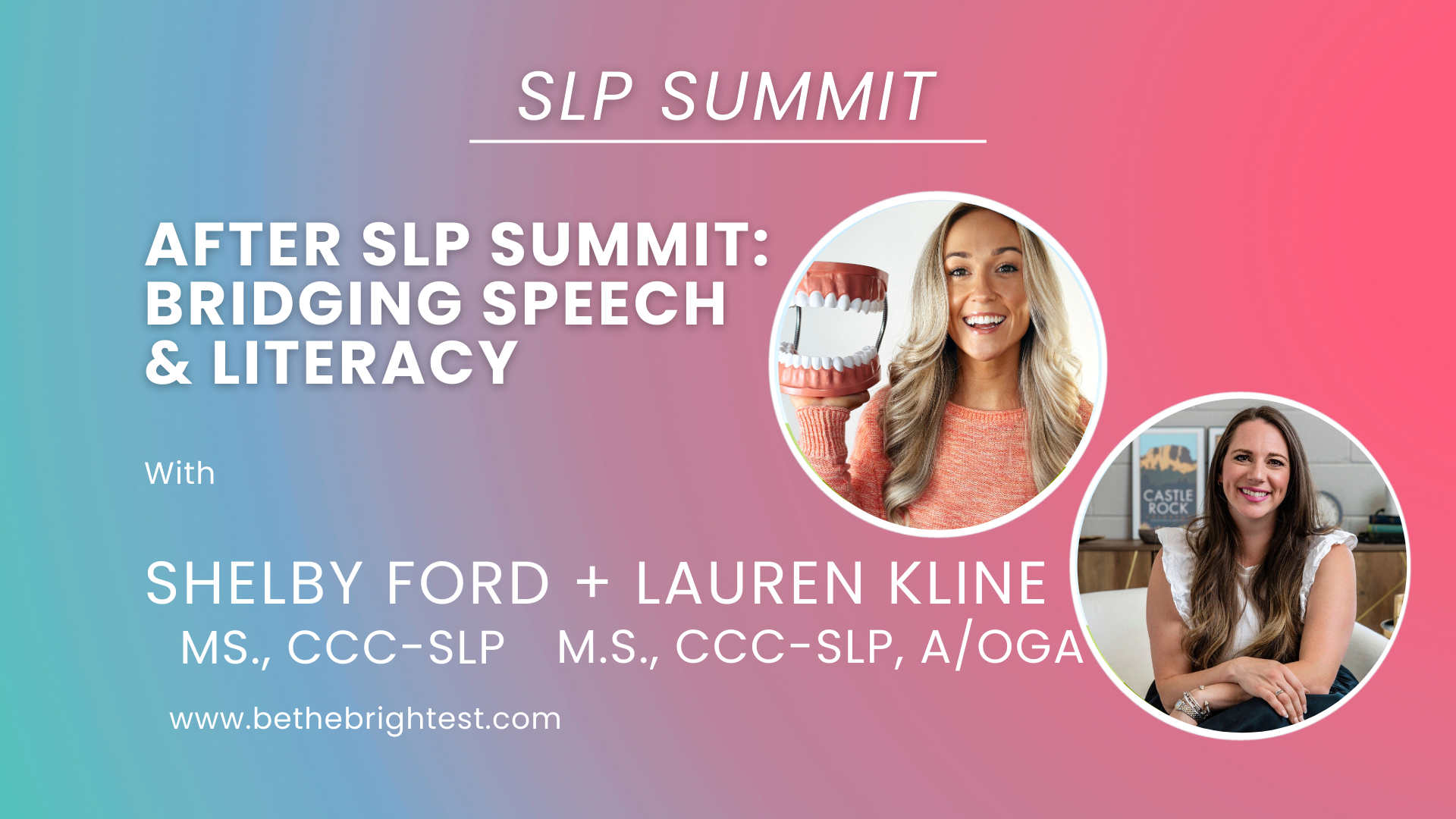
After the Summit: Bridging Speech and Literacy
🎧 Bright Conversations – A Podcast by Bright Ideas Media
Join us for real, relevant conversations with industry leaders, past presenters, and change makers across the SLP and special education space.
📖 Read the Episode Transcript
Scroll down to read the full transcript from today’s episode.
▶️ Watch the Video
Click here to watch the full episode on our site
🎧 Listen on Your Favorite Platform
Listen on Spotify
Listen on Apple Podcasts
⭐ Want ASHA CEUs for this episode?
After watching or listening, head to our website to purchase the CEU add-on and earn professional development credit on your schedule:
👉 www.bethebrightest.com/en/conversations/after-the-summit-bridging-speech-and-literacy
Transcript of “After SLP Summit: Bridging Speech & Literacy” – Bright Conversations Podcast
Hello, and welcome to this episode of Bright Conversations brought to you by Bright Ideas Media. My name is Lisa Kauffman, and I have two very special guests with me today that are together in Colorado, which is amazing, and we're both presenters as part of our SLP Summit. So this is a special episode brought to you by SLP Summit. That is a conference that we do twice a year in January and July with replays, usually for about three weeks afterward. So as of the time of the recording, this is still live.
It goes through February 6, 2026. So if you missed it, catch us in July. But I am here with our guest. I have Lauren Klein, who presented a course called From Sounds to Sentences, bridging speech and literacy in everyday sessions. And then we also have Shelby Ford, who presented S sound solutions, cracking the code for S and S clusters.
So we get so many questions when we do these live presentations. And that's kind of the fun part, I think, when we are able to present life, because you get a few thousand people that just come to the live, and your questions list is long and strong and mighty and impossible to answer during the live. But thank you both for coming on for anybody that didn't get a chance to join us live. Can I have you each introduce yourself and tell us a little bit about your background? Lauren, do you want to start?
So I'm Lauren Klein. I am a speech pathologist and a structured literacy and dyslexia interventionist in Colorado. I also work at Bjorm, and I have a small caseload right now where I work with kids who struggle with reading and writing. And then two of the kids on my caseload also have childhood apraxia speech. So they're not dyslexic, but they do struggle to read.
So really working on speech sounds and reading and doing it, doing it all together. Awesome. And Shelby. I'm Shelby. I'm a speech language pathologist out of New Jersey, and I have my own private practice where I'm specializing in speech sound disorders.
I own Shelby the SLP LLC, and that just encompasses my private practice, my teacher's pay teacher's store and my Instagram and TikTok, all social media stuff. And then I also do marketing for Bjorm publications. So that is why we are here together because we are here for a Bjorm work trip. So this was great to fit right in. Perfect timing.
Yeah. Awesome. I love both of you and was thrilled to be your host as I am today, too. Before we get into all of the questions, I tried to get them grouped because you guys are doing it together and your courses were aligned, but different obviously courses. So we'll kind of go back and forth between some of these sort of main header sections and ask questions where they make sense for both of you.
So the first one is kind of just about, you know, there's always I think whenever information is presented, there can be some confusion about like that's not how I learned it or you know, some sort of specific information on developmental assumptions, like when, when are things supposed to happen, when do we work on it and that sort of thing? So let's start with you, Lauren, we did have Holly that who asked, I have always been led to believe that phonemic awareness occurs after phonological development. So if kiddos who can't read, if you have kiddos who can't read, how do you then do phonemic tests? These kiddos have low cognition in middle school and don't have a consistent understanding of sound. Yeah, this is a great question.
So I like to think about, you know, phonological awareness in general as this large umbrella and then within it, we have phonemic awareness skills and of those phonemic awareness skills, those two main ones that research has shown will help students learn to read are both blending and segmenting. However, there are certainly phonemic or phonological awareness skills that we target with some of our pre-literacy or even our early literacy kids that are important. However, they're not the ones that we really need to focus on. So rhyming is such an important task, but are those specific phonemic awareness skills more important? Yes.
So I think for, well, I don't know the specific students, exactly what their profiles are that you are talking about, I would definitely say if they don't have a consistent understanding of sounds, phonemic awareness is a good way to teach them. The understanding of sounds and understanding that words are made up of sounds. Beyond that, you know, I think it's a hard question to answer without knowing the specific students that she's talking about, but I wouldn't put so much emphasis on some of those earlier phonological awareness skills. I would try to introduce the understanding of sounds and the alphabetic principle that letters or graphene relate to sounds through phonemic awareness activities. Okay, Shelby, let's get you in the mix here.
We had a couple of people, Deborah and somebody who just said LA School SLP was their handle during SLP summit, who had questions about ages for the complexity approach that wanting to know why it is only for ages 3 to 6, and can you use it for maybe students who are older than age 6? Yes, and I think that this is a great question and this, you know, I think that for the complexity approach, what we know from the research is that the research has been done with this age group, but I think that with our clinical judgment, we can expand and know what kids would benefit from this approach based off of, you know, their sound inventory and what sound errors they have, and hey, they're working on SNR clusters right now. So let's do an SPR cluster or, you know, so you can try to, you know, take what we know from the research and know that you can take that to know, okay, I can work on this with kids as young as three, but I don't think that we need to take six as the age cut off. I think that that's just where the research has been, but you can use your own clinical judgment to know which client would benefit from the complexity approach. I'm glad you said that because I think a lot of times we do get so locked into, but it says it can only be this.
And so I think that that's where, like you said, there's research around a certain approach or even, you know, different materials or whatever. It was developed with those ages, but it doesn't mean that you are locked into that. But we like our things concrete. We like to be told, black and white. This is what you do with this age group.
I totally think that's a question. Yes, to make you feel better. There's no research that says that you can't use this or say it's over six. So let me just say ages three and up. There we go.
Exactly. We have research starting from age three that we know we can use it. Okay, Lauren, you're up next. What if a student is already seeing a reading specialist or reading interventionist at school and working on phoning with awareness? Should the SLP still cover the same or similar goals?
I would advocate for yes. I think, you know, working in a school, you probably have a certain level or certain goals that you are targeting. But the more collaboration that we have between us as SLPs and general education teachers, special education teachers, reading specialists, whomever, to kind of share the goals that we're working on. And if there's a way that we can supplement, provide a little bit more help or guidance or just a little bit more practice with these kids, I think absolutely yes. Yeah, I do understand again, I've worked in the school as the majority of my career.
And I remember in California, it was my first full-time job, and there was there was a reading specialist, there's a reading interventionist, there was me, there were all of these goals. And I'm like, I don't know who does what, like I know this is within my scope of practice. But where do I come in and they go out? So I do think if like some of these skills, especially like bonimic awareness, that is something that benefits not just typically that student. I had it when I was in California, there was one teacher that I worked with that we did like every Tuesday.
We did a little rotation for the entire class. And it's just an extra layer of support, but you know, if there are goals that you're working on and everybody is obviously time based, maybe communicate too with that specialist to see like, hey, if you're tackling this, how can I support from my, you know, foundations of communication disorders? Absolutely. With any time that you have a team of people working with a child, it can be easy to be like, there's too many cooks in the kitchen, rather than, okay, let's all collaborate and figure out what this child's goals are and how we each can work together or support one another in doing this. Yeah, it's, I think it is tough.
It is, you've got so many people and you have different communication styles. Some teams I've worked with have been so great about we do meet and we talk about kids all the time and others. There were tensions, you know, that's just life. Like you've got to work with what you have and ultimately I think focus on the student and what is best for that student. Okay, we have another group of questions now that are coming from SLPs that are working with older students.
So especially those students who are in upper elementary and middle school and they can get a lot of frustration around these areas that you ladies presented on because they don't exactly fit into the box that they want to. So let's start with actually a lot of these Lauren are for you. They are all related to your presentation. So we have Holly, I don't know if it's the same Holly that asked them before but she said I have a sixth grade student with low cognition who can read a full paragraph and answer questions but cannot found out CBC, CVCC or CCVC words and does not know what confidence or vowels even are. So is that orthographic dyslexia where do I even start even though she also receives organ gillingham instruction?
I love this question and I loved, I used to be in a middle school and I really loved it. So a couple thoughts were on this I think we can't diagnose dyslexia. There are so many things that go into diagnosing dyslexia and only certain specialists are able to do it. It depends on the state that you're in. So I can't answer the is it orthographic dyslexia without knowing anything about the student?
I just don't think that would be ethically correct to be able to say something like that. However, when we think about the student, if they can read a full paragraph and answer questions but can't sound out CBC the types of words that she talked about, I would like to ask are you talking about being able to sound them out with what goal in mind? Are we trying to sound them out and segment them for the sake of then spelling the words so that it's a functional task that we're doing or are you trying to understand that they can sound out CBC and CBCC words because it's a part of your progress monitoring. I think really thinking about the end goal in mind is really important here and if they have a full paragraph what concepts are within that full paragraph that you can kind of use that as another data point. So are there CBC words within that full paragraph?
I would assume that there are, maybe there are multisyllabic words in that paragraph that contain these concepts that they can't sound out and maybe look at do they struggle with it at the word level but not at the sentence or the paragraph level, really thinking about our end goal with reading is going to be reading comprehension, right? So why are you having them sound out CBC words and does that get you to their end goal of being able to comprehend? However, when I think about not knowing what consonants and vowels are, I'm a huge advocate for teaching my students terminology because I think they in order to talk about reading and in order to learn higher level rules, especially like those three great spelling rules, my kids have to know what a consonant is. They have to know the difference between a suffix that starts with a consonant and one that starts with a vowel because it will then implement or change how they're going to spell certain words. So that's something that I would absolutely teach and if they are already receiving some instruction, I would talk to their reading specialist about it.
I would figure out, you know, how are you going about teaching this? What specifically are they struggling with so that you guys can work together? I love that the consistency, period across what they're learning, especially our kids in special education because they will get so many different teachers and approaches and then even that the supporting intervention is they it's all different. So if you can keep it cohesive at least with your reading specialist, that's awesome and then see if you can loop in. If they are, I know she said low cognition.
I don't know if that means intellectually disabled or just a student who's maybe on the cusp and is in a general classroom. So yeah, again, I feel like we keep coming back to that idea of communication and working together, especially with our kids that are more complex. I am looking at the next couple of questions that are on this topic and it's all from our friend Holly. So I think it, Holly, thank you for asking the questions. I love when people ask questions at the live summit.
Again, I think that is part of the beauty of coming live is that they get to access, you know, your brilliant brains and ask things that they are not sure who to ask. With that being said to you, I also think it's difficult sometimes for you to generally answer questions without knowing the full scope of the student. So I will go ahead and ask these, but I think anybody who's listening, keep that in mind. And then I always think too, like, do either of you have on your contact pages, is there a way that somebody could do a formal consult with you, whether it be as an individual that I feel like I need to support me or I'm going to make my school district paper this because I need this to support the students on make a slow. Yes, and previewing both of these questions by Holly.
Like you said, I love how engaged it involves she is and I love being able to answer these questions. But I don't necessarily feel confident in answering them to the level of specificity that she's asking just without knowing more about this group of students or the activities that they're doing them with it. So yeah, I mean, on my website or my email address, I'm happy to follow up with her if she wants to dive in a little bit more, but not having general knowledge of exactly the full picture here. It's hard for me to answer these with like confidence. Yeah, I mean, I think even like this question about the student with low cognition with the confusion with certain sounds and ability to sound at words.
I mean, that is I don't know in context how we can generalize that. I think there are a lot of maybe variables that go into it. And so that would be kind of if you have that information, you'd be able to support that one. What about this one though that, you know, if you do have a student, I think it kind of ties into the question that we've already asked that if a student can read a paragraph with little to no difficulty and answer sort of wrote questions about it and they can go back so it sounds like they've got some good skills to go back and find texts to find answers, but they still struggle with phonological skills. The question was, how do we explain that?
And I think I have a question too of how do we support that or should we be, you know, what should we be focusing on when we know they can read? They can answer the questions. They can use those strategies to go back to the text to find information. So where in that picture do we, you know, still support phonological skills? Yeah, I think if we're thinking about the student's ability to read and it sounds like they are reading with some level of fluency and then being able to answer questions, that's fantastic.
What specific phonological skills are they struggling with and what is the end goal of those phonological skills? So if this is a really strong reader, however they're a super, they struggle a lot with spelling and maybe those are the phonological skills that are weaker than I would probably target segmenting. I would talk about I would include letters within my segmenting or even manipulatives depending on what level that they are at. I can't necessarily say how I would explain it without having a full profile of the student, but I think looking at those specific phonological skills that they struggle with because there are so many of them and then seeing how do those phonological skills lead us to an end goal of something greater than just doing a phonological skill for the point of doing it. That makes sense.
We had a couple of questions too that were really specific that were more, instead of like the general, they can read and don't have phonological skills that they're having some difficulty at the word level, especially with kind of bells and blending and that, you know, kids can seem solid in other areas, but then it falls apart and those are in these specific areas. So we had a question come in from Carrie that said, "I have a first grade student who really struggles with vowels, primarily dip-thongs. They turn all dip-thongs into monophongs, and do you have any strategies for helping students understand vowels written as diagrams?" Yeah. So this is... This is Kingston.
So in my presentation, I shared a couple of videos of him. Kingston has childhood opraxia speech, and we spent a lot of time working on that long A sound. He tended to struggle more when that A was a dip-thong, so in words like male, sale where there was that movement, and something that we use that... I mean, he was very familiar with the Bjorms speech sound cues that something that he has done since before he was reading, but utilizing those to show the movement within the sound and recognizing that those dip-thongs are truly made up of two different sounds, and that anchoring it to a visual has been what's most successful for him. And I'm happy to reshare the video.
There's actually a video where he and I are looking at two different vowel teams, AI and AY, and on the side, I have the two different Bjorms speech sound cues that make up that dip-thong, and he would oftentimes like, sale would become sell. So he would just kind of reduce it to that short E sound. So then we would pull out the two visuals and talk about, okay, there is movement, this is made up of two different sounds, and we wouldn't move on until he was able to produce the two sounds within that dip-thong. Is that the same strategy then for like the student doesn't have a proxy, or when you see that, do you say, oh, there might be some under-allying motor issues there, or is it just so different from kid to kid? Immediately when I hear part of a vowel team being left out, or when we have these vowels like A, which is really a combination of two vowels together, which is the E and the E.
So when he's dropping the E and A, and he's only saying the E, I think that that could definitely be more, you know, something you see more of with the praxia, but for me, I'm immediately thinking of my arcades, because a lot of time with Vocalic R, you see kids who drop part of the vowel, and they go straight to their distorted R, or they're going straight to their R, but you're like, this is still not sounding totally clear, and I always am encouraging people like, go back and really break down that first vowel, because if a kid's saying air, and it's, and you know, you can't quite get it to be that perfect air sound, then that's something where I'm like, okay, let's go back and make sure I usually separate it by speech sounds, by speech sound cues with the visuals, and this is with kids without childhood praxia speech, that need to be able to see A, your and break down those, you know, already small sounds into even smaller pieces, so I think that this might just be something that kids have difficulty with depending on the sound, or what you're spelling, that's, you know, my speech sound disorders lens on that. Well, I wonder, do you even start to see it coming here? Before it, you know, in order to pronounce it, you have, they have to have kind of awareness. There's a lot of layers in this as well, you know, obviously with all of the things that we do. I think this question actually is great for both of you, because how do you, what is your suggestion for helping kiddos remember the sounds when blending into words, that was from Deb, so I think you guys have both touched upon it for, you know, the visuals that you're both referencing, so can you talk a little bit about that?
With my students, I am going to involve some sort of manipulative. I need them to anchor the sounds to something physical that they can manipulate, manipulate. So whether we're using Alconin boxes that have the, the number of sounds already shown for them, and then they're pulling down some sort of whether it's like a coin or a paperclip, or once they have a basic understanding of phoneme graphing correspondences, they're pulling down letter tiles. I need them to hear the sound and then tie it to something that shows me how many it is. It gets tricky as they get older, for example, if I'm using like a reading rod or something, I might have at the end, if I'm using the word make, I might have one for M, one for A, one for K, and then tied on at the end, I might have like a white little reading rod to represent that silent E showing me, okay, there's an extra sound and, or there's an extra letter in here, but it's going to be silent, but I typically, my kids are able to better blend together when they see something physical in front of them that they can work with, as opposed to just being an oral activity.
I also like using visuals too, so that you can show, oh, you dropped that T in that ST cluster, you said, say all instead of stale, and physically taking it out and showing them what they said with whatever visuals you're using, and I've seen Lauren do this before with those magnetic blocks, and you can actually write on the magnetic blocks with the dry erase marker, and I think that could be for a lot of different, different things, you could even do that with post-it notes if you wanted to, make your own visuals or use the letters, if you are a school SLP, you have access to Canva Pro, and there's a lot that you can create, whether you make your own cues, so you get a picture of a snake that you can use first, or whatever it is, or maybe include the client's interest to help them have a little bit more buy in there, but you can create visuals and kind of do a trial and error of what's working for this kid, and then see, okay, they really benefited from using the visuals here, so where else can we use this technique? Yeah, I think across everything that we do, there is, we are breaking things, like bigger concepts down into smaller things, we are supporting with visuals, with verbal cues, we're doing everything at something to try to support a student, so it sounds like it's no different when we're working on some of these concepts. There were some questions that came in specifically for you, she'll be around the motor, or like the structural tongue and nose and teeth, and all of that kind of things, and how you get around that when you're providing therapy, so there was somebody who asked what if I have a client whose top and bottom teeth don't touch, because of a tongue thrust and long-term finger sucking. Yeah, so immediately when I hear this question, I'm picturing that almost like oval gap that happens in kids' teeth when they have that tongue thrust or finger sucking or pacifier for a really long time, but one thing that I want to remember is that dentition often times, most of the time does not matter for creating a great S sound. Maybe you're thinking that it might sound acoustically off, but when we think about where the tongue needs to be for the S sound, none of it is touching the two front teeth or any of the front teeth at all, so as long as the sides of their tongue, they have that lateral bracing, and the tip of their tongue is on the alveolar ridge or also behind the bottom teeth, then I think that all of that is happening regardless of those teeth, because we also have to think we have kids who are losing their two front teeth, and I think that's a question that comes up a lot is I have a kid who's working on S, but they don't have their two front teeth, and I'm always like it doesn't matter, and I always share my personal experience is that I had to have my two front teeth pulled when I was two, and I didn't get my adult two front teeth to start coming back in until I was nine, and I never had any speech issues, so I always use myself as a case study with that, that you don't just a reminder is that we don't really need those two front teeth or even to have fully formed bottom teeth to make a great S sound.
I'm happy to report if anyone is listening and not watching, Shelby has Oliver teeth at the time. I do. They grew in. They're great. They're fabulous.
Oh, that's a two different question time. We had somebody ask too, like you had mentioned that lateral briefing, what do you do when a child is unable to raise the lateral edges of their tongue or elevate their tongue? So when I think of that, I'm thinking like they can't elevate their tongue at all. What sounds do they have? Sometimes I think about this for S and R too, it's like, well, can they say an S-H, or if they are, if they have a lateral list and they're also lateralizing on an S-H or a C-H, or those other sounds, you know that lateral bracing is a big issue there.
However, if they do have that lateral bracing for other sounds, you know that they can get that elevation. I also would really break it down with the child and maybe even have them explain it back to you. Like, I want you to teach me how to say this sound. So I want you to tell me exactly what I've been telling you, but now I want you to pretend that you're the speech therapist and you're teaching me. And I always kind of like pre-test Omos to see if they're actually understanding what I'm saying.
And I always teach my kids from the very beginning, like please advocate for yourself or something that if I'm not making sense, please tell me like I don't really understand what you're asking me to do with your tongue. A lot of these movements with our tongue that are asking kids to do, it can be so abstract and you can't really give a great visual of it, especially for a sound like S when they can't see your mouth. So that's also why I like to bring a mouth model in and then maybe have them show me point out where should the sides of your tongue go and where should the tip of your tongue go. And maybe actually just, you know what, stick out your tongue and point to the sides of your tongue. Do they even know where the sides of their tongue are?
Do they even know, you know, what they're trying to go for here? So like kind of step back, really make sure that they understand, maybe do a review of anatomy in a way that they can understand, to make sure that there's not any communication breakdowns that might be there. But when I'm working on the lateral edges of their tongue, I want to see them do an E sound. So that's often a sound that I will have them do if I really want to look at that, E and then I have them open their mouth a little bit and say E, I know if you're listening, you can't see me, but you probably heard the difference there. Because if they can do that, they have that posterior tongue elevation and they have that that lateral bracing, they can do that.
So then it's like, okay, well, how can we then, you know, work with one of their strengths and see where we go from there? If you're still not seeing any elevation at all, then that's maybe where we need to look into next steps. But I think that there are definitely some things we can do just to kind of check off, you know, foundations and a cognition. Yeah, I love that. There was a question from Ashley that it was specific to lateral lists that she cannot get an S, a CH, and has tried using TS for shaping, but nothing's working.
So do you have any special tips for that pesky lateral list that everyone hates? Yes. So for this one, if you have tried T to ask and you've tried those final TS words and that's not working, I would want to know, and this is another one where it's like it can be a little case-specific. Have you ever just looked at their T sound and have, you only said do your T sound for me and it sounds acoustically correct? Have you said can you open your mouth a little bit and do a T sound still?
If they cannot, then they don't have tongue jaw dissociation and that's something you need to go back and work on. One thing that I would also try is like maybe using a small bite block or, you know, a stack of tongue depressors or whatever it is that you can try to just kind of help take their jaw out of the equation so that you can really isolate that tongue and see, okay, now can you do your T sound or are they only able to do that when they have their jaw helping with that elevation and that's something that maybe this question makes me think you need to take a few steps back and look a little bit closer at the details. Some questions came in with students that might be a little bit more complex and have more complex needs specific to phonological processes and things like that. So what approach could someone take Anisa specifically asked about a student on her case lived who's 13 with CP who still exhibits phonological processes like quarantine and backing. She is moderately intelligible to familiar listeners but not unfamiliar ones and refuses to use her AAC device to repair communication.
Yeah, this is this sounds like a really tough case. I would wonder what interventions you have been using for fronting and backing. How is this student with minimal pairs? How are they with just kind of working on elicitation and placement? And what does that look like?
So it's a little bit hard for me to totally answer this with confidence. I think we've touched on that a bit. What sticks out to me is refuses to use her AAC device to repair communication and I almost feel like that might be something you want to focus on a little bit more and help get that buy-in from the client and really maybe build that relationship and work with them on what their frustrations are and building their intrinsic motivation because you know when I hear they refuse to use their AAC device that you know it just highlights a different issue that maybe we need to focus more on their intrinsic motivation to really want to speak clearly and to make sure people understand them. We have another question from Taylor who was asking about a student she has with hyponazality who only has goals for S&Z so no voice goals. We are working at the reading level but I feel the hyponazality is strongly impacting how her speech sounds.
How should this be addressed? So for hyponazality I feel like this the way that I'm reading this question is that you're asking you know they only have goals for S&Z but they also have this other issue. So I feel like this is less of a question for S&Z if it's more about the hyponazality so I am not going to touch on that today for this discussion but if it's hypernaizality and we're going back to that nasal list that I talked about where it is impacting S&Z then I would work on awareness of oral versus nasal sounds taking a metal spoon or a small mirror and putting it up under their nose and letting them see how it fogs up for certain sounds like M and D when you do it and how when you do it your S&Z are coming out of your mouth and you don't get any of the fog and then have them do it and have them show it whoa you fogged up your spoon when you did your S&Z sound there and start to work on that awareness and you know that's a different conversation I'm not sure if that's what's being asked here well if it's hyponazality there is no S&Z aren't nasal sounds so it can't be a hyponazality wouldn't impact what needs more if they were saying a word like sunshine then I think you would notice it because of the ends that are in that word yeah what you have to read it all then you're seeing that because of course articulation and it's just overall and an issue so maybe if you're able to break things down and go back to the base it's a little bit of honing on that hyponazality maybe the and the word that jumps out to me is the strongly impacting that hyponazality is strongly impacting so if this is a student with an IEP with no goals or evaluation for voice or maybe what's causing that that you were I would suggest go back to have there been any kind of medical assessments around the structures going on why are they hyponazel and then do there need to be goals added at that just the team need to look at you know supporting that need as well right I know we are coming closer time so if we can get maybe just a couple more questions in Lauren this one's for you crystal asked often in a proxy a therapy we keep the word connected and don't break apart the sounds how do you work on understanding parts of the word without impacting practice of the word as a whole the great question it is I think crystal I love how you're thinking about you know the end goal of our our our child with childhood a practice of speech making sure that we're not segmenting as we are reading this word especially when it comes to longer words so I like to think about a couple of things number one is when we are spelling those words um we have to understand that a word is made up of different parts same thing as when we're blending a new word with those new phonics concepts um we may talk about the idea of blending together but when my student is reading the word as a whole and we're talking about it I don't want them I don't want them reading it well segmented and this is when coarticulation plays such an important part so I think about the word water for example I'm not teaching my student that that T is going to make that sound there we're going to have the conversation that yes T makes the sound however when we blend that whole word together that T is going to make that clap sound it sounds more like a D that water um and I don't I don't want them practicing it in a way that sounds um incorrect or that sounds strange however we will have the conversation of okay there are different types of blending that you can use so for example if we're learning um long a words maybe every word that we are we're practicing has um like a silent e so last week Kingston and I were doing words like rake and cake and make um he in his head would go okay ache ache make so really practicing um different types of blending so whether you're doing on set rhyme or successive blending different ways to help your students recognize that there are parts of that words are made up of parts um but it's important when we read fluently to pronounce it in the way that we would say when we're just speaking okay I then this next question I uh corresponded to when we said that research for the articulation norms broke the the internet I feel like you broke some SLP has Shelby during your um presentation because you were saying that blends and clusters uh the way that you framed them was that very different from what SLPs like like Anisa said that can we get an explanation of the difference between a blend versus a cluster I always got two constants together where blends and three were clusters and you referred throughout your presentation as everything where there was two sounds or resounds as clusters so we had some little I think of the little emoji with the mind blown and I really love your perspective from uh the the speech side of things in the lore and I'd love you to jump in as well from like the reading side because sometimes there's some overlap or maybe concepts come in at certain in certain eras or from certain bodies of research and then they kind of stick so let's start with you Shelby sure um so yeah as a cluster is consonant sounds that are grouped together but still keep their individual sounds um so it could be an ST cluster or an STR cluster but a blend could be something that includes a vowel um that is blending the whole word together and I think just keeping them separate um and we I talked about how this was something that I learned from Dr. Kelly for Carson so we're going to link the blog post that um I worked on with her and it also links a Instagram live like you can watch the whole conversation um where she was kind of blowing my mind with that um and so if you're interested in learning more about that I think we're just going to link the blog post and the Instagram live there um and maybe we can have another podcast episode where Kelly comes on and helps it. That would be awesome.
I'm interested in just blaming Kelly for all of it. Yes um but I also love the way that Lauren explains it on the letter cn so I'm gonna pass it over. Yeah so when I think about um some of my students who we've talked about both clusters and we've talked about blending as a verb so um to kind of lessen the cognitive load for my students I like to teach them as two different parts of speech so I talk about a cluster being typically um two or more consonants that come together but like Shelby said they maintain their individual sound so clusters can occur at the beginning of a word like ST or STR they can also occur at the end of a word um and then so that is a noun I teach part of speech I teach it as a noun it is a thing um and then I teach blending as a verb so it is the act of taking individual sounds either consonant or vowels and blending them together to form a word and um I kind of want about this not necessarily from the idea of like this is the the research that I have behind it but it made more sense to my students when I was teaching them like okay we're gonna blend this blend they were like I don't get what you're saying right now so I was like okay let's take this apart for a second let's talk about first a consonant we have more than one consonant together it creates a cluster what are we going to do with all these individual graph themes we are going to blend them together and I think then they had that aha moment of like oh even though blend can have more than one meaning both a noun and a verb kind of separating them and giving them two different titles really helped my students recognize what they should be doing and what to call what and it sounds like there's no hard and fast research period on wherever this concept of two letters are a blend all the time and it has to be three or more to be a cluster I mean it sounds like there is nothing so I guess if anyone's listening and can contradict that I just know it was told to me as well and I think that's the danger sometimes in doing what we do is if we learn it a certain way and then that's what sticks but that's the beauty too of going to courses and getting continuing ed because you will be exposed to new concepts that make you think in question which is awesome I think of a follow-up question to that too is then as we're writing goals should we not be writing blends anymore I mean or do we need to always use the word clusters I would err on the side of yes I would call it a cluster okay to work yes so we have a million more questions that we are not going to be able to get through even this so this is what I think so amazing too that we went through a bunch of questions during each of your lives we have spent a good chunk of time today going through questions we still have more there is a group of questions about resources specifically like suggestions for other language like Spanish or resource lists for prefixes and suffixes by grade or age or complexity things like that it might able to send those to you guys maybe we can get those linked if you have any great resources that you use or anything that you touched on today when you're talking about visuals or anything that that I love Shelby you said you would share that of the blog post and Instagram live links for your conversation around blusters blusters blusters blusters yeah then you're safe then you've got it yeah I'm working on blusters with this student before we hop off I want to wrap up with just one more question because we all I feel like this is where it does translate where people go to courses and they see this information they're like but wait how does that affect how I write goals how do I take data how do I assess so before we hop off could each of you give us some of your highlight reel of go choose for what you recommend when diagnosing during evaluations or maybe what you're using for ongoing assessment or progress monitoring are there any tools that are specific to articulation or reading or whatever that you that are your go choose for your day-to-day yeah so some tests that I use and I think it kind of depends on what you're diagnosing because I think it really state-to-state can dictate whether or not an SLP is diagnosing dyslexia but if you're looking for more formal reading data I love the C-top the test of dyslexia recently came out and I like it because it includes both a silent reading and an oral reading component and it also has some oral language in there I like the gray silent reading test the gray oral reading test I think including any sort of oral language test is going to be super important when you're when you're looking at a reading profile in general the tils is also really nice and then when it comes to more informal things I've used the Galistel Ellis before I've used there's a spelling inventory in the back of the book called Words Their Way which I really like I'm more than happy to kind of come up and brain dump a list that I'll include in my list of resources too hey what about you Shelby for me I use the Arizona for my test when I'm doing speech sound assessments and then a good old fashioned sound inventory and looking at the placement or voice chart and seeing if you can find any patterns that sometimes is helpful like even just looking at a placement or voice chart and highlighting the sounds that were in error and looking like what's the pattern here is there a pattern and yeah I use the speech sound cues to do a sound inventory in dynamic assessment maybe to see if they can yeah yeah and you want to you know get a speech sample see how they're sounding just when you're having a conversation with them um I'm always taking in what is the family having a hard time with that home what am I seeing um yeah I love that looking at students holistically um is always the right way to yeah um okay so thank you both so much for your time today we will be linking in the show notes some of these resources that we've talked about but just wanted to say really quickly you guys are both so awesome can you share with the audience your handles again for if they want to find you on social media what what platforms you are um active on and what your handles are sure you can find me at Shelby the SLP on Instagram and tiktok I'm definitely more active on instagram my DMs are open if you have a question you can also email me at hello at Shelby the SLP.com I am not on tiktok I'm older than Shelby so I'm not on tiktok tiktok on instagram you can find me at Lauren Klein literacy or my email is Lauren Klein at lksl.com great well thank you ladies so much it's been a pleasure and I hope um our listeners got as much out of this and learned as much as I did during our conversation thank you so much having us
About Bright Ideas
At Bright Ideas Media, we empower educators, speech-language pathologists, and special education professionals with actionable knowledge and engaging learning experiences. We make professional development easy, insightful, and impactful—so you can apply what you learn right away!
💡 Want to keep learning? Explore 150+ hours of live and on-demand courses designed for professionals like you. See all available courses → Click Here
Recommended Courses for You
Here are some courses you might love based on what you’re reading:
📌 SLP Summit Jan '26
📌 How to Teach Phonics for Reading and Spelling Success
📌 /ɹ/ you frustrated by working on /ɹ/? Try facilitative contexts!
Join Our Email List
Sign up to be the first to know about new events, course launches, exclusive discounts, and practical insights to support your professional growth.
Thank you for subscribing!
Have a great day!