How to Run a 20 Minute AAC Training for Teachers and Paras
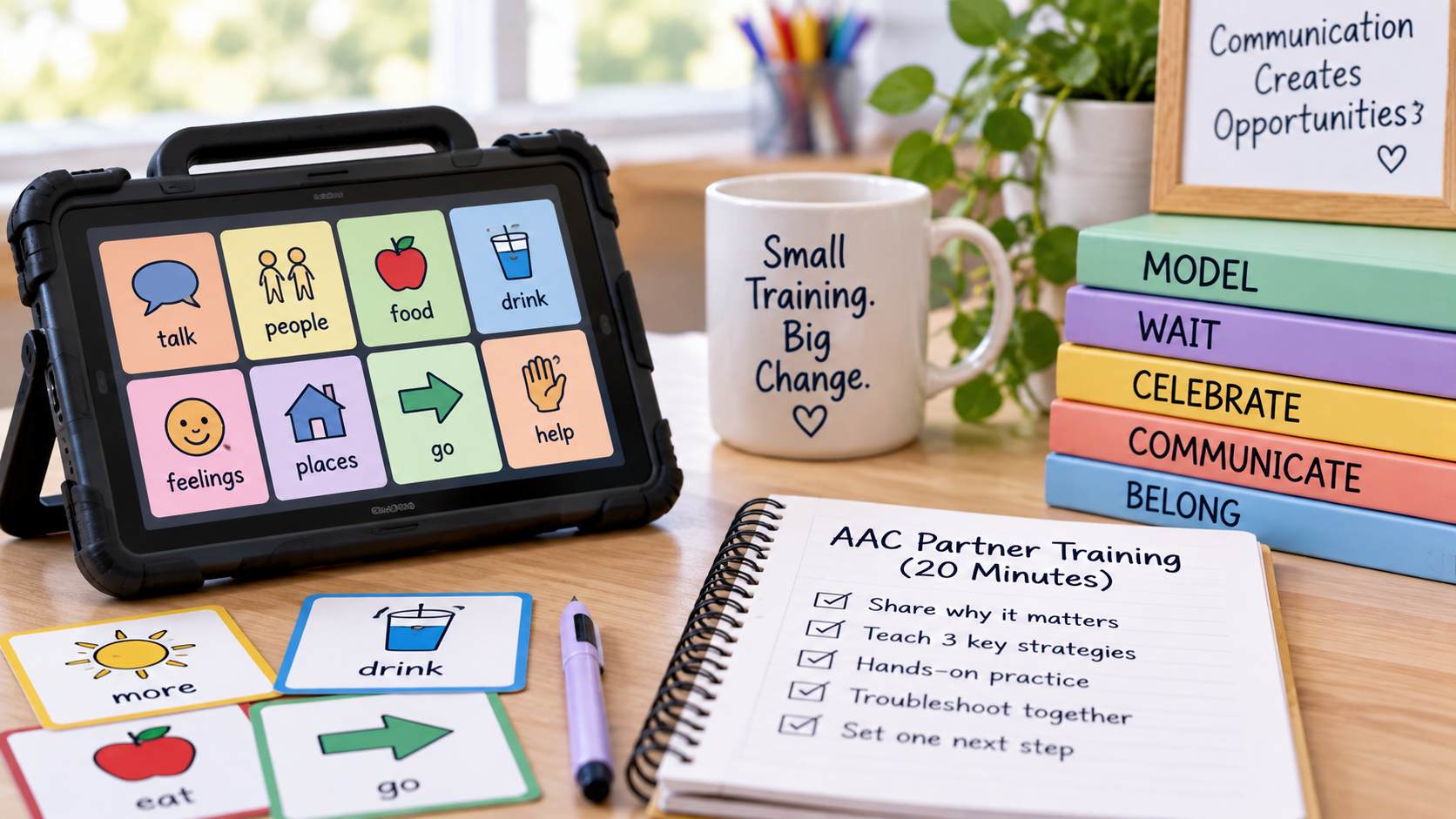
The most common reason communication partners don’t model AAC is that nobody ever showed them how.
And the most common reason SLPs don’t fix this is time. You don’t have a PD day. You don’t have a sub. You have 20 minutes before school, during a planning period, or squeezed into a lunch break.
Here’s how to use those 20 minutes!
Before You Start: The Right Mindset
This training is not about covering everything. It’s about lowering the barrier to a first attempt.
Your goal is not to turn a classroom teacher into an AAC expert. Your goal is to give them enough to feel safe enough to try once. Because once they’ve tried and seen that it didn’t go terribly, they’ll try again. That’s how communication partners are made.
Keep the scope tight, the tone warm, and the asks tiny.
The Agenda (Total time: 20 minutes)
0:00 – 2:00 | Opening: Why This Matters
Start here: not with how the device works, but with why the person in front of you matters to this student.
“I want to start by saying something I don’t think gets said enough: you are one of the most important people in [student’s] communication development. You’re with them every day, in the moments that matter most. What we’re going to do in the next 20 minutes is make sure you have what you need to make those moments count.”
Then give them one honest, grounding sentence about where the student is:
“[Student] is learning to communicate using this device. They’re at the stage where they need the adults around them to show them how it works by using it themselves. That’s what modeling is, and it’s the one thing that makes the biggest difference.”
That’s it. Two minutes. Now they know why they’re there and what their role is.
2:00 – 7:00 | The Three Things They Need to Know
Keep this to three points. Write them on a sticky note if it helps.
1. Model - don’t prompt.
The most common mistake is asking a student to use the device before they’ve seen enough of what it can do. Modeling means you use the device out loud and move on - no expectation, no waiting. “Want juice.” Touch the symbols. Hand over the juice. Done.
“Think of it like reading to a child before they can read. You’re not asking them to read back to you. You’re just showing them what words look like in action. AAC is the same.”
2. Wait longer than feels comfortable.
AAC users need more processing time than most adults expect ... often 10, 15, even 20 seconds. Resist the instinct to fill the silence or move on.
“I know 10 seconds feels like forever. But that silence is often when the communication is happening. Try counting silently to 10 before you jump in.”
3. Celebrate any movement toward the device.
A glance. A reach. A vocalization while looking at it. A partner who can recognize and respond to approximations is worth more than perfect button presses.
“You don’t need a perfect response. Any time they move toward the device or show interest in it, that’s communication. Treat it like it is.”
7:00 – 14:00 | Hands-On: Try It Together
This is the most important part of the training. Give them the device. Let them practice.
Activity: “You be the SLP, I’ll be the student.”
Hand them the device and tell them you’re going to play the role of the student. Respond with gestures or looks, not words. Ask them to model vocabulary for a simple choice activity: offer two things (two snack items, two book choices, two activities) and model “want” + the item as they offer each one.
Run through it for about three minutes. Then switch: you model while they watch one more time.
After the activity, ask them:
“What felt hard? What felt okay?”
Let them talk. Normalize whatever they say. Then say:
“The hardest part for most people is the silence. And you just did it. That means you can do this.”
If you only have time for one part of this training, let it be this. Doing it once in a safe space removes the fear of doing it wrong. That’s the whole point.
14:00 – 18:00 | What to Do When It Feels Like Nothing Is Working
Prepare them for the hard days.
Cover these three scenarios briefly:
“The student ignores the device entirely.”
“Keep modeling anyway. You’re planting seeds. If it looks like nothing is happening, try bringing in something they love (e.g. their favorite snack, a preferred activity) and model around that. Interest follows motivation.”
“I tried and felt awkward and gave up.”
“That’s normal. Every single person who is good at this felt awkward first. The awkward phase is short. Push through it.”
“The device wasn’t charged / wasn’t available.”
“Use a no-tech backup.” (Hand them the one-page symbol board you’ve made for exactly this - see Leave-Behind below.) “If the device isn’t there, the backup is. Communication doesn’t stop.”
18:00 – 20:00 | Wrap-Up + Leave-Behind + One Next Step
Hand them the leave-behind (template below). Walk through it for 60 seconds. Highlight the three vocabulary words you want them to focus on and point to the daily routine where you want them to try first.
Then ask them for one commitment:
“What’s one routine tomorrow where you could try modeling, even just twice? Just pick one.”
Let them name it. Write it down in front of them. Thank them.
“You don’t have to be perfect at this. You just have to show up. And the fact that you’re here tells me you will.”
Leave-Behind: One-Page Quick Reference
Print one per communication partner. Laminate it if you can. It belongs in the room, not a folder.
AAC Quick Reference:
[Student Name]
Device: _________________________
SLP Contact: _________________________
The 3 Things to Remember
Model, don’t prompt.
- Touch the symbols out loud. Don’t wait for a response.
- Wait 10 seconds. Count silently. The silence is when communication happens.
- Celebrate any move toward the device. A glance, a reach, a reach-and-vocalize - it all counts.
The Vocabulary to Focus On This Month
Symbol Word:
Use It When:
Best Times to Model in Our Routine
When:
What to do:
If the Device Isn’t Available
Use the symbol board attached to this sheet. Point to symbols and say the words. Same idea, no device needed.
Quick Tips
- You don’t need to know the whole device. Focus on these 3 pages: ___, ___, ___
- If [student] isn’t responding, try modeling during something they love
- If you’re unsure, model and move on - you can’t do it wrong by trying
Questions? Reach out: _________________________
A Note on Who Should Be in the Room
Ideally, this training happens with the para or teacher who spends the most time with the student. If you can only reach one person, that’s the one.
If you can get the whole team together, even for 20 minutes at the start of a school year, that’s worth trying to arrange. The consistency that comes from multiple trained partners compounds over time.
You don’t need everyone trained perfectly. You need the right people trained enough to start.