Neuroaffirming in Real Life: Rethinking Goals, Language, and IEPs
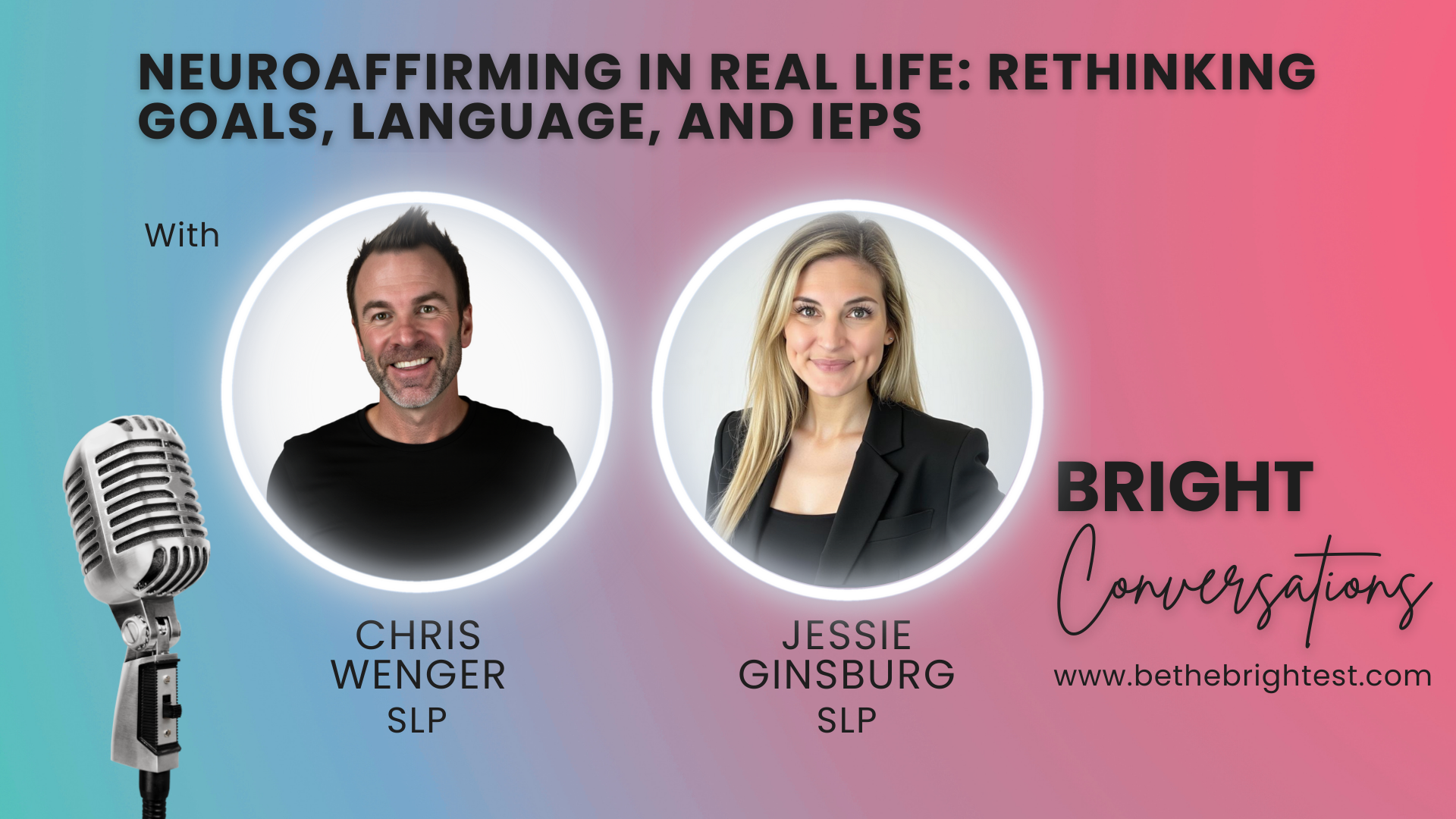
🎧 Bright Conversations – A Podcast by Bright Ideas Media
Join us for real, relevant conversations with industry leaders, past presenters, and change makers across the SLP and special education space.
📖 Read the Episode Transcript
Scroll down to read the full transcript from today’s episode.
▶️ Watch the Video
Click here to watch the full episode on our site
🎧 Listen on Your Favorite Platform
Listen on Spotify
Listen on Apple Podcasts
Transcript of “Neuroaffirming in Real Life: Rethinking Goals, Language, and IEPs” – Bright Conversations Podcast
Hello and welcome to this episode of Bright Conversations. I'm Lisa Kathman and I'm here with our amazing guest today, the power SLP couple, Chris Wenger and Jessie. Oh my God, Ginsburg. Ginsburg, Ginsburg. - Were you gonna call me Winger?
Well, I call you Wang and Mrs. Wang. - Maybe that's true. - It's just what it is. Even, you know, me and my daughter, who you guys met like a month or two ago, she's like the Wangs, Mrs.
Wang, whatever. (laughing) - A whole household of Wangs. - You guys have a lot of Wangs. - There's a lot of Wangs around. (laughing) - Jessie, you are surrounded by Wangs.
And I, like that's how you have to be so like thin and young because you are chasing after these boys constantly. - They keep me busy. (laughing) - That's for sure. That's what's nice right now. Oh well, I guess 'cause Jessie and I are in different settings, but there's like my quiet time of the day.
At the house, when you've got five children running around, there's no downtime. - There is no downtime. It's crazy. And then I'm all into these like wife swap episodes right now with the housewives where it's showing like, you know, the housewives will have like these super orderly, rule-based homes and then they're swapping with people with no rules, no bedtime. The kids are like taking basketball in the kitchen at like one in the morning on a school night and they are just melting down.
I'm like, I would melt down. Like if somebody's playing basketball in my kitchen now at this stage of my life at one in the morning, unless it's like a weekend and I'm, you know, there's a party going on. I don't see how that works, but any hustle, we digress. (laughing) I am super happy to have you guys here, not just because you're super fun to talk to and I could talk to you forever about anything and everything, but just your specialty in our field is amazing. And so I forgot to say to you this episode of Bright Conversations is brought to you by SLP Summit, which is coming to us live in December, December 12th through 14th and registration opens December 1st.
So anyways, I wanted to just, can you tell for, if there is anybody that is not aware of you guys, can you each give us like a brief little intro about yourselves, your specialty and where you're currently focusing in the SLP world? - Yeah, I'll go first. Do you want me to go first, Jesse? - You. (laughing) - I'll go first.
Yeah, right. So I gosh, it's funny. I've been in this district coming up close to 25 years. So just my hands. - Weird though, because he's only 25, so I don't know.
(laughing) - Oh no, 'cause he does he tell everyone, he's like, I'm only like 31. - No, but he is lucky because people always assume he's younger, it's probably the energy and emotional, no, I'm just kidding. (laughing) - That's funny, 'cause do you know what? There comes a time in your life, in your career, where you're no longer like that young employee or staff member on campus. I reached that point and it was so sad.
Like someone's like, what's it like working with all these young staff members? Emma, what do you mean? I'm part of that group, aren't I? (laughing) - You're like, I think it's great in your beard. (laughing) - Oh, it's been a tough year.
I'm telling you, the children at home, I'm telling you, they make it. But yeah, so that's kind of where I'm at. I've been in the schools for that long and have had experience working with Jessie over on her practice and in other private practices, supervising, and yeah, it's been a really fun ride. I love it. - Jessie, tell us a little bit more about your practice and what you're specializing in there.
- Yep, so we're in LA and our practice. See, it's mostly kids zero to 10 and we just celebrated our 12 year anniversary. And other than that, I do a lot with Chris where we train therapists online, we have therapists that we train all around the world, we have families, we connect with around the world, we consult with families internationally, we speak internationally, and then when we're not doing that, we're rounding up our five boys, nine and under at all. - But Mia still talks about, Mia is my daughter for anybody listening and we went to LA for a concert, it's just like, I always say it's like an Uber ride from Phoenix, it's like a 45 minute flight on Southwest or whatever. And so we got to hang out with you guys and she's so cute 'cause she's like, "Oh, I just have like baby fever." She's 21, so she wants, she's very much aware like she wants babies, but she doesn't want them right now.
So she was like, that was the perfect baby around your boys and she's like that Jack man. I would just, he's just the cutest baby I've ever seen. - Oh, watch out because I also had baby fever at 21 and now here I am five years later. - So you're speaking around the world. I mean, we ended up meeting, I know Chris, we had you do, it was back in like 2019 when Asha was in Orlando and you were like, you did, I don't, do you still do like part time DJ stuff?
Do you even have time for any of the stuff you do? - I hung up the gloves, but it's just reminiscing on those days 'cause we had so much fun, like Orlando, getting out their music and having this. - Oh, this wasn't a thing. - Anything that gets him out of the house until 2 a.m. is not gonna be a green flag at this part in a point in our lives.
- That was a fun convention and actually you guys had, we're hanging out, that's how I met you too, Jesse. And it was just like our super fun vibe and then you guys have really grown into like again, personally and professionally, this power couple just speaking on neuro-firming practice. And I wanted to know a little bit more about, when did that really click for you? Like was there something that you used to do kind of early on that you've completely changed your mind about? What did that look like for each of you?
- Gosh, yeah, for me, the journey is like specifically with like neuro-affirming approaches and practices, really started to resonate when we had our kids. Like because all of the practices and seeing how it is within our own family structure and the things that we talk about on social media and the practices that we do with our clients and our students are the same things that we're doing at home. So trying to offer some flexibility and choice and understanding if they're dysregulated, how do we co-regulate and just all of those strategies. So it's been really cool to be able to not just talk about it but practice it like 24/7. It's like, and then that's the other nice thing too is having Jesse and I kind of this co-partner like, hey, I need some support, what are your thoughts on this?
Whether it's with work related stuff or with the kids at the house. And so that's been the big change for me. What about you, Jess? - Yeah, I mean, I have a very specific moment that happened where it kind of just one of those things where it blew up my world of what I thought that I knew, which was that, you know, I had been educating therapists on autism for years. It was just kind of this like niche I had fallen into and I was always a play-based therapist, you know, very child led, always had these values of putting connection first.
So I had been training therapists and I had a Facebook group with, I don't know, maybe several thousand therapists in it. And I, there was a time when I put up some kind of posts and some one commented who was an autistic SLP and she said, if you really cared about autistic people, you would use identity first language. And that was the very first time I even had heard of what identity first language is, which is saying autistic person, as opposed to person with autism, which is what's drilled in our heads and grad school is using, it's a person first, never forget, there's a person before their disability. So that was one of those things where I had this moment where I was not just like, oh, okay, let me make this switch. It was very stressful, Chris knows, 'cause we had so many conversations about it, but she basically gave me a bunch of resources to start reading and that's when I really started intentionally spending time researching, reading blogs of autistic people.
Like, wow, look how many autistic people there are out there trying to educate others on talking about autism as an identity, as of a piece of someone that shouldn't be, we shouldn't be trying to take that piece away from them. And we shouldn't be separating the person from the autism because they were just one together. And so that was kind of like what was the first peel of this onion just opening up. And it was a very, very slow progression where I went through maybe like a year where I was just saying on the spectrum. It's like, no one could get mad at me if I just say on the spectrum.
But we were talking about this before we hit record, which is, it's very hard online. And Chris and I have both grown on social media and we try to get out there and educate people as much as possible. But the ironic thing is that the content that really causes you to grow is the content that you get very wary of making after you have grown because it just reaches such a wider audience that people come at you. I mean, people have literally said to us, like, you guys should stop having kids. You are like the most like ridiculous things that people have said to us online.
But anyways, the point being that, you know, fortunately a lot of us are in this field because we enjoy learning and we enjoy growing. And that's something that I think a lot of SLP share. And you probably see that through SLP summit, you know, people go every single time you guys have summit. They're there just because they want to learn what's new. So fortunately we do have a lot of people who want to be able to learn more.
And, you know, what we've been trying to do is really, when we talk about neuroaffirming practices, making sure that we are raising up the voices of the people that we are talking about as opposed to talking over them. - One of the, that's the key part is it is interesting that when we get something at like a grad school level, that person first language, you understand like kind of the thinking behind it, but really if you're putting people first, you're listening to that group of people. So whether it be autistic people or whatever, if it is a group, particularly if you are not a part of that group, really being person centered is listening to the person. And that is the interesting thing I think about, especially with autism, it's just that evolution in the voices that we now see in the autistic space and listening to them and what makes sense to them. It makes it hard for me to argue with somebody telling me what represents them and their space and their living.
- Yeah, totally. And that's like for like a lot of subjects, not just like on the identity and the person person, kind of language, but like just a lot of concepts. I think at a point now where I get so many different viewpoints and different perspectives that I'm absorbing and listening to everyone. If somebody disagrees with me, I'm like, okay, hey, I'm listening. And I think that's so important for everything.
I think the big thing for me when it comes to certain type of language in my setting is also really like, we all kind of want the same thing, which is the goals and the supports and the services for the kids, right? So sometimes, especially on social media, we can get lost in the finger pointing in the language or it's like, hey, look, we're all here together trying to, we have the same mission. We want to help support the kids as best possible. So yeah, listening is so important. - How does that, I'm curious especially, because I think like Jesse working with families and you have access to parents, that's really cool and you have them young.
And I feel like you can help shape a lot of the thinking around their children, neuro diversity, everything. So it is a very unique kind of perspective versus Chris, I feel like with you, you're now at this stage where not only kids are older, but you have no clue how they've been brought up in the quote unquote, not just from their personal therapy experiences, but their parents' beliefs, the staff that you're working with. Can you talk us through a little bit about how maybe even some examples of situations you've encountered where you've really gotten maybe some pushback from families and teachers or even kids themselves, students themselves and how you've managed to support that. - That is inevitable, honestly. We do an IEP meeting and you've mentioned certain language or you'll get pushback for trying a different approach.
And so that's a really challenging thing because I learned something a long time ago and Jesse and I just brought his name up yesterday, but there's this guy, his name's Rick Levoy, and he had this workshop called Fat City, so Fat meaning Frustration, Anxiety, Tension. Anyway, he was kind of a predominant leader within the field of special education. And I remember seeing him at a conference like 20 years ago and he said in IEP meetings, you're going to have people that will either disagree, there's gonna be big emotions. And he said, take everything seriously, don't take things personally. And that is so hard to not do, but I always resonate with me.
I'm like, okay, don't take it. Like people are, they got big emotions and they're passionate about things, but if something gets said that they disagree with you on, don't take it personal. So when somebody gives me pushback in an IEP meeting with a different approach or different language, I try to do my best to shape my language with how I feel could best support the kids. So I always put the student first in their need. So I'll give you a fairly recent example.
I was in an IEP meeting. I have a student who is ekulele who would say a certain phrase from a cartoon show that he likes. And the strategy in the meeting from one of the behavior texts was, here's what we gotta do and everybody has to be on board. We have to do our strategy called planned ignoring. And then there was a behavior plan that he, that this person presented.
And basically it was, it has to be all of the teachers and it has to be the one-to-one aides. We have to inform the family. So outside of school, any time this child says these phrases from the TV show, ignore, never pay attention to it. And I was like, oh man, that like thinking about that strategy and how I could best support. So me chimeing in, using some language, where I'm like, you know, what if that child's way of connecting with people is through that and trying to guide, we butted heads on that one for lack of better descriptions.
And so with that discussion, it was more of me trying to focus on, I think it's important to prioritize us understanding where the child's coming from. And it sounds like he's trying to connect with people. So let's observe that. So that way I'm kind of mentioning, you know, the long-term outcome. But yeah, situations like that are so hard.
So I use the same strategies that I would do with the students like declarative language. I wonder if removing the star chart and the token system might actually reduce some of that anxiety and help keep the kid regulated to where they can access learning and communicating a little easier. I'm wondering if instead of ignoring the child when they are saying to infinity and beyond, I'm wondering if it might be better if we kind of join in and then we turn that into some more language and see how that goes instead of ignoring the kid all day. You know what I mean? So I'm like not like guiding, or I'm not like using a compliance-based statement but kind of navigating the ship to how I think best serves the kids.
And then after that, what I do is I send like some research or just some thoughts through an email following these meetings to the parent. And then all CC, the person who might have a different belief, just CC, and when I see them, I'm like, "Hey, I CC'd you on an email of some things "I wanted to share with the family, "just so you kind of know what my discussion is." So my hopes are that they'll slowly start to learn some of these strategies, but-- - You're like so crates, like Bill of Ted's Excellent Adventure, Socrates. - Socratic Thinking with them, which is so, I had a director once that I always loved when she was in a difficult conversation. It was, "Help me understand," was kind of like how she would lead that conversation and that's exactly what you're doing. So I wonder if, or how would this look or whatever, it's just getting people to, sometimes I think people come in with these beliefs but don't necessarily have the ability to explain why.
It's just like, because that's like how you said Jesse, because this is what I learned in grad school. This is how it's done versus that kind of evolution of, oh, it could be something. - Yeah, we actually, sometimes when we do webinars or we travel and speak, one of the stories that we talk about, I show like a minute video of a story back in the '50s, it was up in Montana and there was these 15 fire jumpers that went to this fire. It's called the Golf Dodge Fire, is that it, Jesse? I'm drawing a blank, the Dodge Fire.
- I don't know, but they're all smoke jumpers. - Smoke jumpers. And so they jumped to help fight this fire and the fire was so big, they're like, "Oh boy, we gotta get out of here. We're not gonna do it." So they all ran, except for one guy. One guy did something different, which was he burned the brush around him.
He said, "Hey, follow my lead." They're like, "No way, we gotta get out of here." So he burnt a fire around him to burn off all the brush and then dropped to the ground, put his head in the dirt, and then the flames and the fire went around him. He was the only one that survived. And he was the only one that survived 'cause he did something different than what he had been trained to do. These guys are trained to keep their gear on and just to run. And the one thing was that the key message was that in order to grow, you have to be willing to unlearn the things that you've learned.
And that's the challenge sometimes with, when we come in with these approaches that we've learned through grad school and textbooks, is that some approaches that are outdated, we have to try to say, "Hey, look, we gotta unlearn that "so then we can regrow and the tree gets bigger." - Well, and I always think too, especially in the world of special education, like that whole idea, it's funny that we do that with our students and that whole process of learning, unlearning and growing, but with ourselves, sometimes we can get so locked in. How have you seen a shift? And I loved it. Jessie, you hear from you too, and then go up from young to older too, with the whole goals, how those have shifted to. Since when you started to where they are now, and I guess, I think it is great that you get kids younger, but are you getting pushed back from schools?
Like, have you heard that from parents where you are working on certain goals and then they have a kid that's in school and you're getting kind of maybe they're in a system that isn't necessarily built at that point for neuro-forming practices? Do they, do you hear any of that? And then for you too, Chris, I think with the older kids that's gotta, there has to be a huge shift. - Yeah, and I think that you hit the nail on the head earlier because you said that the way that we connect and communicate with parents really shapes the way that they understand their child. But the thing is that the goals that we see are the same.
They are the same at the ages I'm working with at three as they are with Chris's students. They're eliminate echolalia. They're trying to keep their body still, making eye contact, staying on conversation. So I think for me, what I try to do is, from a young age, especially, try to help the parents understand that the best thing that we can do at this age is foster connections because connections and better relationships is how kids are going to learn. So for us, when we can kind of like put the, like, we don't want you to think about high school right now, you know, we want you to think about what can we do today?
What can we do that takes 15 minutes out of your day today that's going to make a big difference in your child's life? And I think that that does take a lot of pressure off parents because when we have these goals in mind of like, I got to get them to high school and college and beyond, then it takes us out of the present moment, but so much of that learning comes from just being able to have those strong relationships and foundations of being able to co-regulate, help them through big emotions, be there for them. And those are really the things at a young age that will set the foundations for the future. - Have you had a team, Chris, where you've tried to introduce neuro-firming goals and they have just been like, no. We're someone on the team is just like, that does not work and we are not doing that.
- Yeah, I've had that and I will always use like the language where to see the alternative approaches because usually what happens is if you get pushback with a certain goal, like let's say it's a self advocacy goal or like some type of goal to identify energy levels or whatever the neuro-diversity-affirming goal is and you get pushback on it back to what you were mentioning. It's like, help me understand what type of goals are you wanting to work towards? And then once I hear those, I can then follow up and elaborate and explain, well, I'm wondering if that's just teaching the child, that's more of a compliance approach, if that actually is leading to more dysregulation or if that's actually teaching the kid to mask or to suppress who they really are or if that's forcing them into a situation because like if I propose a goal and they're like, well, we really wanna work on social skills. We really need them to get out and start communicating with peers. So it's like, okay, I want that too.
What are your thoughts on the goals? And they're like, well, we need them to go up and do initiate conversations with their peers, at least two for, you know, at lunchtime. Like, okay, so for any kid, whoever it is, if you're being forced to do things that you don't wanna do to talk about subjects you don't wanna talk about, you're gonna start to become hyper vigilant of like, did I say the right thing or did I not say the right thing? Did I initiate enough conversations and add enough thoughts to this one or did I not? Did I sustain, I contact enough or not?
And then you're like, you know what, this is just way too stressful. Now I don't even wanna go up to anybody. So it's like the, sometimes those compliance-based masking type goals end up being the thing that creates the anxiety. It's not uncommon for, well, I shouldn't say it's not uncommon, but I've had this happen where, 'cause I work with high school students where I'll get a freshman student where they have a big push. Like let's say the parent brings a support and that support person's like, hey, we want to work and push towards all these social type goals, like these neurotypical social goals.
It's not uncommon to see that type of student fresh or a sophomore or junior year have an increase in anxiety. So then we have these meetings and they're like, well, we don't know what's going on. There's some anxiety and depression. And it's like, I was trying to mention this freshman year with these goals, like all we're doing is creating more stress for the kid. He's got 50 goals, nobody knows what the goals are.
And like 25 of those goals are teaching this kid to not be who he is. It's like here. - And that's exhausting. I mean, outside of you going to autism, like anytime you have to be who you are not, I mean, it's exhausting. - Oh yeah, like-- - Put on a kid all day, every day is a lot.
- Oh gosh, yeah, it's so wild to think about. 'Cause I think about that even like in scenarios in all of our lives, like if we go to like a cousin's wedding, right, and then we get there, we're anticipating what table we're gonna sit at. So we know which family members or friends that we know. But like imagine getting there and then all of a sudden someone's like, sorry, you can't go instead of that table. You have to go sit at that other table of people you've never met and you have to strike up conversations with all of them.
You have to make sure you talk about the Cleveland Browns and then you have got to sustain eye contact for three to five seconds. You've got to at least have three to four conversations. It's like, I don't want to go to weddings every day. - Right, it's too many rules. - Oh my God, where's the bar?
- I mean, I would do that anyways, but anyway. - Right, yeah, that's what we all do right at weddings. We're like, you know what, since we, it's so similar, right? To reduce stress and anxiety, we're just gonna go that way. - To see what the wedding couple's specialty drink is.
Get a couple of those going. (both laughing) - Because you guys get that opportunity to connect with SLPs around the world and in different stages, is there anything that you're seeing in kind of this next generation of SLPs that feels promising when it comes to autism, neurofermi practices, anything? - I feel like because, you know what I've noticed, especially on social media, but like with our programs and signups, you get those analytics to see what people are from. There's like a significant amount of people from like the UK and Australia, and they really are on it. Like, they're so cool to see like on a global level of just people that are getting and understanding and learning and just doing these practices.
And I love seeing that. So yeah, I feel like it's a lot more lately in the past year or two, where we're seeing it, you know, on a global scale of people learning. That's actually my passion. And Jessie and I talk about it, which is going and working and developing countries and Jessie and I in the future wanting to help. (laughing) - To start a country?
- To start a country of our own. We're a biocontory down in Nicaragua, at Little Island. - Okay, so you didn't get part. And we don't have a lot more time, but what I had asked Chris before you took Jack to the bathroom too was just in this kind of current generation with all of the people that you guys get to talk to you and you're reached with social media and the presentations. Is there anything that kind of gives you hope in this newer generation of SLPs that are coming out of grad school?
And have you heard, are they learning differently about specifically autism as they're coming out of school? - They are for sure, which is really, really cool. I mean, obviously not every school, but we couldn't have had this conversation five years ago because not enough people knew what the word neurodiversity meant to have it. So we are for sure making, there's definitely a gradual increase in knowledge. I think social media has contributed that to a lot, but I interview people in our clinic constantly and I'm interviewing people out of grad school and it's really awesome to see.
And Chris and I just did a panel recently with a professor at NYU, he's talking about neurodiversity and it's just we're seeing more neuroaffirming practices everywhere, that's not to say there's not massive changes that need to take place. But I do think that the baseline knowledge has elevated which is really exciting. - If you have, oh, sorry. - I was gonna mention that too, like what Jesse mentioned, I've been hearing too from either emails and people reaching out that are professors in these colleges now. So like a lot of the concepts now, these things five years ago, as Jesse mentioned, we're kind of unheard of being taught, but in grad school, undergrad, we're hearing a lot more of it, which is amazing.
I love that. - If you had a team right now that kind of thought about neurofirming practice as being an equivalent to no expectations for students, what would you say to that, Chris? - Wait, say that again? - I feel like again, like thinking of that shift of what neurofirming means, but I think especially with maybe people who have been in the field for a little bit, whether it be an SLB, a special education teacher, a principal, whatever, but I think some people will be like, oh yeah, that's just a trend and it means that we don't have any expectations for the student. - Oh, right, yeah, like if you could explain this in like a framework that could start a conversation with those.
- Yeah, definitely, like I've heard that conversation too, but we're only focusing on strengths and the kids not gonna get services or supports or goals. It's like, no, that's not the idea behind neurodiversity affirming approaches. It's understanding that because our neurology's different, we have different neurotypes, I can make it challenging in situations. So based on those differences, what are the supports and accommodations and services we can provide so we can help the client or the student now? I think that's the best way of how I frame it.
- What are some resources, Jesse, that you would recommend for SLPs kind of starting out on this journey, including your own? I think always following the two of you on social is a treat, but what I know you offer other courses and is there anybody else in the field we should have our eyes on that you would recommend just from starting out kind of wanting to broaden learning in this area? - Yeah, absolutely. I mean, we do have a show that we do every week called the neuro from show and in Academy where we teach these things as well. Oh my gosh, Chris is really, really good at constantly being on the hunt for new people, but I think that for me, my eyes really opened when I just started following more autistic creators on social media.
And that was just a really fun way to stay up to date, hear about real life challenges, what actually is supportive for them. And I think that that's a really good starting point. - So how can they find the two of you on social? - We are everywhere sensory SLP and speech dude. - Is there gonna be a sensory dude or a speech gal?
(laughs) - Yeah, that's funny. Yeah, 'cause actually for both of us, we did join forces. We kind of took like the sensory SLP speech dude and that's kind of the birth of neuro affirm. We just said, "Hey, why don't we both do something together?" Which is really cool 'cause it's fun to collaborate on projects and do that type of approach. - So obviously you work in different settings, but you're together all the time and then collaborating.
Is that super fun? Jessica, do you love it? - It's funny because we actually talked about this recently that we're like, we're lucky that we can work together 'cause we've both been in relationships where you're like, I could never work with this person. And our entire relationship was built upon work because it was like our shared passion for what we do that really drew us together. So it is overwhelming at times when the conversations at 9 p.m.
are about how can I rewrite this goal to make it more neuro-firming. But like Chris said, this is our life because we're raising kids right now. We're raising neuro-divergent kids and our whole life is about like how can we create a more affirming and supportive environment where our kids are more regulated and their parents are more regulated without needing to have a bottle of wine to be regulated. - Sometimes that still happens, but you know that it's not the everyday. No, it's so fun following you guys.
And again, love you both personally and professionally and really appreciate you coming on today to share with our bright ideas audience. Is there anything before we go that you want to end on a takeaway for anyone who I'd be listening? No pressure. - Chris always has some random one-liner dad joke. - Some dad jokes.
No, I think that I just feel like a lot of promising things moving forward for the future. I mean, or just like as the years unfold, as the days unravel with all of these things, I see more and more of. So I just feel like I feel like a hopeful future. - Yeah, and I'll say, you know, we love you and we think you're doing an amazing job and you and your team are one of the reasons why all these approaches have spread because you're able to get so many people together so much. So sign up for us up your summit.
- That's right. - You have both presented for SLP Summit and it is, I mean, that's when we're thinking about doing some podcasts and like you guys are always fan favorites, obviously, but just that we are coming up on our ninth anniversary of our summit, which is crazy to me. And so we hold it if you are new to SLP Summit, we hold it every January and every July and it is a free conference and it really is about getting information out there in an accessible way. So registration is set to open December 1st. The live courses are January 12th through 14th.
We have a Monday, Tuesday, Wednesday lineup. So check that out and then they'll be on demand for a couple of weeks as well. I don't know the exact end date, but go to bethebrightest.com and you can learn more. But thank you so much, Jesse and Chris for your time today. It has been a pleasure as always.
- I had so much fun. - Yeah. - So thank you so much for having us on.
About Bright Ideas
At Bright Ideas Media, we empower educators, speech-language pathologists, and special education professionals with actionable knowledge and engaging learning experiences. We make professional development easy, insightful, and impactful—so you can apply what you learn right away!
💡 Want to keep learning? Explore 150+ hours of live and on-demand courses designed for professionals like you. See all available courses → Click Here
Recommended Courses for You
Here are some courses you might love based on what you’re reading:
📌 Neuro-Affirming Play-Based Support for Autistic Children
📌 The Cost of Masking: Supporting Neurodivergent Learners Needs
Join Our Email List
Sign up to be the first to know about new events, course launches, exclusive discounts, and practical insights to support your professional growth.
Thank you for subscribing!
Have a great day!