S Sound Solutions: Cracking the Code for /s/ and S-Clusters
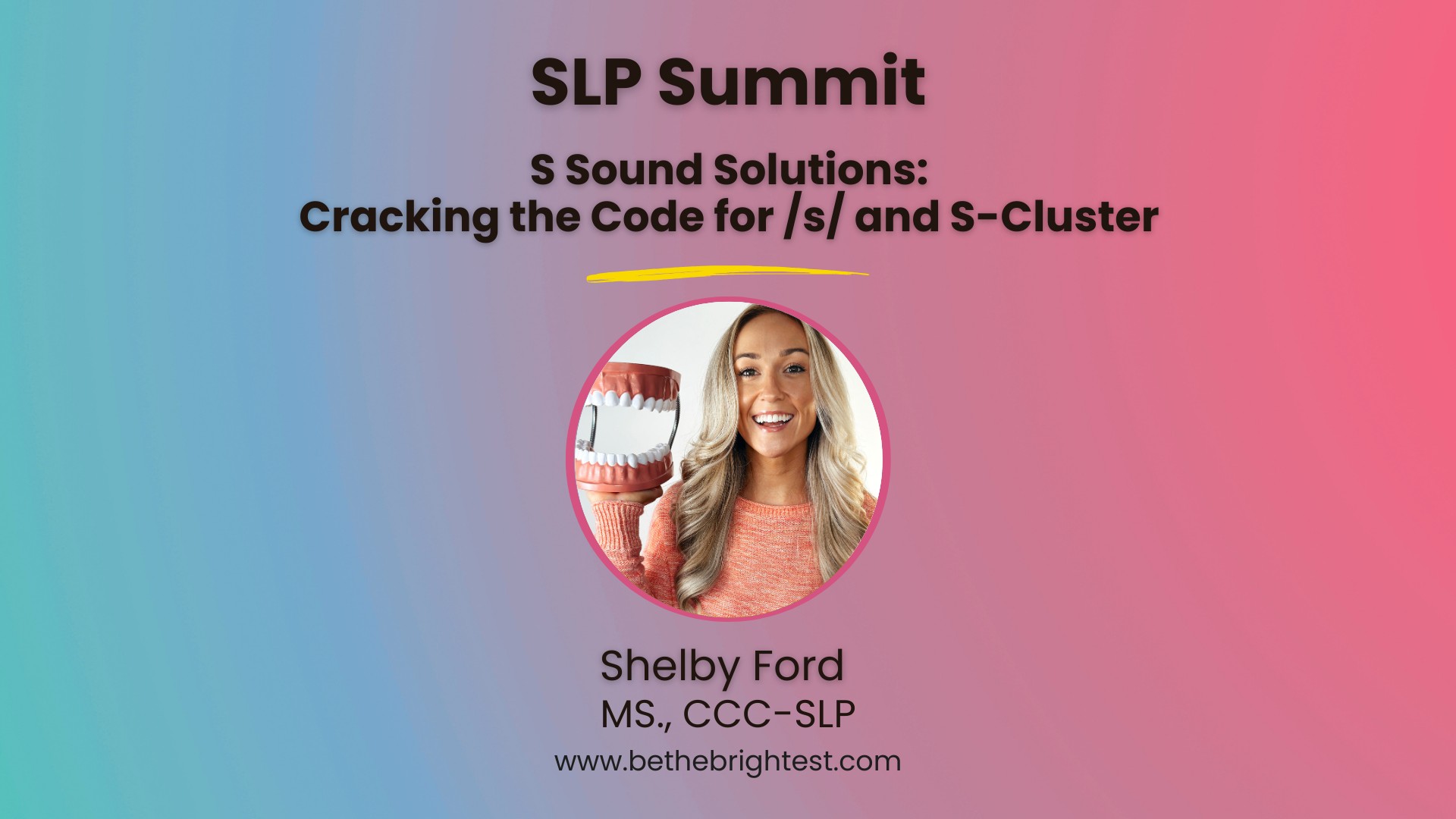
SLP Summit Jan 2026 – Session Recap
The /s/ sound is one of the most common targets in speech therapy—and one of the most deceptively complex. While it may seem straightforward on the surface, accurate /s/ production requires precise timing, airflow control, and articulatory placement. When any of these elements break down, distortions can persist despite consistent practice.
This SLP Summit session takes a closer look at /s/ sound production through a clinical phonetics lens, helping speech-language pathologists move beyond surface-level cues and into more intentional, effective intervention.
🎥 Watch a clip from the session below
Registration is available until Feb. 6, 2026—register now to access the full course and earn ASHA CEUs.
Why /s/ Errors Persist
The /s/ sound demands a fine balance of tongue placement, midline airflow, and jaw stability. Small variations in structure or movement can result in lateral airflow, interdental placement, or distorted sound quality.
This session breaks down the most common reasons /s/ errors persist, even in students who are otherwise stimulable or highly verbal. Participants explore how articulatory precision and motor planning play a role in long-term success.
Understanding the Mechanics of /s/
Rather than relying on generic cues like “keep your tongue behind your teeth,” this presentation focuses on helping clinicians understand what accurate /s/ production actually requires.
Through detailed explanation and examples, the session addresses:
-
Tongue shape and placement for midline airflow
-
The role of jaw and dental structure
-
Airflow direction and pressure
-
How coarticulation impacts /s/ accuracy across word positions
By understanding the mechanics, clinicians are better equipped to troubleshoot persistent errors.
Moving From Accuracy to Generalization
One of the most challenging aspects of /s/ therapy is helping students carry accuracy beyond structured drills. This session emphasizes strategies that support generalization by gradually increasing linguistic and motor complexity.
Participants learn how to:
-
Select word contexts that support accurate production
-
Structure practice to reduce breakdowns
-
Fade cues intentionally
-
Build carryover from words to sentences and conversation
The goal is not just correct /s/ production in isolation, but consistent accuracy across environments.
A More Intentional Approach to /s/ Therapy
This SLP Summit session encourages clinicians to slow down, analyze the sound systemically, and make informed clinical decisions. When therapy is grounded in phonetic understanding rather than repetition alone, progress becomes more efficient and meaningful.
For SLPs supporting students with persistent /s/ distortions, this presentation offers clarity, confidence, and practical tools to refine intervention and improve outcomes.
🎧 Check out the full course!
You can register for the SLP Summit through February 6, 2026! Registration is free with an optional ASHA add-on for $29.99 for all eight courses. Courses must be viewed by Feb. 6, 2026 and you must opt in for ASHA credit after each course by Feb. 15, 2026.
🔖 This course was originally presented live at the Jan 2026 SLP Summit. Captions available on replays.
🕒 Replay Access Ended? You Can Keep Learning!
If you missed registration, we’ve got a perfect next step to support your journey.
👉 /ɹ/ you frustrated by working on /ɹ/? Try facilitative contexts!
In this self-paced course, you'll:
- Understand why /ɹ/ is considered one of the most difficult speech sounds
-
Learn the tongue postures required for accurate /ɹ/ production
-
Explore differences across pre-vocalic, vocalic, and cluster /ɹ/
-
Use the vowel quadrilateral to select facilitative vowel contexts
-
Optimize treatment word lists to support accuracy and generalization
-
Apply clinical phonetics to improve efficiency and child outcomes
This course is ideal for SLPs who are ready to move beyond trial-and-error approaches and use science-based strategies to make /ɹ/ therapy more effective and less frustrating.