SLP CEO Chat: From Clinician to Entrepreneur
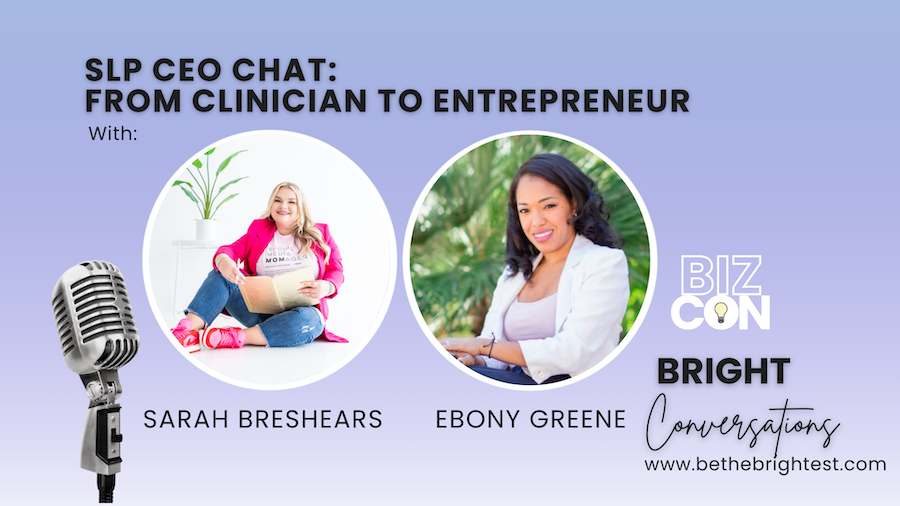
🎧 Bright Conversations – A Podcast by Bright Ideas Media
Join us for real, relevant conversations with industry leaders, past presenters, and change makers across the SLP and special education space.
📖 Read the Episode Transcript
Scroll down to read the full transcript from today’s episode.
▶️ Watch the Video
Click here to watch the full episode on our site
🎧 Listen on Your Favorite Platform
Listen on Spotify
Listen on Apple Podcasts
⭐ Want ASHA CEUs for this episode?
After watching or listening, head to our website to purchase the CEU add-on and earn professional development credit on your schedule:
👉 www.bethebrightest.com/en/conversations/slp-ceo-chat-from-clinician-to-entrepreneur
Transcript of “SLP CEO Chat: From Clinician to Entrepreneur” – Bright Conversations Podcast
Hi, and welcome to another episode of Bright Conversations. I am your host today, Shontaye Glover Jones. And today I am very excited to have two fantastic guests. We're talking to SLPs who took their clinical expertise and really built businesses from it.
We're going to start talking with Ebony Greene, and then we'll also be talking to Sarah Breshears about what they're building, what they're doing. And I want to jump right into the conversation because I want to be respectful of your time. So please, Ebony, why don't you go first and tell us who you are and what you do.
Absolutely. Well, thanks for having me. I'm really excited to be on this podcast. Be the brightest has always been such a great resource for clinicians. And I love the work that you guys are doing. So thank you.
A little bit about me. I'm a speech language pathologist. I am a private practice owner. And I am a multi passionate entrepreneur. So I started my first business, which was my private practice, back in 2019. I was working in the schools, had a not so great experience, and so decided to pivot and start a private practice.
I started pretty much as a brand new right after my CF clinician. And there was a lot that I had to learn, but I was willing to take the leap and see if I could figure it out. Thankfully, I was able to figure out how to run a business successfully. And so today I have a multi disciplinary clinic. We have a team of about 30 35 therapists. And then I have additional services that we provide with direct service providers for respite, rehabilitation, attendant care. So that's a whole different department with a little over 50 providers.
My second business is online coaching and mentoring. So as I was growing my practice, I wanted to get information to therapists that needed support with scaling growing, especially during COVID. That was a really difficult year for a lot of private practices as I was looking in the Facebook group, seeing people having to shut their doors. And for me, it was actually the opposite. It was one of my biggest growth years because we were doing teletherapy in the schools.
So through school contracts, doing teletherapy, I was able to have a successful year of growth. And we didn't have to really cut back on anything. I mean, we just continued to grow more and more. So I decided to teach a course called the school contracting masterclass to help SLPs learn the process of school contracting, especially to help them just keep their doors open during COVID.
So that's a little bit about me and what I do today. I still teach my courses. As I mentioned, my private practice is still growing. And there's a few other things I do on the side, but I'm sure we'll talk about those later.
I was going to say, I feel like you're being modest, but that's okay. We'll make it to everything a little bit later on. Sarah, please tell us all about what you do and who you are.
All right. So I am Sarah Breshears. I worked as a clinical speech pathologist in every setting except for SNF and home health for about eight years. And the pandemic also really affected me and my career. And I found myself completely poor now at the end of 2020.
And I had built an online brand, short and sweet speech, started with a TPT store and figured out that I needed to learn how to market that. And then started having SLPs reaching out, asking me, well, how are you doing your social media? And can you help me with mine? And so 2020, I took on my first volunteer social media job. And then 2021, we fully launched social moguls.
And we have gone through hundreds of launches with our clients now and have served some of your favorite SLP brands online, like they made for more conference. And through that have kind of branched out and started offering courses and one-on-one mentorship for people who don't want to outsource their social media, but want to learn how to do it strategically for themselves to grow their business and not just their following.
I think what's inspiring to me about both of your origin stories is the fact that you don't come from a business background. And there are so many SLPs who are in the same boat. You know, there are few people who did study meeting business or marketing first and then transitioned over to this clinical field. But a lot of us, we got into the field because we want to help people. But then we realized, like, I want to do more than that. There's more, there are more layers to me beyond that.
And so many of us don't necessarily have an expertise in marketing or business. And so hearing your stories and hearing how you were able to transition, but also utilize the right people to help you grow, is really inspiring. So I really want to get into that today and hopefully this conversation will motivate more people. If you were kind of on the edge, not sure, thinking about, hopefully you'll take the link, the leap into starting your own business or at least a side hustle if that's something that you've been thinking about.
So I also want to add that I have had personal connections with both of you. I've taken Ebony's course for contracting. I've worked with Sarah for Bright Ideas, having her do a course that was like really phenomenal. You're being modest too because in that course you talk about your humble beginnings and how you grew from what a lot of folks wouldn't have expected, you know, where you came from to where you can't where you have gone.
And something that's really that I think about a lot, and I guess I'm deviating a little bit from what I said, when we talk about what I think about a lot is that a lot of us are first generation entrepreneurs. And we don't come from a family or support system who has done it before. So you really don't have someone that set the path that you can look at and say, what do you think about this? You're really figuring it all out on your own.
And no slight to anyone who has that privilege, but it is a privilege. And it kind of you feel a little bit of a leg up when you're getting started because you know that it's possible. And sometimes when you don't see it right there, you don't know that that could be you too. And when you start to think of like what does an entrepreneur look like, you may not see yourself.
But you too are making it really attainable and really reachable for a lot of folks because you're like so many of us who started out just wanting to help people and then realizing I'm built for more. I'm made for more, a little plug for it. And wanting to do so many other things.
So I just wanted to add that little tidbit in there as well. And if I could just reflect on what you just said and just go deeper, you mentioned how important it is for us to show up so that we can serve our communities and show what's possible. And I don't think I've ever shared this with you, Shante, but you were an example for me before I started my business of what an entrepreneur looks like as a speech language pathologist.
Because your first book that you wrote, Liam's first cut, someone at my clinic purchased that book and gifted it to my son. And he was like, you need to look into connecting with her. The author is an SLP. And so I looked you up on social media and started following you. And I was like, wow, she's an SLP. And she's also an author, right?
So at the time, actually, I had already started my private practice, but I was thinking of other business ideas. And I thought it was really cool that you were an SLP, but you were doing something outside of SLP, right? That you were really passionate about. So you writing that book and me like reading it to my son every night, I was like, wow, this is so cool that an SLP wrote this book.
So not only is she using her clinical expertise, you know, it was about a child with autism. But you're also tapping into something else that you're passionate about. So I feel like that to me was very inspiring to pursue other passions outside of just being a speech therapist.
Thank you. I appreciate that. I do think that we tend to put ourselves in a box and we start to think about what we're able to do. And Sarah, you talk a lot about this too. There's so many other opportunities for clinicians outside of starting a private practice or having a TPT store.
And I think that's kind of where you really, you really like hit the spot for folks because you talk about how specifically your area is people who are in a medical profession or wellness profession. Those are the folks that you really want to work with, but you want to talk about how you can have a business and make it work for your life so that you're not living just for your business and showing folks how you can create these systems so that you can grow and go beyond just having your typical work life, whatever that may have seemed for you.
And so I guess what I'm getting is how do you start those conversations for people who are thinking like, I love what I do, but I feel like I could do more? How do you help people transition those skills from being an SLP into other businesses and how have you used your skills to grow in your business?
Yeah. I think that this is something that my brain just naturally does now because I have walked through this process with so many people and I have to catch myself. Someone will give me like a tiny little fragment of an idea and I'm like, oh, do you know what we could do with that? You could totally turn this into a business and this could be a branch and this, you know.
But I think that it really comes back to like, what is the thing that you are most passionate about about your work? What is the piece that you if you showed up to work and you did that one thing every single day for the next year, would you still love it? And how can we lean into that?
And my favorite way at this point in my career is how can we lean into that in a way that allows you to help even more people while also helping you make more money? And a lot of times that's a digital product course membership of some kind, but we always always start with what is the thing that you just absolutely love and really lights you up because entrepreneurship, I know we can all attest to this, is not the easy road.
I always say it's not the easy road and if it was, everyone would be on it. And so you have to truly feel passionate about what it is that you're building and why you want to build it because it's going to get hard. And whenever it does, if you're not in love with it, it's going to be a lot easier for you to quit.
For sure. I totally agree with you. Ebony, what was the thing that made you feel like, well, your story is interesting because you were working in a setting where there wasn't quite a seat for you at the table and then you decided I was going to create my own table. But what was the thing that made you say, I still like this, but I need to do it this way. I need to do it my own way?
Yeah. So I always tell the story of my last day of working for a school district as a direct employee, as a direct hire. And that was kind of the moment where, like you mentioned, I decided I want to do this, but I want to do it my own way.
I was preparing for my last IEP meeting on my last day of work. I had resigned in November of the school year. So it's kind of the middle of the year. And it was me and the school psychologist, we were both in the room waiting for everyone else on the team to arrive.
And she said to me, Ebony, I know this is probably hard for you. You've done such a great job while you were here. But she goes, I know how hard you're working. And I don't know how much money you're making, but she told me how much she was making. And she said, but I'm a contractor. So everything that I'm doing, I get to bill four.
And when she told me how much she was making compared to how much I was making, because I was a part-time therapist being paid a part-time wage, and I was still working more than the hours that I was actually paid for. Because as we know, a school caseload is a very intensive workload. You're constantly working around the clock, right? But I wasn't on salary. I wasn't making a full-time salary. So I was putting in a lot of free hours.
And when I learned how much this school psychologist was able to make as a contractor, that was when I decided if I ever come back to the schools, I want to make sure that it's in a way that honors my expertise and my time. And the freedom that I want to have, because the whole reason I took the job in the first place being that it was part-time was so that I could have time with my kids at home. And I wasn't able to do that with the hours that I was working.
So that is when I started to investigate a little bit more about how I can partner with school districts, how I can still meet their needs and provide the services that they are desperate for because they don't have enough providers. But doing it in a way where I was not overworked, where I wasn't overwhelmed, and where frankly, I was a bad therapist because I was just trying to turn out the paperwork, you know, and wasn't really able to do a good job as a clinician.
So that's when I discovered school contracting. I got my first school contract and did a great job because I kept getting asked to come back and add more schools to my contract. So that was the moment for me was when I had an honest conversation with someone who from the outside looking in saw how much I was working and recognized that you probably want to consider, you know, coming back in a different way, coming back in a way that honors your time and your expertise and the hard work that you put in.
Yeah. Sometimes it takes that, right? Sometimes it takes someone on the outside that's not within our circle to look at what you're doing and acknowledge like you do a lot and you're not really being valued for all that you bring to the table. And sometimes it's just that little push that makes you say like, okay, I'm gonna do that. Exactly. But then it was scary. It was scary to me.
Okay. That was my next point. That was my next point. It's scary. And then there are a lot of gaps, you know, you don't go from saying, okay, I'm gonna go out and try to get my first school contract or go out and create a course. You don't go from the idea to success right away. And you offer services to help solve those pain points for individuals before yourselves.
How did you close those gaps? How did you figure out how to market? How did you figure out how to have the finances to get started in the beginning?
Yeah. So it was difficult to learn all those things because I don't have a business background. So I had to do a lot of research. I had to find mentors. I was taking a lot of classes on online YouTube University as many things that I could do to help fill that gap. I was doing them. I was going. I was flying to conferences all over.
I remember one year, which was the first year that my business made seven figures in revenue in one year, I said, I wanted to go to conferences where I was learning from the top people in their industry. So I made a list of all the people that I wanted to hear speak or whose conferences I wanted to go to. And I made it happen. I didn't have the funds to pay for all of these conferences up front. I was doing the PayPal credit and all these different things to just be able to get in the room. But it definitely paid off because there is a gap, as you mentioned.
In fact, I'm actually a doctoral student right now researching the gap in preparation for speech language pathologists who go into private practice. And the data shows that most of our preparation is very clinical. You can look at some of the accreditation standards. All the things that are a part of the system of becoming a speech language pathologist is very clinical focused. So we have to go out and learn these things on our own.
And so that's exactly what I did. I wish it were different because I feel like a lot of people get kind of shy away from private practice or starting a business because they don't have that foundation. So that's how I did it. And it worked out. So now I'm paying it forward by helping other people learn some of the things that I didn't know when I first started.
Yeah, that's fantastic. I didn't know that was your area of study for your PhD program. But we definitely need that research, that data. Because I don't know how many graduate programs have implemented more business courses. Are you guys familiar with that at all?
No, I haven't heard of any. No, it's focus is still more clinical. And I know for me anyway, all of my professors, they recommended that you don't consider business until your near retirement. You know, you do all your clinical work. And then when you're thinking about what will I do next, that's when you should start thinking about private practice.
But that's not realistic anymore. That's not where we are. And I think it's so crazy because if you look at PTs, they are taught from the beginning. It's almost like an expectation that you're going to own your own business, psychologists, same thing. I don't think, you know, they learn everything that you need to know to run a business, but certainly more than we're getting in our grad programs.
Even just planting that seed is enough to make you say, maybe I should go do more research on my own because these folks who are my mentors, who are my professors are telling me that's within my scope within my reach. But we don't, we don't get that. So I love I appreciate your transparency and sharing that information.
I do want to go back in a bit. We'll talk a little bit more about transparency and salary and earnings because you both are very transparent about that. And I think that that is super helpful too. But Sarah, I wanted to get your input too on how did you close those gaps? How did you figure out what to do from going from clinical to more of a business aspect?
Yeah, I really gave myself a deadline. I decided on Christmas Eve that this is what I was going to do. And I was in a school contract at the time, like a travel contract, different type of school contract. And that was through mid June. And so I said, okay, we have through mid June to figure this out. And then by August, I want to feel comfortable saying no to going back to the schools.
And that's exactly what we did. And so I just dove all in. I spent all of my time outside of the schools working on my own social media and talking with clients and working on their social media and taking courses. And I had my very first business mentor. I started with her right away. And it just consumed my life. And I loved it.
It was what I was passionate about. It was what I enjoyed doing. I was having so much fun. But I gave myself a solid six months where it was like, okay, this is my only focus. And I took my first non-paid client, one of my SLB friends actually ran for Senate. And her race started that January. And so I got to run the social side of her campaign.
And then I took our first paying client in March. And then my big goal to be able to walk away from my full time job as an SLB was I wanted to be at $10,000 a month. And we had a $13,000 a month in September. And I said, okay, we're good. And just kept running.
It's so important to set those goals for yourselves. And I think that it's commendable what you were able to do. But what both of you have been able to do. And you just talked about it. And you both are very open and honest about, you know, what you bring in.
Sometimes there's a little bit of shame that's around talking about your money. There's definitely a thing where people don't like SLP influencers or don't want to see you talk about, you know, what you have or what you what you've earned. Because that's really what it is. It's what you've earned. No one's given it to you. But for some reason, people still think there's a taboo to that.
And we can get into the psychology of that in another conversation. But I do think that it's important for people to know that it is possible for you to have a seven figure practice. It is possible for you to have six figure months and so forth. So and that those are the goals. And not only that, but it's possible for you to build a business with systems that allow you to have your business earning for you when you're not there doing every aspect of the business every day.
So you both talk about that in your emails and your social media. But for those who may not be following you just yet, hopefully you will be after this conversation. Can you tell everyone a little bit more about why you're so passionate about being transparent about what you earn and how you've been able to get to the point that you're at today?
Yeah, I can answer that first. So for me, it's about, you know, I talked about going into these other rooms to learn about business and to be around people who are doing really well in their industries. So one of the things that I noticed in these rooms where people are doing extremely well in business is that they talk about money. They're not afraid to talk about money.
So right now I'm in a group chat with women who have seven figure businesses. And when someone asks, hey, what's everyone's goal for this month? There's actual numbers being shared. It's not, oh, well, I want to make enough money to pay blah, blah, blah. It's like, no, I want to make a hundred K this month, right?
And so that taboo and that veil, so to speak, is not there in rooms where people are climbing and really, you know, reaching those higher levels of success. So I see myself as someone who belongs in those rooms, which means I cannot be afraid to talk about money. That's what people who are doing who are at the top are doing. I need to be doing that as well. And if it means I'm the only one to start doing it, then I'm going to be the only one. So be it. But I want others to be able to join me in this conversation as well.
So it's not just about me sharing. It's about let me share so you guys can also start joining this conversation.
How about you, Sarah?
I totally agree. My presentation that I did previously with I think it was from free school lunch to 50k months. And that really is the story of where I came from and what, you know, there's a lot of misconception whenever you grow up in very small town and you grow up in poverty and you grow up getting school lunch and school breakfast and, you know, praying that none of your friends notice there's a lot of misconception about what could be possible for you.
And I don't know how my parents did this, but they really did a good job of making me completely delusional about what is possible. And that has served me so well. But the thing that has kept me reaching for more is seeing other women talking about it. And Ebony was a great example of that for me whenever I was first getting comfortable talking about this.
And, you know, I had my very first like, well, it was it was one of the really big milestones. We I wanted to make more in a month than I made in my CFI. And whenever I first set that goal, I was like, well, okay, if we if we say that like maybe we'll do like 35,000, but like it's good to have a goal, right? And then we did 54,000 in the month and my goal was 50. And I just cried the whole day because it was like everything that the world had told me was not possible for me. I was doing and then some.
And I was very, very hesitant. Like I set with the draft in my phone for a while. And I literally like hovered my finger over the button before I posted sharing that because I knew that people were going to have thoughts, people were going to have feelings about that. I was going to trigger some people with it.
But the only response that I got to my face, I don't know what people said in DMs or Reddit forms or wherever, but the only response that I got was this is amazing. Thank you so much for sharing. This is such an inspiration. Thank you for showing us what's possible.
And if any I truly believe that if anybody has a response other than that, then that is a mirror for them to reflect and see like what what is that triggering in you and what healing do we need to do around that. And I get it because the message that we are given as women is don't talk about money. It's it's not ladylike and and sharing like very transparent hard numbers. I feel like is very taboo. Like you said, like it's not it's not common, but I think it's so so important.
I've had other examples that one of my business coaches, she did a podcast and she talked about making 100k months. And I just had this moment that like clicked in my brain of well, she's not special. I mean, I love her, but she's not special.
Yeah. Yeah. I think a lot of times we so you said a couple of things. I do think that the people who have a negative reaction, there's something about your story that's triggering something in them. And that's something they should work on and identify. We don't often see this with men, you know, when men talk about their success and what they the the plane that they have or the vacations that they can take. We don't see people react the same way, but there is definitely a way that society looks at women when women talk about money or when women demand to be in certain spaces. We're not viewed or given the same respect.
And then I do think I agree with you 100% too about when when it comes down to having those conversations, it's it's it's difficult. Like you think twice about like, should I share this or shouldn't I? But it is inspiring when you can see other people who are doing it, you know, it's attainable. And these aren't, I mean, in our mind, you're our friends because we know you virtually, but it feels like it's really attainable even if I've never met you in real life. It feels like this is something that I can do too.
And a lot of these people don't have more skill than you. They may have more audacity than you. They may have more courage than you, but it doesn't mean that they're smarter than you. They were just willing to try, even if they had to try scared.
Yeah, I love that you use the word audacity because I've said from day one that my business was built on audacity. It was built on the audacity to believe that I had something worth sharing. It was built on the audacity to believe that I deserved a seat at the table or to be in the room. And I think that that word has a really negative connotation sometimes, but whenever you're building a business, have all the audacity because that is what you need to be successful is to believe audationally in yourself.
Yes, I've seen a meme. I think it's a meme go around. It talks about being delusional, like audacity, delusional, whatever you want to call it, but do it.
We did get a question from social media. Someone wanted to know if you had any advice for a graduate entrepreneur, what they could be looking at, what should they consider as they're looking already while they're still in grad school with starting their own business.
Well, I can just share what's worked for me. And I'm sure Sarah can have a lot more to say about this because this is her lane, but starting a personal brand. That is what has really helped me grow my online business, but the personal brand came before it became a business. So anybody can start developing their personal brand because it's unique to you. There's only one you. There's only one person who can tell your story.
And so use that as a foundation for whatever business you want to build, whether it's a product or a service. It all starts with a personal brand because people want to buy from someone that they know, like and trust or at least feel like they can based on what they, you know, the brand that they are developing online.
So that's my two cents is start building that personal brand and use that as sort of a springboard to whatever else you want to build. But Sarah, I'm sure you have some more advice around that.
No, that is always the starting point. It always comes back to any form of business, like there has to be some point of connection. Whenever we're asking people to trust us enough to give us their money or trust us enough to bring their children to us or their aging parents or whatever form of transaction that looks like, there has to be a level of trust. And that starts with people being able to know a little bit about you in order to trust you.
And so if you don't know what you want to do yet, start sharing your journey, start sharing the process of you figuring that out and take people along for the ride with you because whenever they see you in that whole journey, they're rooting for you. And as soon as they have the opportunity to support your business, they're going to whatever that looks like.
I'm so glad you said that. That's always my advice too when people ask. And I always tell people to don't discount the number of people you think are following you. You know, a lot of people get stuck on these vanity metrics. And if you have five consistent followers who are always commenting, watching your stories, that's an audience. Don't wait until you have 100 or 1000 or 10,000 people. Start talking about your ideas, your journey, the whole thing and bring them with you. And more people will come along.
But we get caught up in thinking like, you know, 50 people, that's not a big number. If you put 50 people in a room, that's a lot of people. And then if you think about how many folks they'll go back and tell and say like, you know, Ebony has this really amazing private practice, you should check it out. If you know anyone who's looking for services or, you know, I needed help with my social media and I went to Sarah and she was able to help me. It's a ripple effect with the word of mouth.
So I always add that into like, don't wait until you feel like you have that magic number of folks to say, okay, now I have an audience. Your audience can start with four people.
Truly, I feel like that's easy for people to get hung up on is the follower count and in the vanity metrics, the likes. But I feel like anybody can have any amount of followers and that doesn't translate to a business. You can also, I've had multiple six figure years with 1200 followers. Like it, it really is not a direct correlation. Is it easier whenever you have a larger audience? Yes, if they're an engaged audience who trusts you. But if they're not, then you can have five million followers and it doesn't matter.
Correct. Correct. Yeah, I totally agree.
All right, ladies, what is one business tool that you would say you cannot live without?
My Google calendar. It keeps me in line and you've seen where I'm supposed, if it's not in my calendar, it's not happening.
I have to agree, the calendar, for sure. I put everything, even my personal appointments, if I have to pick up my kids, date nights, I mean, everything is in my calendar. So, if it's not in the calendar, it doesn't exist. And it's something that I live by every single day.
Yeah, agreed. One other thing that I will add that I got from you, Sarah, is using my settings and my notifications and recognizing that you can't always have access to me. So I set notifications so that I won't get that alert until I'm ready to be back looking and working again so that I can carve out time for myself, whether it's to do something else, another project or hang out with my family, whatever that might be, but using the notifications so that you control when people can access you, that's been really important for me too.
I love that you are using that. I recently took it one step further and I got a brick, the little gray box that you, it's connected to an app on your phone and whenever you tap it, it locks certain apps so you can't get into them until you go back to the brick and tap it again. And so every night at 10 p.m., it locks like almost all of my apps, except for things that I'll use like podcasts or whatever to listen to whenever I'm going to sleep. And then in the mornings, it's on my fridge and so I can't lay in bed and scroll social media or look through my email. I have to get up and go to the kitchen and tap it and then I can get into.
I like that and it's called a brick. Okay. All right. I have to add that now to my because the scrolling in bed can be such a time suck. So yeah, that's good. That's a good one.
What would you say is the best investment that you made in your business? I'm going to say, you know, in addition to investing in yourself and in your education, what else would you say is the best investment that you've made in your businesses?
I can go first. For me, it's the investment in my company culture. So what we do to ensure that our team members feel appreciated and supportive or supported, excuse me, it costs money, right, to do things for staff appreciation or to kind of just give them give back, right?
So one of the things that we do every single year is actually beneficial for the company culture of my organization, but it also is beneficial for the people that we serve. And that is going on an international outreach trip to go and provide therapy services. So we're actually about to do our third one this week.
So just reflecting on all the, you know, the resources, the time and effort it takes to put into something like this is significant. It's a lot of times, you know, we had to purchase flights and hotels and all those things. But this is something that is so important to my team. People are really invested in this.
I've always, you know, I'm a, I'll try anything once type of girl, but if I do it once and I feel satisfied, I don't have to do it again. And they're like, no, we need to keep doing this. So I'm like, okay, we're going to keep doing it. And that is the biggest investment to me is knowing that it is a lot. It's a big investment, but there's such a huge ROI because of the culture and just everybody feeling like they got to be a part of something big. So that's it for me.
I see social media stories though, that you often pour back into your, your staff too. Like that's very important for you that you reward them and you let them know how much you value what they bring to the business. And they feel like they're part of it. They're not just, you know, coming to a job that they feel like they're part of the community. So I do see, I commend you on that.
Yeah, for sure. We do wellness days, we have appreciation events, birthdays are a really big deal in our office. So everybody has like, their office decorated and a gift and all these things. And this year, it's funny because someone on the team was like, can we vote? Can we take a vote on how much effort we put into celebrations, like birthdays and work anniversaries? And I was like, sure, you know, we don't have to do anything big if you guys just want to say like happy birthday. And everybody on the team was like, no, we want to keep doing it, but we just need to be more organized.
And I was like, okay, so it's clearly something that they think is important and valuable. And I think this comes from my own experience. I worked for a number of clinics and private practices where I really didn't feel like I was a part of a team. And especially when you work at home health, driving from patient to patient, you don't get that interaction with other colleagues or team members. So we try our best to fill that gap just by doing these appreciation events.
And we, you know, we have meetings, we do things that require, like I said, the time and the effort to do them. But to me, those are things that you're going to get a return on your investment for. So I'm the type of person who sees spending money on my team as something that is more worth it than any expense on like equipment or more tangible items, I guess.
That's great. How about you?
I think this is a recent one for me, but I think, and it sounds like it's not related at all. But last fall, I did yoga teacher training. And it was a decent monetary investment, but it was a huge, huge time investment. It was every Friday, Saturday, Sunday for three and a half months, and then practices during the week. And I think a lot of people think of yoga and they think of like, oh, it's stretching, but the practice of yoga is so much inner work. And getting certified to teach is really deep inner work.
And it just allowed me to uncover so much about myself that I really wasn't tapping into and uncover that in a way that I can use that to pour into my clients and pour into the content that I'm creating and just be able to hold space in a totally different way for the people that I work with. And I've had multiple people tell me, wow, you feel like a totally different person than you did like six months ago. And I think that that investment in your inner work is always always worth it. And you always get an like an invaluable return.
I'll say agree agree. Congratulations on that. I guess with your rebrand that you recently did with social models, we didn't realize that there was also a rebrand of you too. And I think that that's really, really commensible. We talk and we hear people using the word community and connection so much now. But oftentimes it's empty, you know, there really isn't that that piece. But it's so important that you really have authentic community and authentic connection. And it shows up, it shows up in your work when it's real. So both of you, I've noticed it just virtually. So congratulations to you both.
Thank you.
All right. My last question. Well, second to last question. I want to know if you don't mind sharing, what's something that you treated yourself with after having like a really successful year or month or day, like something that like, oh, I deserve, I'm going to go do this.
Oh man, where do I start?
Yeah, go ahead Sarah.
So this is something that I actually haven't shared publicly yet. Last December, I want myself a new car and the I held out because I was like, this is the one that I want. And I down to like the trim package. I was like, I'm not settling for anything less. And so I bought a Mercedes GLC and her name is Marilyn. And she is beautiful.
And I truly, I think like, you know, it's great to have a nice car. But I every time I get in my car, I feel like genuine gratitude and just like joy and not not because it's like a Mercedes or whatever. But I think because it's, it's a symbol of all of the work that I've done. And you know, my first car was a 95 Ford F-150. So we have come a long way.
That's really cool. Ebony?
Well, for me, I was actually going, there's so many things that I buy myself because I believe in treating yourself. But I think the most significant purchase I ever made was actually not for myself. So before I started this whole journey of private practice and, you know, seven figure business, all this stuff, I was pretty much a stay-at-home mom. I stayed home with both of my kids until they were in preschool. And my daughter actually, I stayed home with her until she was in kindergarten.
And so being a stay-at-home mom, I wasn't really contributing to the household. I mean, I had like a little part-time job where I was working at a clinic like a few hours a week, but that was just so I can get out of the house. So I was pretty much a kept woman, which I have no complaints about because I know that, you know, that's definitely a privilege.
But I always said, you know, if I, if I made enough money that I was going to do something special for my husband, because he has always, I mean, any car I bought, it was all him. Like, I was just, I was staying at home. So the first purchase I made after I bought myself my dream car was I bought him a Cadillac Escalade. And, you know, I made the first payment and then he was like, okay, I know you just, you're just joking. When you said you bought this, I'm like, no, it's going to come out of my bank account. I'm going to pay, you know, the monthly payment.
So that was, that felt really amazing because I had, I was dealing with some stuff internally, just feeling like I don't make any contributions to the household. He makes all this money. I'm just a stay-at-home mom. So it was really empowering to be able to be like, I can, I can buy this car for him instead of me having to always be the one, you know, receiving.
And he's never asked, you know, for me to pay him or back for all this stuff. He's bought me, but it just felt like something that I wanted to do because I could. So that was it for me.
That's fantastic. Both of them, both stories, I love that. And I like that both of you, your stories are related to buying cars. So that's really, really cool. That's amazing.
Before we go, before I ask my final question, I know we talked a lot about like your stories. We didn't, if you tuned in because you were hoping they were going to give you a blueprint for exactly what to do, you have to contact them directly for that. So I do want to talk a little bit about how folks can reach you, how they continue to follow you and how they can work with you.
Yeah. So you can find me on any social media platform, Instagram, LinkedIn. I'm also on Substack. I don't know if you guys are into Substack yet, but Substack is up and coming and I'm excited about that. So follow me on any of the platforms. If you're interested in my courses, I have a page called the SLP Business Suite, where you can find out about courses. And then, of course, Made For More is my in-person event.
Sarah is our social media manager. So she gave us a little shout out earlier in the conversation, but Made For More was something that I started because I realized that while I was going to all these different conferences, learning from people who weren't in speech language pathology about business, that there was a gap, right? We don't have a conference where you can just go and learn about business. You have to go other places.
So I started this conference with a colleague two years ago. It went really well. And so I just decided to keep doing it. And this year, we're hosting it in Miami. So we'll be in Miami July 24th and 25th, 2026th. So definitely follow that page because the content is fire because Sarah runs it and we want you to be in the room.
So yes, well, you can also find me in Made For More this year. I have been the last two years, both years and could not love it more. And everyone always leaves so invigorated and excited. And I feel like everyone leaves feeling so held and supported too.
But other than in-person at Made For More, you can find more info about the work that I'm doing at social-mogals.com and on Instagram, social.mogals. You can find all of my courses, coaching, I'm hosting a retreat this fall. You'll find info about that and any in-person events that we have going on as well.
Awesome. Before we go, this is my last thing. I would love for you to complete this sentence. The thing nobody tells you about running a business is...
That is hard. I feel like for me, building a business is the biggest personal development project you will ever take on because it forces you to face all of your limiting beliefs. It forces you to face any mental garbage that you're feeding yourself. And all of those blocks will show up as challenges in your business for you to overcome. And it's really beautiful. It's really freaking hard sometimes, but I wouldn't choose any other path.
I would say no one tells you that it's survival of the fittest. Starting a business is one thing, but sustaining it is a whole different game. Knowing that you didn't just start this business to do it for a few months or even a few years, you're in it until the end. And I always tell the people that I mentor and that I coach, every business has an expiration date. Every business is going to end. So it is either going to be on your own terms or it could be involuntarily.
So it really is survival of the fittest. And that is something I didn't think about when I first started. I just knew, oh, I'm going to start this business. I'm going to bet on myself. But here we are seven years into it. And I'm like, okay, what's the plan going forward? Because eventually, I'm either going to want to sell it or I don't know, my kids probably don't want to run it. So you have to figure out about what the future holds.
So it is almost like having another child, honestly, because you're starting something from an infant stage and it's going to grow until it's an adult.
I could not agree with either of you more. I think that sustainability is a whole conversation that we could have, because we do talk a lot about starting. But once you get started growing and sustaining as a whole other conversation. And I feel like I've been helped by this conversation. There are lots of really good gems.
I agree with you, Sarah, with the professional development piece that you talked about, and it really does for you to look at yourself and confront some of the limiting beliefs you have about yourself and what you think you're capable of doing. So I'm going to close with kind of the way that we started out, talking about being audacious and having the audacity to believe that you were made for more, and that you don't allow anyone else's ideas about you or what you can be or what you can become limit you.
So I want to thank you both for joining me today for this conversation. And if you enjoy this conversation and want to hear more, there are lots of other bright conversation topics. You can find us on Apple Spotify, or you can watch the video on bethebrights.com. Thank you again. I appreciate you both.
Thank you so much.
Thank you, Shontaye.
About Bright Ideas
At Bright Ideas Media, we empower educators, speech-language pathologists, and special education professionals with actionable knowledge and engaging learning experiences. We make professional development easy, insightful, and impactful—so you can apply what you learn right away!
💡 Want to keep learning? Explore 150+ hours of live and on-demand courses designed for professionals like you. See all available courses → Click Here
Recommended Courses for You
Here are some courses you might love based on what you’re reading:
📌 Filling the Void: Realizing Your Worth to Open the Practice of Your Dreams
📌 Business Essentials for the Beginning Entrepreneur
Join Our Email List
Sign up to be the first to know about new events, course launches, exclusive discounts, and practical insights to support your professional growth.
Thank you for subscribing!
Have a great day!
