Supporting the Deaf and Hard of Hearing: Inclusion, Access, and Empowerment
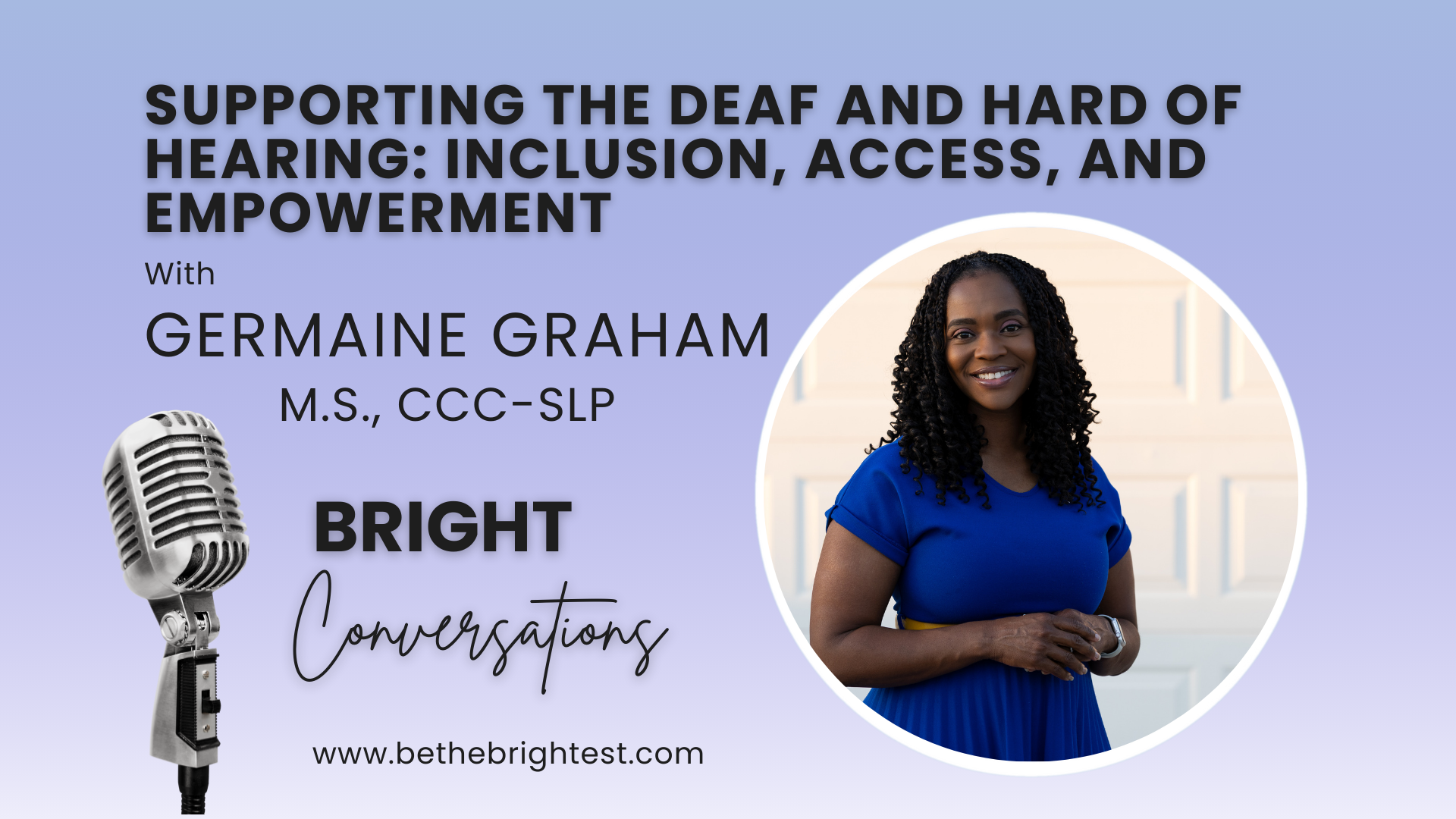
🎧 Bright Conversations – A Podcast by Bright Ideas Media
Join us for real, relevant conversations with industry leaders, past presenters, and change makers across the SLP and special education space.
📖 Read the Episode Transcript
Scroll down to read the full transcript from today’s episode.
▶️ Watch the Video
Click here to watch the full episode on our site
🎧 Listen on Your Favorite Platform
Listen on Spotify
Listen on Apple Podcasts
⭐ Want ASHA CEUs for this episode?
After watching or listening, head to our website to purchase the CEU add-on and earn professional development credit on your schedule:
Transcript of “Supporting the Deaf and Hard of Hearing: Inclusion, Access, and Empowerment” – Bright Conversations Podcast
Hi, and welcome to another episode of Bright Conversations. I'm Shontaye Glover-Jones, and I am excited to host another conversation today. Today, we are meeting with fellow SLP, and I would say specialist when it comes to working with the Deaf and Hard of Hearing, Germaine Graham. I'm looking forward to chatting more about how she has become so involved in this field, and her work, and all that she does. So Germaine, welcome to our podcast, and thanks for sending down to have this conversation today.
Absolutely, thank you so much for having me. I'm excited to be here today. - Awesome. So first, let's talk a little bit about who you are and what you do and how you became so invested in this particular aspect of our field. - Sure.
So who I am first, 'cause I definitely have to separate that from what I do. - Absolutely. - Who I am, I am Germaine. I am a mom of five. I am married to my wonderful husband, Clifton of the 17 soon to be 18 years.
And I'm just very passionate about communication in general. I love having conversations with my kiddos about everything from A to Z and just connecting with people in general, making sure that I'm understood by those who I have an opportunity to meet and that I'm able to understand them and kind of learn more about them. So I'm definitely very, very passionate about communicating and just getting to know people. - Yeah, that's awesome. And it's beautiful, your family.
Being married for 18 years is an accomplishment in itself. So congratulations. (laughing) - Absolutely. - Now, tell us a little bit more about your work. You know, you have a background in supporting deaf and hard of hearing students and your story's a little bit different.
I remember initially we worked with Germaine for the equity series a few years back where she co-presented a course with Michelle Hu, Dr. Michelle Hu, just talking about how we could be more equitable in our practices when we're working with people who may be deaf or hard of hearing. So tell us a little bit more about how you became familiar with the field and how you ended up working with this particular population. - Yeah, so my story is kind of crazy. I think it's a little different, but I actually met my first deaf adult working in high school at McDonald's.
And that kind of got the initial speed of like curiosity, wanting to know how to communicate with this individual while I was working. They did not speak. They used American Sign Language. And so I made it my mission every time I clocked in for work to try to learn a little bit more sign language so that I could communicate with this person. And so that initial experience, that seed kind of stayed with me until I went to school.
I thought that when I entered Jackson State University, shout out to JSUV, I love. I thought that I was gonna be a dentist and I started taking the courses, the biology classes and everything. And that was just a little bit too much. I did not enjoy it as much as I thought. And so once I talked to my advisor, told her more about what I'm passionate about, what I really enjoy doing, she suggested the field of speech language pathology and communicative disorders.
And so I changed my major. We had to take elective classes in undergraduate and so sign language came back around. And I realized that I could satisfy one of my electives by taking a sign language class. And long story short, later came to realize that we had a deaf school that was about 15 minutes, the Mississippi school for the deaf, was about 15 minutes away from the main campus of Jackson State. And it's actually right in the backyard of where I completed my graduate degree at JSU.
And so everything just kind of came together. I took the ASL classes later, started working at the Mississippi school for the deaf and learned throughout that process that an SLP could work in supporting speech and language outcomes for deaf and hard-of-hearing people. So McDonald's was the gateway for me. - And so right from that moment when you finished your degree program, did you always work with the deaf and hard-of-hearing population? - I did.
I was able to do observation hours during my undergraduate program at the School for the Deaf. And God was all in everything throughout because when I graduated with my undergraduate degree, the School for the Deaf had an opening because the SLP that I observed during my undergraduate time retired. And so they had that opening and she was GG. My initials are GG, so the old GG went out. And the new GG, I know, right?
And the new GG came in and so I interviewed and got the job and I stayed there from really after I graduated. That was my first job, stayed there for nine years until I relocated here to Arizona. - Wow, yeah, that was definitely destined for you to have that position. - Absolutely. - I want to talk a little bit about like some of the language and terminology because, you know, so far we've been talking specifically about deaf and hard-of-hearing and making sure that people feel comfortable with the right terms to use when we're discussing people who have had any type of hearing loss.
So, I guess my question is, you know, what is the proper way to describe an individual that you encounter who has hearing loss? - I think it's always, depending on who you encounter, I think as a general rule of thumb, I like to tell people that we don't use the terms hearing impaired, you know, we don't use like deaf and dumb or any of those kind of older terms that were used to reference this community. How individuals within the community identify or choose to identify will always vary, but just to be safe, you know, to say deaf or hard of hearing. And we know that that also encompasses those who are deaf-blind. There are those who are deaf-disabled, late-deafened.
It's kind of a big umbrella, right, of different identities and communities under that term of deaf and hard of hearing. But hearing impaired is not something that I use. It's still there. And of course, we see that in educational settings, right? One of the eligibility is still that way.
But just to be safe, you know, deaf or hard of hearing or an individual who is deaf or hard of hearing. - Okay, thank you for that clarification. That definitely is still a classification label that I see too here in New Jersey hearing impaired. So good to know. You know, I say we often are learning and unlearning and sometimes it's good to know what language is outdated and shouldn't be used anymore 'cause we never want to offend the community.
So thank you for sharing that with us. Let's talk a little bit though about language acquisition and distinguishing speech and language when we're talking about deaf and hard of hearing community. What are some of the, if you're an SLP listening to or watching this episode, what are some of the key things that you should keep in mind about language acquisition when you're working with a younger child who may be deaf or hard of hearing? - Yeah, I think that's a really great question. I share a lot kind of about that on social media, really trying to help educate parents and professionals about just the difference between speech and language, the difference between sound and language and just understanding that there is a process of development when it comes to auditory skills for those families that choose to pursue the use of hearing technology for their children.
I always like to say that while a child is learning to make sense of sound, if they have access to sound through any type of hearing technology, that they should always be exposed and have access to language because the two are very different things. We know that when it comes to auditory development, we work on detection, right? We work on children being able to discriminate what they've heard, being able to identify what it is that they've heard and then comprehend spoken utterances. But every step of the way, we can't assume that just because they've heard something that equates to language, being accessible to their brain. And so that distinction in and of itself for SLPs to take on that role of educators as well as facilitators of language development is something that I really think that we need to make clear to families.
In addition to, you know, that's one thing to be able to, I guess say things out of your mouth, right? Move your lips and your teeth and your tongue in certain ways to produce the right sound. But it's another thing to have deep comprehension and deep ability to explain what that thing is, what it's not, what I do with it, my experience with it. The last time I saw it, how it tasted, how it feels, all of those kinds of things are things that we look at in terms of language, right? Being able to describe things, being able to analyze things, being able to label all of those things are completely separate from me being able to do that with my mouth.
I can do that same thing using my hands or any other mode of communication. - Yeah, you bring up a lot of seemingly simple points, but sometimes overlooked. But you're right, a lot of that can be done without moving your mouth as well. But we may not always keep that in mind. - Yeah, it's huge.
- Yeah, you briefly glossed over the fact that you share some of this information on your social media, but I do want to point out, you share a lot of education and you really are a huge advocate on specifically Instagram. I'm not sure about any other channels, but that's where I've seen and learned a lot from you. So I want to make sure that everyone knows that you're very active on social media. And can you just share your social media handles? - Yes, so I am most active on the channel that you just mentioned that you've seen me on is Instagram.
And it's the same name of my private practice. It's definitely communicating and that definitely is spelled D-E-A-F. But definitely communicating is where I do most of my education on social media. - Yeah, it really is education. And it's amazing because it's all there for you for free.
You just have to take the action to go visit. We'll definitely link to Germaine's Instagram account in the show notes so that you can take a look and definitely follow her because I've learned a lot as someone who doesn't often encounter in my practice, individuals who are deaf or hard of hearing. But I do remember working in schools and I do remember when you get that student who has a history of hearing loss, they may or may not have some sort of hearing technology that they're using. And then you're expected to be able to give support to the student, to the classroom teacher, to the family. And if it's not something that you are regularly practicing, you wanna make sure that you're giving the most up-to-date information.
So, and I know that this isn't unfamiliar. My story isn't unfamiliar. So do you have any advice that you would give to particularly school-based SLPs who work with a general population and occasionally also do receive a referral for a student who has some sort of history with deaf or hearing impaired? Also, cochlear implants was something else that I would see occasionally too. - Yeah, so it's really funny that you ask.
I don't know that we discussed this previously, but I'll be giving a presentation at ASHA this year specifically related to that topic, working with school-based SLPs or kind of teaching school-based SLPs, how to support deaf and hard of hearing students within that mainstream setting. So I'll be doing that presentation with the teacher of the deaf. It's a really cool kind of interesting collaboration. - Yeah. - As I shared with you, most of my practice is working with bilingual students who communicate primarily using American Sign Language rather than spoken English or spoken language.
And the TOD that I'll be sharing the time with works with more oral deaf students or those that focus on listening and spoken language skills. So we'll be sharing that. But the bulk of it comes down to thinking about the language that's most accessible to that student and thinking about kind of where the gaps are, what kinds of things could we do as professionals to support their language access and their language, their comprehension of language. And so we share a lot of tips within the presentation that talks about prioritizing visuals, making sure that we're using multi-sensory approaches, that maybe they have some challenges with listening. What else are we doing to make sure that the information is still accessible to them as they continue to build those skills with listening and with understanding what it is that they're hearing.
We talk about accommodations within the IEPs to make sure that students are set up for success, modifying the environment. Not so much the material all the time, but kind of making sure that the environment is conducive for their learning. And then if needed to addressing any modifications to the actual content that they're learning to make sure again that they're able to keep pace and really perform the way that they need to within the academic setting. One thing I will tell all professionals is just to take a deep breath, right? It's about making sure that not that we're comfortable necessarily, but making sure that we take the time to connect with our students.
And allow them to inform us about how we need to kind of accommodate their needs and meet them where they are. We don't have to know everything on day one. It feels like you want to know like, oh my gosh, I've never worked with a deaf child. I need all the information, but you really don't. We still have to follow the same procedures as far as reviewing their history, understanding what their hearing levels are, what that has the potential to impact or a student that does not utilize hearing technology.
What are their skills like in the language that they use? And if it's a fine language that you're not familiar with, then being able to access resources to help you understand the student. The onus is not always on you as the provider, but also making sure that you're aware of resources and materials and supplemental things that can help you to be able to provide services to that student. Those are really good tips and so important because I think automatically, your first thought is I'm expected to be the expert, but I don't know what to do. And I love what you said about connecting with the student first because no matter what you are encountering, connection is so important.
And if the student doesn't feel a connection with you and that you're invested in their progress overall, it's really hard to make that progress when the connection and the trust isn't there. So I appreciate you sharing the importance of starting there and taking a breath and acknowledging that you don't have to know everything and you're not expected to be an expert in everything. So it's okay to not know. And it's okay to take advantage of those resources that are out there for you to improve. - And I will add if you don't mind.
- No, I don't mind it. When I worked at the Mississippi School for the Deaf, I told you that I took two, I don't know if I mentioned the number, but I took two undergraduate ASL classes. And that was it. My coursework was very heavy with communicative disorders, anatomy and physiology, neuro science, all these things. And we had maybe a sliver of information that specifically related to working with Deaf and hard-appearing students.
And so you can imagine me as a provider, right? I went in my first year and I barely knew how to sign. You know, I wasn't, I didn't come in and I was fluent. You know, I didn't know everything that there was to know, but I really did prioritize really connecting with my students and being honest about what I knew, what I didn't know, asking them to help me. You know, I would finger spell words that I didn't know the sign for.
And Lord, I trusted these middle school and high school students that I had to work with to make sure they were teaching me the right thing, right? But it was so much fun and some of those students, you know, I still am able to see from afar, you know, via social media and things like that these days, but just to see how they've grown and how much they've helped me and my progress and my growth as a professional. It's just something that I'll always, you know, look back on and cherish. - That's really sweet that they were working with you and teaching you too. I like that.
- Oh yeah. - But you do have to be careful with middle school and high schools 'cause they could have to leave something else. I've been on TikTok. There are a few creators who will teach you like the things that you really wanna say sometimes but aren't always appropriate in certain contexts. But sometimes you need to let somebody know like, "Listen, I don't have time for you today." So they'll teach you how to sign those kinds of things.
So it's really interesting to see the dynamic of the more appropriate, I'll say, the more generally appropriate sign but also learning how to have fun with sign language too and express the full range of your emotions and your thoughts. - Right. - Yeah. - I agree. (laughs) - How do you help?
I know we talk a little bit about prioritizing language and that it's not just about speech outcomes but how specifically are you able to help families and other team members understand that need? - I think, so I will preface this answer by saying that I don't work with teams very often. - Okay. - Not anymore because I operate in private practice now and it's just me in my practice right now. We're going to grow but it's just me right now.
And so the work though that I do like within some school systems that I work with as a contractor, I've talked to them just about understanding where children are in terms of their actual language development and kind of looking at where they need to be, right? So utilizing those skills that they do have to support them in their journey with accessing language and with developing in their language skills. And as someone that really has strong expertise in this area, what I try to help parents and families understand as well is when children, for those who do utilize hearing technology, when they are learning to listen, it's easier for them to connect a spoken word with something that's kind of already a concept or an idea that's already been developed in their brain, right? And so regardless of what age the child got their technology or was amplified and had that access to sound, if from, we say day one, but of course we know that vision takes some time to develop with babies. But from the beginning, we're exposing them to language and helping them make connections.
We're strengthening the neural pathways within their brain. And so when they actually have that access to sound, there's something for that concept that's spoken to connect to with something that's already been established in the brain and that neural network has already been developed. So we're not developing a new pathway, we're adding on to one that's already been established. And so the same thing when I mentioned working within the schools, you know, sometimes deaf children will know how to say a word, but then if they see the word in print or if they see a picture of something, there's a little bit of hesitation because there's not always that connection. And so in those instances where that's happened, I will sign a word and they'll say that same word, right?
Or they look at a word and they're not able to read that word, but I'll sign it, they'll voice it and I'll say, "Hey, this is how you spell that word." And they're like, "Oh." But had they not had that foundation of either recognizing the word auditorily or knowing the word that's when it's signed to them, then making that connection with a printed word, of course, would be a lot more challenging. So I like to kind of share that kind of explanation and experience of we don't have to always create new networks if we sign and build language from the beginning, there's already a pathway that's developed and we just add things to that pathway and strengthen it and strengthen the other connections as well as we think about really supporting language. - What you were just describing, would that be an example of language deprivation when a child doesn't have those connections? - It could be. There are, I think there's a lot of conversations happening around language deprivation.
I just went to an amazing conference in Michigan, actually the first language deprivation conference that has been held. And I think when we think about language deprivation, it might be a little bit of a different conversation because the child could be in, I think that when we start to talk about that, we talk about the difference between exposure versus access because a child, a deaf child sitting in the middle of a room filled with hearing people is exposed to language, right? There's language happening all around, but the problem is that the language is not accessible to them. And so language deprivation more so happens when deaf children or language, should I say, is not presented in a way that can fully access the child's brain. So those are the two, the differences between those.
And I don't think a lot of professionals really kind of understand that difference. But there is a difference and that's really what we talk about when we talk about language deprivation and language access because again, we want to make sure that language is accessing the child's brain so that those neural networks and those pathways can be strengthened rather than weakened because we're pursuing only one method to language acquisition. - What do you know or what maybe was discussed about the effects of language deprivation on brain development for those children? - The impacts of language deprivation are very severe, significant, can be. Depending on the amount of time a child has been deprived of language.
And what we know about language just in general, not as it relates to deaf children, but what we know about language is that it impacts every single area of our lives, right? It impacts our relationships, it impacts our academics, it impacts our social skills, it impacts how we function in society, what we're able to understand, how we can express ourselves to be understood by others. And so when you think about deaf children and them not having the appropriate means to access language because of how it's presented to them, then we start to think about how that impacts them even on the smallest level. If I'm trying to ask for that cup of milk and I have no way to ask for it and I'm three and I don't even know the word for milk, I just constantly am frustrated. There are so many things that I can't express.
Nobody's telling me what this thing is. All I can do is point to it or tantrum or make up, sometimes families make up home signs in this, in that kind of situation because maybe the family doesn't know the sign for it either. But there's a language that's developed because again, at the heart of it is communication. And so when we talk about the language deprivation, the impacts can be very global in nature and long lasting, lifelong, which is why I'm so passionate in talking about this because it's, you know, that what we say is that it's 100% preventable. - Yeah, yeah.
- It is 100% of the time. It is 100% preventable if we would support families with using American Sign Language or the signs language, you know, that's in whatever region they live in, but to make sure that that information in that language is accessible to deaf children. - So that was a perfect segue because I wanted to learn more. I imagine that being in private practice, you do work more with families and caregivers and not just the support staff or educators who work within the students. So how can professionals support families and caregivers and help them to feel more confident as they're learning ASL?
- So depending on the age, I think of the child or the family that you're working with, you know, there's materials that can, and websites and other resources that can be shared with families to help them learn ASL. One curriculum that I often share with families, especially for younger students is called ASL at home. It's a curriculum that was developed by an SLP and a deaf linguist. And it teaches families more than just vocabulary, but it also gives them an opportunity to practice, you know, signing sentences, to incorporate, really the heart of it is incorporating ASL within your everyday daily routines. I think a big part sometimes a family's hesitation is that they feel like they have to be fluent from day one or know all the signs, you know, again, just like we as providers might feel that way.
On day one, I have to know everything, but the reality is small changes, right? Small additions to a child's day done repetitively or repeatedly, you know, over the course of the day, over a course of the week, it's just building, right? And compounding and growing. And we see that change within children again, when either they have access to language or when they see, oh, I signed this and my mom understood, right? I made a request and I got a positive response back to it.
So it just continues to build. So ASL at home is a curriculum that I absolutely love. And it also provides information on deaf community cultural wealth, DCCW, to help families understand more about deaf culture, more about various types of capital, right? That can be used and built within this deaf child's identity that they can retrieve later or come to understand as they grow. And so it's not just teaching, like I mentioned, vocabulary, not just like throwing a whole bunch of information, but it's also educating families about their child's deaf identity and about the deaf community at large, while also helping them to build that connection and establish a strong relationship with their deaf child.
And it's not overwhelming. - Yeah, that's important to share because often that feeling of overwhelm is what keeps individuals from moving forward, the fear of it being overwhelming or to time consuming or to complicated. So it's nice to hear that from you that it's not overwhelming. And I just wanted to touch on, you mentioned identity and are there aspects? Or what aspects would you say are any resources to help an individual so that they're incorporating not just their deaf identity, but all the other aspects of their identity as they're learning to communicate so that that individual feels fully supported and validated in all that they are.
So I'm thinking of, you know, cultural traditions, different languages because some people, the assumption is often that it's English and ASL. English may not be the native language of the family or the child. And so are you familiar with any other resources that we could share in that regard that help to amplify the full identity of the individual? - Now, that's a really great question. I think that the like resource library of those kinds of additional resources and websites, especially for those who are not, you know, the traditional English speakers or may speak other languages, that in conjunction with signed languages, is something that's still really being developed.
And we're finding, you know, over time, more and more requests for, hey, can we add, you know, this plus ASL, this language plus ASL. What does this look like as family? They're trying to not only understand for themselves that they are not English speakers, but then understand how a word in their language translates to a word in American sign language so that they can confidently, you know, communicate and connect with their child. I would say that Spanish resources are, they're leading the pack, I guess, in terms of languages that we're making sure that we have ASL resources, English and Spanish. Those are the three that we are, you know, kind of looking at more so now.
But then we also have other organizations kind of leading the charge in that way. I know that Hands United, specifically for families that sign, Hands United is a wonderful organization. There is a, no, she's trilingual, SLP. And I think she's based on the East Coast now, but she operates trilingual by modal SLP as her account, that's a wonderful resource. I don't remember the name of the other organization, but the leader of that is Selena Ponce.
She might be over Hands United, don't quote me on that though, but I'll be sure to get you that, the links and resources for that as well. One thing though too, I will mention is making sure, like you stated, incorporating the cultural values and the traditions and things like that for families. There are times that I come across families that I don't know their traditions or I don't know the holidays that they celebrate or things that they don't celebrate or they're like, no, we don't do that here. I think it's a matter of us as professionals making sure that we ask those questions and kind of do like an ethnographic kind of questioning and understanding of who it is that we're serving, right? And not assuming that everybody's like me.
I don't celebrate Halloween. And so there were kids that came to me and were like, Ms. Gigi, what are you gonna be for Halloween or what are your kids gonna be? The assumption is that everybody's like me. We didn't dress up, but we did do fall festival.
We made s'mores. We did cake walks and did the hay rides and all that kind of stuff. We just don't dress up, you know? And so some families, you know, the same way can celebrate a lot of different things. But as as providers, I think it's important that either we learn, you know, the signs associated with that, the vocabulary, the language or, you know, that we bring in resources and materials to make sure that however we're serving that student is something that they can connect to and relate to because we also know that when students feel a connection to the material, they're gonna retain it, you know?
They're gonna have a different attitude or a different approach to learning when it comes to the work that we do with them. And so that type of approach, I think, is very culturally sensitive, culturally responsive and making sure that we adjust, you know, to be able to meet the needs of the families that we serve. - Yeah, it helps them to have more buy-in because it feels more relatable and they know that this is what will be used. This is useful for their lives, too. - Right, yeah.
- Absolutely. - So you mentioned earlier that you are in Arizona. How can folks get in touch with you if they're interested in having you come and speak to their organizations, speak at their schools, work with you? I don't know if your practice is accepting new clients at the moment, but share now with everyone how we can stay in touch with you and follow the work that you're doing. - Yeah, so I do have a website.
It's the same name as my practice. Again, it's definitely communicating.com. All of that information in terms of speaking engagements, speaking requests can be found there on the website. You can complete a form and I can contact you and follow up with you that way. Specific to local Arizonans speaking services, there's also a contact form on there or you can always feel free.
My email address is there. My direct phone number is there. You can contact me via that platform or that way as well. And then of course, social media. I am on Facebook as well, just not as active there.
So if you want a quick response, then find me on Instagram at definitely communicating. And I'm happy to connect in either one of those ways. - Okay, great. Germaine, thank you so much for sitting down with us today in this conversation. Before we wrap up, was there anything that you want to share with the audience, any closing or takeaway that you want them to hold on to from this conversation?
- I think overall, I would just really emphasize to everyone to really prioritize language when it comes to deaf and hard of hearing students. And we know that American Sign Language is not the only way for deaf children to acquire language. But as children are learning to make sense of sound and communicate orally, we want to always make sure that they have access to language and that those neuro pathways are being built and strengthened and developed. But I think that would be all. And again, feel free to reach out anytime.
I'm happy to provide additional resources, information, or be a support to you in any way that I can. - Fantastic. It was lovely seeing you and speaking with you again. And if you enjoyed this conversation and would like to hear more, visit our website at beethebrights.com for more conversations like this conversation we had today with Germaine. And we will be sure to link all of her information so you can also follow and keep in touch with her too.
Thanks for joining us. Have a great day.
About Bright Ideas
At Bright Ideas Media, we empower educators, speech-language pathologists, and special education professionals with actionable knowledge and engaging learning experiences. We make professional development easy, insightful, and impactful—so you can apply what you learn right away!
💡 Want to keep learning? Explore 150+ hours of live and on-demand courses designed for professionals like you. See all available courses → Click Here
Recommended Courses for You
Here are some courses you might love based on what you’re reading:
📌 Using Curriculum to Support School-Age Deaf and Hard of Hearing Students
📌 Unlocking the Power of Gestalt Language Processing
Join Our Email List
Sign up to be the first to know about new events, course launches, exclusive discounts, and practical insights to support your professional growth.
Thank you for subscribing!
Have a great day!