The Speech Shelf Story: Building Affordable Tools for SLPs
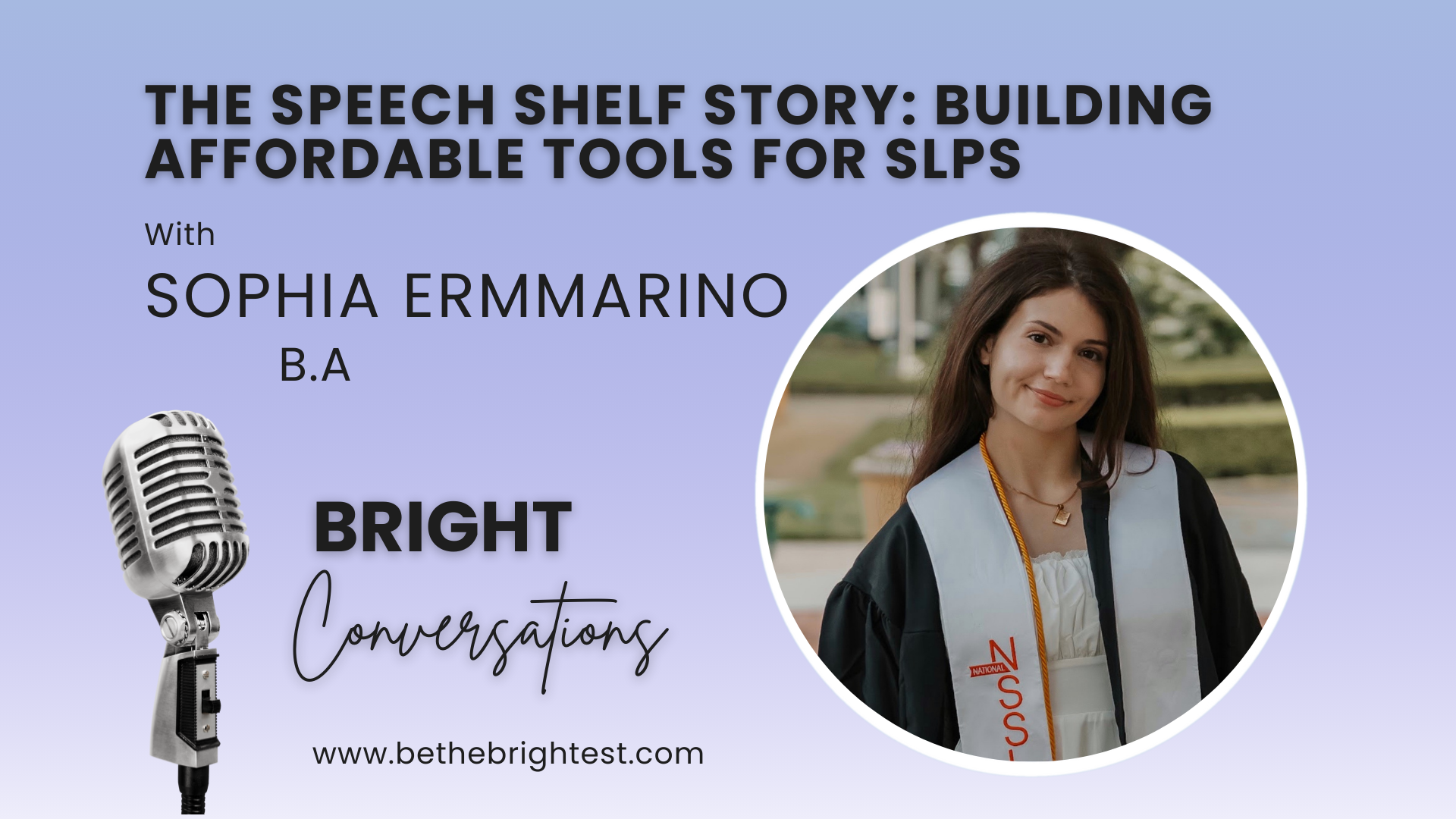
🎧 Bright Conversations – A Podcast by Bright Ideas Media
Join us for real, relevant conversations with industry leaders, past presenters, and change makers across the SLP and special education space.
📖 Read the Episode Transcript
Scroll down to read the full transcript from today’s episode.
▶️ Watch the Video
Click here to watch the full episode on our site
🎧 Listen on Your Favorite Platform
Listen on Spotify
Listen on Apple Podcasts
👉 www.bethebrightest.com/en/conversations/the-speech-shelf-story-building-affordable-tools-for-slps
Transcript of “The Speech Shelf Story: Building Affordable Tools for SLPs” – Bright Conversations Podcast
Hi, and welcome to another episode of Bright Conversations. I am your host, Shontaye Glover-Jones, and today we have our very first graduate student on the podcast. I'm excited to sit down and chat with Sophia Ermmarino. She is a graduate student currently studying in New York, I believe, rights in New York. Yes, and she's also the creator and founder of the speech shelf.
She has created a subscription platform that offers unlimited therapy materials for less than a cup of coffee, so you can't beat that. So, thank you for being here, Sophia. Welcome. Thank you for having me. I'm so excited to talk about this.
Yeah. So, tell us a little bit about what school are you in, what year are you in your program. Mm-hmm. Well, I am at Stony Brook, Southampton, that is, it's one of the sites for Stony Brook University, and I am in my second year, so I graduate in, I think, seven more months now that I'm counting down the days. I'm excited to be in the CF here, but I do love Stony Brook.
It is, I have learned so much in such a short amount of time, and I'm so grateful for the experience. Yes. Whoo-hoo. To graduation around the corner, congratulations. So excited.
Stony Brook is a beautiful campus. We've been for some football games, and it's just a lovely, especially this time of year, with the fall foliage, it's gorgeous. Yes. Yes. New York has, right now the leaves are changing, but New York has such a beautiful fall.
I love it. Mm-hmm. And are you a native New Yorker? Yes. So, I grew up on Long Island, and Stony Brook's graduate program is fairly new, so I'm so happy to be a part of it.
And yeah, I've grown up here at Commute. It's great. I love it. Great. So, let's get down to it.
You know, we are happy to have you here as a student, and we don't often get to hear student perspectives. But one of the things that we do want to be mindful of is that you guys are the future, you will be joining the community, and we want to hear how can we make this a better field from the beginning when you're studying. So tell me, what was the genesis? What was the problem you hoped to solve when you decided to create the speech show? Yeah.
So I started the speech shelf when I had noticed that graduate students were either sacrificing additional time on creating resources, creating the therapy materials, or they 're sacrificing money on spending the materials. And as graduate students, we don't have a lot of either. We don't have a lot of time, and we don't have a lot of money because we're trying to get to that point. So I really wanted to find a middle ground, and I thought it would be great for CFs too, just entering the field of speech language pathology, because we do leave grad school a little empty-handed with our own materials. And I noticed that some of them even were doing fundraising on teachers pay teachers to raise money for their funds.
So it really led to the question, "That's great. That teachers pay teachers has this fundraising for materials, but do we really need to fundraise in the first place? Or an option for them to have a place where they could just get their starter kit and feel confident when they enter into their first sessions as a CF?" So that's where the idea was born. So I started just bulk-making materials, thinking of ways that I can mitigate that cost in that time, and that's how I got started. That's fantastic.
I love someone that seeks solutions when they see a problem. And you're so right. You know, money and time is limited when you're in graduate school. And even at the beginning of your career, it's hard to get everything that you need at an affordable price, and you want it to be accessible, and you want it to be really relevant. And I think that it being created by a student who's in there in the moment and learning, it helps a lot to make sure that it's practical, and not all theoretical, sure.
So we heard a little bit about what you experienced. I'm curious, though, why did you think, like, "I don't want to just purchase materials from teachers' pay teachers or, you know, what's out there. What made you decide, like, "I want to try something different?" Right. So I love teachers' pay teachers. There's such amazing creators on there that make such detailed and inspiring materials.
I was thinking more of the person -- and I was -- I've seen it, for example, when people spend $3 to $5 on each material, and that can add up quick. And it changes by the semester what you need and when you need it. So I was thinking more of a home base, so you just know that you have things right there, and you could print it out. You don't have to look all over the internet, not really sure about what you're paying for. I just wanted it to be another option for SLPs, and kind of to have that weight lifted off their back, that there's at least a speech shelf.
I have that if there's not really that material out there, or I don't want to pay that price, or I don't have the time to make it. Yeah, that's smart. And I have to admit, you know, even as a non-CF, sometimes money is still tight when you're getting started. So is this open to SLPs who are now, like, working in the field as well, or do you try to just market and keep it as something for brand new students and clinical fellows? It's open to everybody.
So that's actually something I always talk about. Eighty-nine percent of Americans right now are worried about costs of living. Life is expensive right now, so I wanted a home base for everybody. So absolutely. Fantastic.
How do you keep it affordable without sacrificing the quality of the worksheets and activities that you post? Right. So because my platform is fully digital, I'm not printing the materials, I'm not packaging them, I'm not selling them, that allows me to keep the price lower. And it allows me, I have fun doing it, and I'm a creative person. So it's not really something that costs me a lot of money in the first place.
So that's why I'm able to keep the prices really low. Awesome. Fantastic. That's great. You're very transparent, which I've noticed in our couple of conversations, you don't mind talking about how you got started, why you got started, why this means so much to you.
I know one of the things you also want to talk about is that there isn't enough financial transparency when it comes to the field of speech language disorders and communication disorders. Let's get into that a little bit. What would you like to normalize about that conversation? Right. I think that when we talk about just how much things cost in the first place, it takes away a lot of stress on people.
I noticed when I was applying for grad schools, there were some graduate schools where it was hard for me to find even the price tag on them and how much it costs. It took a lot of phone calls for me and a lot of different websites trying to calculate the cost myself and that stress alone was a lot for me. So I think when we just start naming prices, that is enough to open the conversation. Is there change and also expose if things if prices are too high? So something I like to talk about is textbooks.
Textbooks have an 800% inflation rate since the 1970s more than the inflation rate of housing. So I always like to think about how can we mitigate that cost for grad students who haven't even gotten their first paycheck yet and need to pay for this textbook. So I think when we just talk about the prices, it opens a lot of conversation for change. Yeah. Absolutely.
One of the conversations that I know folks have had for a long time is just tuition in general and the structure of graduate programs for our field. A lot of folks aren't in a position where they can go to school full time and not work. So they do need to work while they're in school or having the option of a part- time program where you can continue to earn money while you're in school. So having these conversations and reflecting the needs and the perspectives of the people who are entering these programs are super important and necessary for pushing the field forward. What do you wish more programs or supervisors discussed with students when it comes to the financial realities of the field?
I think something that I have noticed affects graduate students is those little costs along the way that come out of nowhere, paying for a subscription for something, for testing or paying for a workshop that we didn't expect to be $90 and we didn't know we maybe take making. So that's something that just comes up along the way along with the tuition, which is I know that's the biggest stressor, but those little tiny things that I think we can start making changes now can be maybe more advancement towards that. When we let students know, hey, these are the prices that are coming up. Students can put up a sign money for that. They can't anticipate the cost and that makes a big change too because when costs come out of nowhere, there's that unpredictability and there's that stress for students.
I am not aware of professors or programs requiring you to sign up for additional courses. That's just not something that was required when I went to graduate school. So it took a little bit about that. What exactly are you expected to do? So in New York State, at least we have a lot of additional things we have to take.
So I have to take a lot of workshops for my teaching license to teach at New York State. Sometimes those workshops are free, sometimes they aren't. And sometimes when you subscribe to things such as subscriptions for simulations or subscriptions for studying for the praxis or paying for New York State certifications or getting fingerprinted in New York, it's a hundred dollars to get fingerprinted and you have to work in a school. Those little things along the way add up and I think those are the prices that potentially can limit students even further with tuition. For sure, I know that makes a lot of sense.
Salary transparency is something that people talk a lot about too. Often times it's just uncomfortable conversation. People don't want to get into the conversation of how much they make or how much you could potentially make in a particular setting. But it really does guide your decision making about where you want to be. Most of us, I dare to say all of us come into this field because we want to help people.
But like you mentioned, it's expensive to live these like every time you go outside, you're guaranteed to spend a couple hundred dollars just on the basics, the minimum. So you want to be able to be well compensated for the work that we're doing. And yes, you know, that doesn't make us greedy, but we have to survive also while we're helping others. So what is it that from your perspective, what is it that you have experience and what would you like to see when it comes to transparency in salaries? Within salaries, I think if we change our mentality first, that's a great start .
Because if we don't go in confident talking about salary, that is what potentially limits us. We are such a compassionate field. We want to help people. And with that, somehow it's gotten twisted that when you're not compassionate, I mean, when you think about money, it takes away the compassion and you're still a compassionate profession and you're still a compassionate person, even when you want to be fairly compensated. So I think starting to prepare graduate students early in the field, and my school has done an amazing job doing this with telling us about it.
This is what's expected to make in this state, in this field, and at this time. And this is how you can advocate for yourself. This is the tax forms you should be filling out. My school did a great job with explaining taxes to us and which tax, tax forms we should ask for, which is something that could be so easily missed during your CF year. So that's something we should just have the conversation.
The conversation is just the perfect start and it really prepares the students. I remember, you just made me remember the first job that I had when I was filling out my tax forms, I checked off that I was tax exempt. And I don't know why I did that. And no one caught it. Like no one in HR caught it.
And so it was probably luckily I had only worked a few months of that year. So it wasn't like a full year where I didn't pay taxes. But that was a lot of money to have to pay back later on when you had to file my taxes. So that's great if schools are incorporating that. If someone's listening though, and their program hasn't provided that kind of information.
Do you have any tips for them? Like what questions they could ask, who they could go to at the university to try to find out a little bit more for how do you prepare for you when you do get your first job? Yeah, I would say I always know that graduate schools have so much to talk about in such a short amount of time to a little over two years for a full-time student sounds like a lot. But within the field of speech language pathology, it's nothing with everything that you could talk about. So when we go to the professors, I would advise just opening the line of communication.
Hey, a lot of us have questions on this. Can we designate just a little bit of time to talk about our expectations? What we should expect when we go into the field, chances are they would love to hear the student's input and would love to help you. And that makes a great relationship for graduate schools and students. That shows support and the graduate students will feel supported when those conversations are had.
Good. Thank you for that tip. That's a great tip to share. You often mention with your resources that accessibility isn't just about affordability. What do you mean by that?
Yes. So when I was looking into creating the speech shelf, I noticed that accessibility goes beyond that in the sense that time is accessibility and quality is accessibility. If you are a SLP, a CF, or a student and you feel you can only afford materials that are not the type you would like or with the quality you would like, that is a form of you not having the accessibility because you can't pay for the material that you would like. So I feel that when you have all those elements in one, that really helps everybody have a seat at the table. And everybody can give their client the therapy they want to give them because that is true accessibility to me.
You walking into the room feeling confident with the materials that you have. And that you didn't have to sacrifice your time or your money on that. But while you've kind of answered my next question with what role does a speech shelf play in building the culture of accessibility, but also thinking about promoting a culture of sharing instead of competition. Right. Do you still feel, I remember feeling, I went to graduate school in the 2000s.
And I felt like it was incredibly competitive all the time across the board, not just getting in like in individual courses, in thinking about grades, thinking about opportunities. Everything was always a competition. Do you still feel that that culture of competition throughout your program? And I don't mean that in a disparaging way, it just was the nature of the program. We were all like pushing and competing and not always given the space to be more collaborative.
Right. I think we're actually coming a long way from that. I just collaborated with speaking of semantics on a post about, hey, we're all in this together. We know it's expensive and we're all doing amazing. And I think with the rise of social media, we have built more of a community.
And I see it in at least my cohort. Of course, no matter what there's, we want to be our best, we're going to be competitive. But I've noticed that we are very supportive of one another and we all want to see each other succeed. And thinking the rise in technology and having the social medias and being able to connect to one another and understanding we're all struggling in different ways. But we're all in this together has really, really helped.
And I think that culture is starting to shift. I am seeing it. Good. Good. And I imagine the speech shelf too is helping to shift that culture as well.
Then people have another resource where they can receive information and they know what's coming from one of their peers in the resource. And do you create all of the resources that are on the speech shelf? Yes. So I use a mixture of my own art and I use AI generated materials that I use prompts for. But I don't use any AI to actually use the physical evidence.
That is all evidence based from ASHA or any other credible well researched website. So for the images, I use that and then I use Canva. I'll use Procreate, which is another drawing website. And I use my Google slides and I combine it all and make it one. How?
How do you find the time to balance all of that? Yeah. I've always been a busy person just naturally. I enjoy doing it. I was an art minor in my undergrad.
I enjoy creating things and I make the times for the things I enjoy. But I do try to make sure I have time spent, you know, just relaxing in grad school that is hard to find, but I do live by that motivation is never always going to be there. Discipline will always be there though. So I try to keep a very disciplined mindset and the things I have to do for the week. And I space it out.
So it is manageable. Okay. Good. That's awesome. Really good advice.
I tell the students that I mentor to try to carve out time doing something for yourself, whatever that might be. And sometimes it is work, but if it brings you passion and joy, it doesn't feel like work. It doesn't self care or, you know, relaxing. But yeah, your life can't just be school all the time. Try to find a little bit of time to just relax and decompress and then come back when your cup is full again.
Right. Do you plan to continue the business after graduation? Yes. Yes. I want to grow it.
I have plans for it. I would like to do some things in person. So I would love down the line, a long term goal of mine to have a speech pathology material swap. So you may have heard of like clothing swaps where people bring their own clothes and they swap clothes. I would love to do an in person of speech pathologist bringing materials.
They don't use anymore and maybe passing it on to CF centering their year or fellow speech pathologist just trading materials to keep that cost down, but be exciting and have new things. So there's things definitely I'm brainstorming and I want to keep it alive and I want to grow it. That's awesome. Do you have any advice for anyone else who might want to create something meaningful while they're still in school or a business idea, even though they're still in school? Yeah.
So one of the things Stony Brook actually taught me was your career starts the second you step in the door for grad school. Your career has started. You can grow. You could be who you want to be. So I say go for it.
Even if you're a graduate student, you still have so much knowledge. You still have so much to offer to the field and take it. And if you're uncomfortable, that's where the growth happens. I was uncomfortable launching the website. And I'm so happy I did and I'm having fun while doing it.
I would definitely advise anybody to start anything they're passionate about. Yeah. What is the subscription cost or a monthly annual fee for subscribing to the speech show? It's $5 a month, it's less than a latte at Starbucks, at least for me. I get it fancy with whipped cream and stuff, so it's like $7.
But yep, $5. Yeah, like any coffee shop these days, it's hardly a coffee for under $5. And is it a contract or agreement where you're locked in, or can you just pay? No, you could cancel anytime. That's awesome.
That's really fantastic. I hope you're sure to include the information for the speech shelf so that you can visit the site and check out the subscription plan in our show notes. We'll also include ways that people can connect with you, Sophia, after the episode. We, at Bright Ideas, one of our premiere events that we host every, well, twice every year is the SLP Summit. And this year in particular, I'm excited about having a panel that includes clinical fellows and more seasoned SLPs who've served as supervisors and just sharing the experience and the perspectives from both ends of the spectrum.
And hearing from one another, what you wish the other side knew, what you would like to know, what you would want them to do differently maybe even. So I'm looking forward to that. And you know, the SLP Summit is something, it says SLP, but it is open to students, it's open to CEF, it's open to anyone, we have parents, we have non SLPs who attend to because it's really impactful for a lot of people who we find it applicable. But my question for you is how would you like to see the relationships between students and clinical fellows improve or ways it can be enhanced with their supervisors, either supervisors in a clinical setting or supervisors in school setting, work settings, how would you like to see things shift a little bit in that regard? I think it comes from a mutual understanding of we're both going, we both have the same goal and that's growth in education and it's giving our clients the best care possible.
And I think when we start with that, we could create really healthy relationships. I think one of my advice for fellow students is just be a sponge for learning and be excited to get things wrong. It's one of the main places in grad school where you could get something wrong and just learn from it and move on, you don't have your license, you just grow, you get to experience things and it's exciting when you don't look towards, oh no, I made a mistake, it's so much more exciting to be a student. And for CFs, I would maybe, I would say just the understanding that this is a really busy time for students and they were once there and sometimes I think it may get lost in translation of the stress that the students have. And sometimes we are working a lot or there's things going on in our personal lives that impact the way that we come to our class or come to clinicals and I think when we have that understanding and put it on the table, that can really create ways for us to troubleshoot problems and just have a great relationship between CF and supervisor or supervisor and intern.
To your point too, I'll say on the supervisor side or mentor or whatever it might be, that's important to create that space where you can feel safe to mess up. So yeah, the expectation isn't that you come in knowing everything and that you feel safe to just make attempts and to try and to share your perspective, even if it's not exactly what you're looking for. We have to keep in mind that this is a learning space and that errors will occur. And I agree with you a hundred percent, like keeping the humanity and the empathy at front of mine on both ends is so important because we, whether you're a student or you're currently working, we all do come, we all show up with a host of things going on, you know, being a student or SLP supervisor, that's just one aspect of your identity. But we bring with us sometimes, you know, personal things as you mentioned.
So just keeping that in mind and showing each other empathy does go a long way for maintaining that connection and building a stronger relationship. I had an amazing relationship with my CF supervisors to the point where we're still in touch and friends and they still continue to mentor me to this day. And I think it's wonderful when you can walk away from either a clinical placement, your fellowship, your externship or even school and hang on to those relationships because it really is a testament to how well you connected and understood and respected each other. And I think having a mentor or at least someone that's higher, that's more experiencing you is so helpful as a student. So I do recommend seeking that out and I recommend for people in my position to being open to accepting mentees because it does help.
It's a hard program. It's a hard time to go through that graduate program. So in wrapping things up, we talked about your site, we talked about some of the things that you hope to do moving forward with the speech shelf. How can people continue to follow you and how can people support you in your mission? Right.
So I have an Instagram and it's just the speech shelf where I post about financial transparency, ways to lower costs while you go through grad school and my materials. So that's one way to support just giving a follow. And my website is the speech shelf.com where everybody can go look at the materials and then sign up if they would like. Those are my two ways and if you ever want to contact or email me, it's the speech shelf at gmail.com with any ideas. I always love getting suggestions for materials to make too because that helps me know what people want or people feel that the space is missing.
So I love getting suggestions for things to make. I forgot to ask earlier, is there a focus for the materials? Do you focus on pediatrics, do you focus more on school based issues, medical? So I try my best to do a little bit of everything. I have a couple materials for adults that would be great to get advice from people.
More things I can make for adults would be great. I also create some things just for students in general. I make data sheets that they can use or I have just a printable decoration they could put up in their office if they would like that. And notes to parents like formats to say what we didn't speak for, they could just check it off and hand to the parent. So there's a little bit of everything.
I'm having fun just like experimenting and have people taking what they would like from it. Awesome. That's fantastic. I wish you the best of luck with the rest of your studies and with your business with the speech shelf. If you enjoyed this conversation and learning a little bit more about Sophia, please do check out her website, follow her on social media, and we'll be sure to make sure you have access to all of those links.
If you enjoyed this conversation, we have plenty more that you can listen to on the website or you can catch it on Apple or Spotify wherever you listen to your podcast. Thank you so much for joining us today, Sophia. It's been a pleasure chatting with you. Thank you so much. I had so much fun.
Have a good one.
About Bright Ideas
At Bright Ideas Media, we empower educators, speech-language pathologists, and special education professionals with actionable knowledge and engaging learning experiences. We make professional development easy, insightful, and impactful—so you can apply what you learn right away!
💡 Want to keep learning? Explore 150+ hours of live and on-demand courses designed for professionals like you. See all available courses → Click Here
Recommended Courses for You
Here are some courses you might love based on what you’re reading:
📌 Foundations of a Strengths-Based, Child-Led Approach to Speech Therapy
📌 Making Sense of MTSS – A System of Supports for ALL Students
Join Our Email List
Sign up to be the first to know about new events, course launches, exclusive discounts, and practical insights to support your professional growth.
Thank you for subscribing!
Have a great day!