What Is Masking?
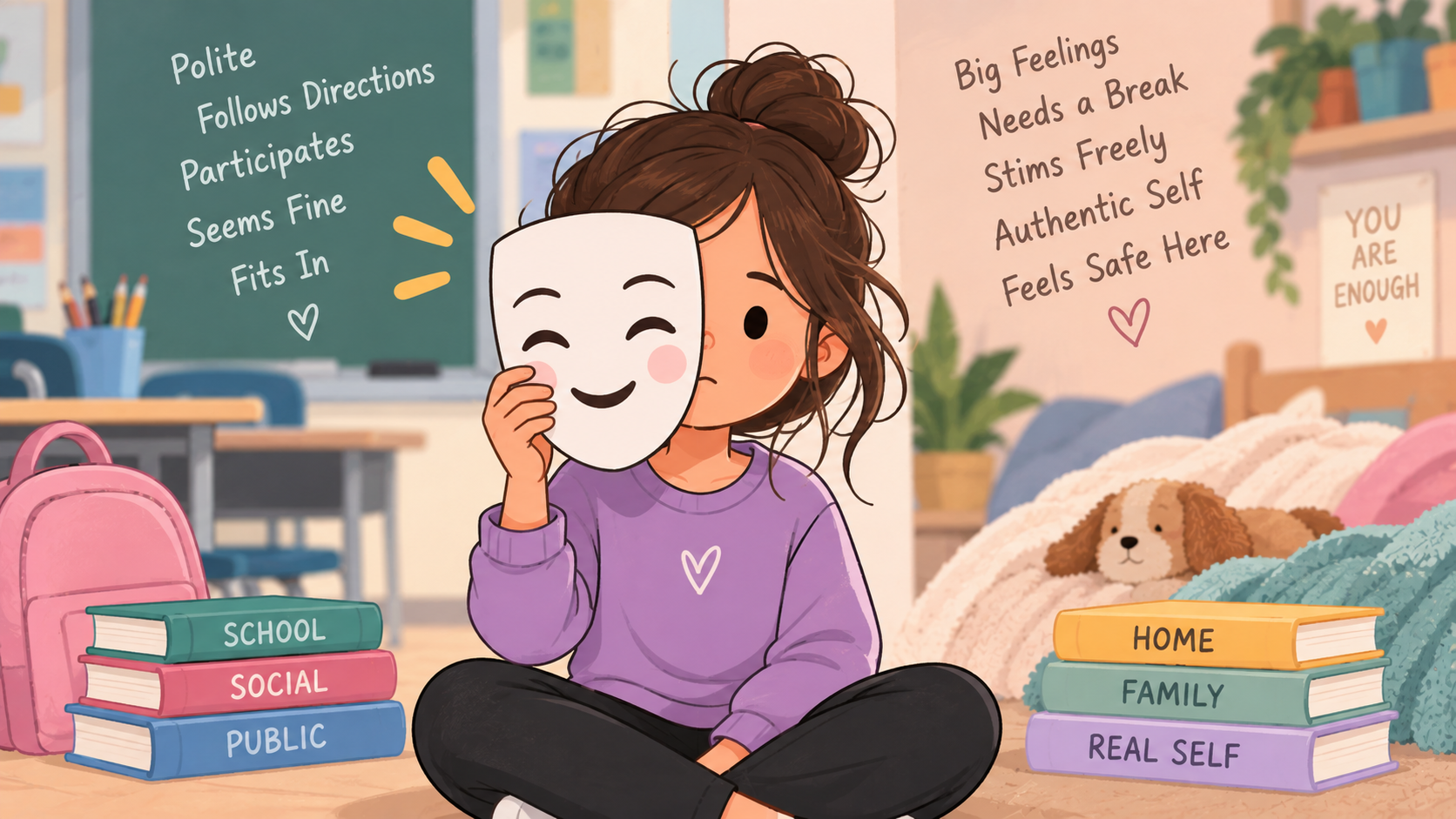
If you have a neurodivergent child, whether they are autistic, have ADHD, or carry another neurodivergent profile, there is a word that may explain a great deal of what you are experiencing as a family. That word is masking.
Masking is not something parents often hear about right away. It does not always show up in initial diagnoses; yet, it quietly shapes almost every part of your child’s daily life.
The Definition
Masking is when neurodivergent people adapt to the environment around them to be more socially accepted by neurotypical peers and to conform to adults’ expectations.
In plain language, your child learns what “normal” looks like in a given setting, and then works very hard to appear that way even when it costs them enormously.
This is not deception. This is survival. From a very young age, neurodivergent children learn that certain things about them draw negative attention, correction, confusion, or rejection. So they adapt. Although the focus is on children, masking is not limited to kids.
Here is an example. When someone asks, “How are you doing?”, some autistic people may process this literally as a genuine question that deserves a genuine answer. But, they quickly learn that this is just a greeting, and generally society does not want to hear how you are actually doing.
They learn to say “I’m fine” even when they are not, because that is what the social script requires. This is masking at its most surface level. And it extends far, far deeper.
Who Masks and Why Some Groups Mask More
While masking affects all neurodivergent people, Dr. Huff is clear that not everyone carries the same pressure to mask, and not everyone masks for the same reasons.
Women and Girls
Historically, research on autism and ADHD was based primarily on white boys and men. This means that the more social, adaptive presentations common in girls are often missed entirely. Women and girls tend to pick up on social cues more quickly and are more socially conditioned to conform. As Dr. Huff explains, there are certain things considered “odd” or “not feminine enough”, so girls learn to mask those traits very efficiently, often leading to later diagnoses and years of misidentification.
Black People and people of color
For Black and brown people, masking is often a safety mechanism. Dr. Huff speaks to this from her own lived experience as a Black autistic woman raising Black autistic and ADHD children:
A white peer’s behavior is labeled assertive. A Black peer’s exact same behavior is labeled aggressive. This is particularly true for Black women, so masking becomes a protective net to survive environments that were never built with them in mind.
Trans and Gender-Diverse Neurodivergent Individuals
Research has increasingly found that a significant number of neurodivergent individuals do not identify with a specific gender or sexuality. For these children and teens, masking both their neurodivergence and their gender identity can be an exhausting double performance driven by the need for safety and self-preservation.
What Masking Looks Like: Three Core Types
Research using the Camouflaging Autism Questionnaire (CAT-Q) by Hull, Baron-Cohen, Allison, and others, identified three key features of masking:
1. Compensation
This involves mimicking and copying neurotypical social norms. Your child may:
- Watch YouTube videos or TV shows to learn how to respond in social situations
- Memorize phrases and scripts from peers, songs, or movies
- Study popular culture so they can contribute to conversations they have no interest in
- Mentally rehearse entire social scenarios before they happen, “If they say this, I’ll say this”
2. Masking
This is the active suppression of traits in order to appear less neurodivergent:
- Suppressing stimming (rocking, hand-flapping, vocal sounds) in public even when it is needed for regulation
- Forcing eye contact even when it is painful or distracting
- Pretending to understand instructions when they did not process them fully
- Laughing at jokes they do not understand or agreeing when they disagree
3. Assimilation
Strategies used to fit into uncomfortable situations:
- Going places or doing activities that are sensory-overwhelming or socially exhausting, just to fit in
- Refusing accommodations (like leaving class for speech therapy or resource room) to avoid looking different
- Not using their AAC device in public, even when that is their most effective way to communicate
- Controlling situations subtly to reduce unpredictability
Why Children Mask: The “Why” Matters
Understanding why masking happens changes how we respond to it. Neurodivergent children mask to:
- Avoid punishment or correction for behaviors that are natural to them
- Gain social acceptance and avoid bullying
- Fit into environments where differences are pathologized or seen as problems
- Protect themselves in contexts where being “other” carries real consequences
Importantly, adults sometimes unknowingly encourage masking. When we tell a child to stop stimming, or say, “Your friends don’t like it when you make those sounds,” we are communicating to hide that part of themselves to be accepted. It is often not intentional, but the impact is the same.
What This Means for You
If you are reading this and thinking, “This explains so much,” you are not alone. Many parents describe the moment they learned about masking as one of the most clarifying moments of their parenting journey.
The exhaustion you see at home is real. The disconnect between what school reports and what you live is real. Your child is not two different people; they are one child who has learned to survive in two very different environments.
This article is based on content from Dr. Destiny Huff’s course, “The Cost of Masking: Supporting Neurodivergent Learners’ Needs”. Dr. Huff is a licensed professional counselor, certified trauma therapist, and non-attorney special education advocate.