Who We Are and Our Stories: Exploring Identity, Culture, and Narratives
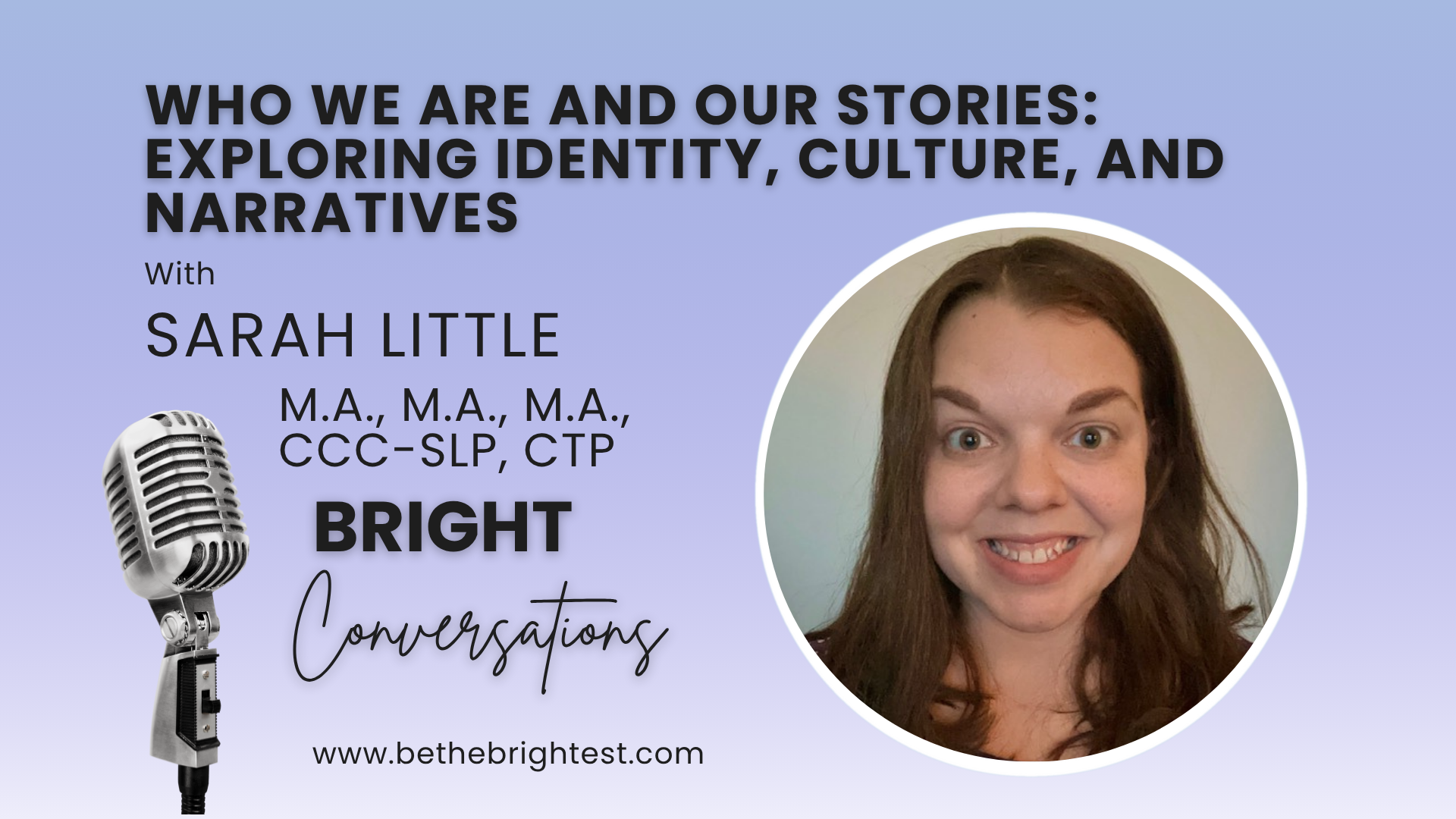
🎧 Bright Conversations – A Podcast by Bright Ideas Media
Join us for real, relevant conversations with industry leaders, past presenters, and change makers across the SLP and special education space.
📖 Read the Episode Transcript
Scroll down to read the full transcript from today’s episode.
▶️ Watch the Video
Click here to watch the full episode on our site
🎧 Listen on Your Favorite Platform
Listen on Spotify
Listen on Apple Podcasts
⭐ Want ASHA CEUs for this episode?
After watching or listening, head to our website to purchase the CEU add-on and earn professional development credit on your schedule:
Transcript of “Who We Are and Our Stories: Exploring Identity, Culture, and Narratives” – Bright Conversations Podcast
Hi and welcome to another episode of Bright Conversations. I am your host for today, Shontaye Glover-Jones. And today I'm super excited to sit down and chat about a topic that is near and dear to my heart. I'm being joined today by Sarah Little and Sarah, welcome to Bright Conversations. I'm looking forward to our talk today.
- Thank you so much for having me Shontaye. I'm really excited to be here. - Of course, of course. Why don't you tell the audience a little bit about yourself? - Oh, well, I currently live in the Chicago area.
I work as a bilingual speech therapist for the Public School District. Been here for about five years, originally from Ohio. I also do bilingual speech and language evaluations around the greater Chicago land area. And my background was actually originally in Spanish and linguistics. I had been, you know, PhD track and then found speech therapy and absolutely loved kind of that combination of language, knowing language development, but also that hands-on piece and also the advocacy component to it.
So I kind of fell in love and became a huge dropout, as some people say. - So you're currently working in schools as a speech therapist. And one of your passions is talking a lot about and advocating for cultural awareness within our speech community and beyond. How did you happen to feel so passionate about this particular topic? - I think there could be different ways that I could answer that question.
An obvious way is that I came from language departments and a PhD program in Spanish, you know, and I worked with so many other people from all over the Spanish-speaking world. As an undergrad, I studied Spanish and French, had some time abroad, lived in Guatemala for a year after my undergrad. But I would say that when I'm actually reflecting on it, the question of identity and that kind of sense of belonging was something that I had really been searching for since I was a little kid. So I think that's actually why it was drawn to languages in the first place and really understanding other cultures. Really is a way to better understand myself.
- Can you expound a little bit on that? When you say that you were drawn to searching for that sense of belonging since you were little, I'm just curious since you brought it up. If you don't worry. - No, no, not at all. I will say for me anyways, everyone's story is completely different.
For me, I think that the question of identity and that sense of belonging is also very much tied into my own mental health journey and a healing journey. I think, you know, if we talk about different types of identity, different ways that people can identify, you know, that's a very nuanced question. For all intents and purposes, I am quite privileged in a lot of ways that I do show up in the world, right? I am white from a middle class background. My parents are educated, they're citizens.
So I think on paper, a lot of people wouldn't necessarily anticipate that I would be questioning my sense of belonging. I think that for me, my personal experience and particular childhood trauma really kind of disrupted that sense of belonging. I think because of that, I just always had this curiosity about the world and other cultures. And really, it was looking for where do I fit, you know, because I didn't really know who I was. And, you know, when you look at child development and different developmental stages, a lot of times, you're searching for that belonging externally.
But really, it's learning to know who you are so that you can belong to yourself internally. - I, that a lot of what you said resonates. But I also do think that oftentimes, there are those subtle messages that we receive from the world that make us question our belonging. When you see these visuals, when you hear certain messages, they make you think I must not be valuable to this community, to this society, because I hear what you say about people who are similar to me. And so you start to wonder where do I fit in?
Do I fit in? But then, as you mentioned, I think ultimately, it does come back from more of an internal work that you have to do to recognize your birth and where you fit in. - I'm gonna segue because I feel like this is a segue to talking about the wheel of power. And when we talk about power and privilege and also identity, for someone, anyone who's not as familiar with looking at identity and all the different aspects of your identity, you mentioned several things, you mentioned your race, you mentioned your gender, you mentioned your family dynamics and how you grew up. And I often talk a lot about this talk that I went to several years ago in Chicago, actually.
- Yay. (laughing) - The presenter was talking about identity and she had asked everyone to break out into groups. And what she wanted us to do was to talk about what factors of our identity were most important to us, like list of the top three. And I've started actually adopting this activity when I do talk too, because it's always very curious to me to see what people feel are the most, and I don't wanna say the most important, but like the most apparent aspect of identity. And I remember being in the group and I was the only black person in the group and I said, you know, that was the first thing to me that was the first piece of my identity that I know people will see and acknowledge before I even open my mouth, before you know anything about me.
I know that the world first sees me as black and a woman. And so anything that you associate with those two factors is going to come into play when you think about how to interact with me. So I'm gonna ask you that question. When you think about your identity and you mentioned, you know, your privilege and your background and everything, what do you think are the top three aspects of your identity that are most impactful, most apparent? - That's a good question.
Sorry to put you on the spot. - No, no. Well, and as you were talking, I found it really interesting because I kept thinking, I wonder if your answer would have changed if you were not, if you were with many other black women, for example. But you're right, like there are, for the most part, like those salient aspects of our identity, right? And I think, at least for me, I can't speak for anyone else.
I wouldn't be surprised if sometimes it flexes. - Yeah. - Maybe it depends on a mood, but I think, frankly, definitely my, you know, perceived race, my race, right? You know, white person, because I know that there's so much privilege in that. And I think I've really tried to do self-work, and I know that's a lifelong process of recognizing, hey, my lived experience, how I show up in the world every day, how the world responds to me in turn, so much of it really is rooted in, you know, this very basic privilege that I do show up with.
Definitely my identified gender as a woman, you know, I also because of a lot of experiences, positive and negative that I've had as a woman. And the one that's coming out to me at the moment, I would say is probably education level, is one of them. I think because of the way Granite currently, I'm being interviewed on a podcast so that, you know, biases me towards that answer. But I think it also depends on who I'm engaging with, even what frame of mind that I'm in that day. Not to say that identity always flexes, but it's just, it's wonderfully nuanced, right?
It's not just how we self-identify, but as you mentioned, like your cognizance of, all right, how are people reacting to me? - Yeah, it's about how you show up in the world, but also how the world responds to you, and I think that's the, when we talk about intersectionality, it's important to recognize all of those aspects of our colleagues and our clients' identity because there's so much more to it beyond just that, what you may think is the most important factor. In that room that day, I remember people saying for them, what was most important was their marital status, whether or not they were a parent, their religion. And those things for me, obviously it was a room full of women because speech pathology is majority women. But those things had not come into my mind, even though they are part of my identity, they were way lower on my list.
I probably would have also said education because I recognize that's a key part of my identity and also my privilege too. So it's always interesting when I talk to people and I ask them those questions because I'm always curious about, what aspects of your identity are you most comfortable sharing, most do you feel like people respond to the most in the world? So, yeah, I do want to talk a little bit though, when you were doing your work and you're talking about identity and what we believe about ourselves, how do you think that our own personal narratives help to solidify your identity? - I think personal narratives can be incredibly powerful. Whether they are fully grounded in fact, but so much of our narratives, the stories that we tell ourselves right, is how we experience something and that can completely vary based on, based on how we identify or our previous lived experiences.
Yeah, does that answer that question? - Yeah, no, that totally answers that question. Do you feel like when it comes to our personal narratives, our lived experiences, how do you feel that that impacts the way that you work, especially working in a school setting where I imagine you probably see a diverse group of students, how do you feel that that has impacted, and maybe it shifted over time in the way that you practice? - Yeah, for sure. I would say that for me, I think, because of my experience, frankly in therapy, I have been to therapy for many years for personal reasons.
Each their own, I will not push that on anyone, you know, but that is part of my experience. And I think working through things that have happened to me from the time I was a little kid, I think that it's made me a lot more cognizant of the perspective of the students and how I engage with them, not just from my perspective, as a professional, not just from my perspective of how I wanna show up for them, but also how might they be perceiving me right now? How might this be helpful for them or supportive for them? How can I help them be seen? Or am I not helping them be seen right now?
Right, I think there's a cognizance that I have based on some of the experiences that I have, and I'm sure that all of us carry this, right? Even regardless of the privileges that we have, everyone has those challenging moments and knowing, you know, if I were to be in that situation again, if I were the adult there, or if I was the other person, how can I show up differently than what I had to experience, right, or how can I make this person feel seen? How can I create connection instead of rupturing it, right? And how much more powerful can that be? Because we're gonna make mistakes.
Especially when we're talking about these conversations is a bit of a segue, but especially in talking about these topics of identity and culture and trying to do our best to help our kids really figure out who they are and be proud of who they are. We can't know exactly what their living experiences are, nor for anyone, but, you know, kind of recognizing, okay, we're gonna make mistakes. And when we make mistakes, we can hold ourselves accountable and we can repair. And that repairing, that saying, "Hey, I'm really sorry." Or that might not have been exactly how I wanted it to come out, but even just kind of admitting our humanity and being authentic with them, I feel like that also offers that opportunity for even deeper connection with them, even just as people, 'cause they're people. - Lily, I agree with you.
And I commend you for allowing yourself to use your lived experiences, both negative and positive, to impact how you work with children now, so that you can make sure that children are having a better experience. I don't work currently in schools, but when I did, I used to always feel like, I don't know that I'm doing what I'm supposed to be doing, because I would spend a lot of time making sure that the kids knew, like, "I see you." And you know what? Let's talk about this right now. And we'll get back to pronouns, or we'll get back to earnings and whatever you're working on, but I would spend a lot of time just being really empathetic with my students and connecting with them, but in the end, it makes such a big difference, because-- - I was gonna ask. - That's when you see progress everywhere.
Like, you become their safe person, their safe space. They know that you're invested in them, so they become invested in themselves, and then they want to grow, and they wanna improve, and they're willing to work on anything you put in front of them. And so, I'm guessing that's also a lot of the reason why you work with other SLPs, trying to get them to become more aware and more culturally responsive in their practice and integrating more cultural sensitivity and awareness in our work, you know? - Yeah. - No one could be an expert in a group that we don't belong to, but we can still recognize and respect those differences and allow space for them in our therapy rooms.
- Absolutely, absolutely. And honestly, it's a great learning for me, because as you said, like, none of us knows everything, but I think that's the really powerful thing, right? When we recognize we all have stories that we can bring to it, and we all have experiences, and we can learn from one another, too. - Yeah. What do you think has been one of the more important factors for you or ways that you've been able to incorporate culture into your therapy sessions?
- Mm. That's a good question. Let's see if this answers your question. I think for me, it's been really fun to try and find topics that everyone can relate to. So, I'm gonna give a very simple example.
I'm a foodie. (laughs) I love traveling, and one of the top things that I love to do is trying different foods. So, one thing that I absolutely love doing is finding lessons that focus on food, food that's familiar to the students, and then also tying it into other cultures in a way that, hey, so did you actually know that radishes originally came from China and kind of tying in these familiar lived experiences, especially when you're talking about something that is so familiar to them. If you're in my community, if you're talking about tamales, you might have so many, so many memories around holidays, around birthdays, around weddings, making tamales with your grandma, or, oh, that one time that I got sick eating this whole plate of tamales, you know, all these things, and then finding out whether it be through food or through holidays, like, actually, did you know that people, all the way across the world that you never even heard of, do something kind of similar. And, or showing them pictures of food or videos of food or something, oh, wow, they just, there's something about having it be just familiar enough, you know, where that curiosity is peaked, and then, oh, either it, whether it'll have some kind of reaction, whether it's good, bad, something in between, it has some kind of interaction, and then it sparks this curiosity in them, not just to reflect on their own experiences, and, oh yeah, not only do I love tamales, I also love poosa, so I love this, and I love that.
But then also, why did they do that? Why did they eat that? Where does that come from, you know? And how cool is that? To be able to take what we do, you know, targeting very practical skills, communication skills, but ultimately, kind of communication is being able to connect, and kind of doing that on like a much broader level, too.
- I love the simplicity of that example, though, too, and anyone who's listening and not knowing where to begin, it really can be something as simple as using food, because food does connect all of us, whether you're a foodie or not. I am also a foodie, and I do like to travel, and I do like to try new foods if it doesn't look to, that's my funny stuff. But, yeah, I think like kids in general love learning about food and how food is a part of so much, you know, family, culture, holidays, food, it does bring back a lot of core memories. So I think that's a great example of a way that you could use food and begin to talk about differences and similarities among cultures across the globe. So yeah, thank you for sharing that one.
- Yeah, absolutely. Yeah, absolutely. - It doesn't always have to be so drastic, you know? Like, I think people often think that it's a bigger task than what it actually is, and sometimes it can be that people are just talking about, you know, holidays, you know, in this country, we celebrate it this way, but here in America, we celebrate it this way. It could be really that simple, but you're still having the opportunity to make those connections and talk about differences and similarities in cultures across the world.
- Oh yeah, or even where holidays come from. - Yeah. - Genuinely, and maybe this is, maybe this is a self-serving way to look at it, but for me, if I feel that if I'm really invested in it, if I'm curious about it, kids know that. - Yeah. - They feed off of that.
So if I wanna take a little bit of extra time to kind of front-load the work, you know, to read up on a little bit more, look for YouTube videos that might be good to kind of go along with a reading or a book, then, you know, it doesn't feel nearly as much of a chore to me, and when I'm talking about it with them, they sense it, you know, they sense the energy that you bring. - For sure, a thousand percent. I always say, if you're feeling a little bit bored with the activity, a mess. - Oh yeah. - Yep, and it happens.
- Well, let's talk a little bit about literacy. I know that that's also one of your areas of passion. What has been your method for bringing, or targeting literacy skills and bringing culture and awareness into the therapy room through literacy? - Honestly, usually I will kind of design my interventions based on themes. I try very much like literacy-based interventions.
So I try to target a theme for four to five weeks, and a lot of times I will design it around one, typically an article. And that's also based on the age group that I work with, you know, the primary grades that I work with are grades four through six. So a lot of times I'll typically pick an article, or it can be a book or a short book, short story, 'cause there are some fabulous children's books, and I know I don't need to tell you that because I know you know, and I know that that must be a passion of yours. But I think usually I'll find one that I'm like, this has got a lot of good stuff from there kind of build out. So, for example, there are some read works as great articles.
One that I did a few years ago was about Thanksgiving, and it was actually, I believe the article name was how Thanksgiving is also a day of mourning. And a lot of times, you know, it talks about Native American history and how layered it is, right? Like on the one hand, there's the beauty of the story of Thanksgiving, and kind of this coming together, this community, and what happened after that, right? Like what is the history of Native people in this country? But even just one article, you can target vocabulary, you can target, you know, if you're really talking about these semantic mapping skills, if you want them to be able to recall their own experiences, you can easily spend two weeks, three weeks, just on pre-reading, where, hey, we're gonna target one paragraph today out of a two page article.
So, typically, I will try to find whatever article or book that I wanna focus in on, and then build it around that. - Do you have other resources, Bisa? I know you mentioned ReadWorks. Do you have other resources that you can share where you pull articles from, or even listening to stories? - I definitely have, I can definitely share some links with you as far as really great stories.
I love Coloreen, Colorado, if I'm remembering correctly, it's a website that has a lot of, like, lists of children's books, and also based on topics, which is fabulous, news, ELA, I used to love, however I don't think that I have a subscription, but they were great. Amen Litt was another one, and there are honestly so many great people to follow on social media as well, on Instagram. I can definitely give you a list, and maybe we can put it in the show notes, 'cause I don't wanna, you know, incorrectly remember which is very plausible. - Of course, yeah, that would be awesome, that way people can go back and refer to that list or those links later on when they're looking for resources. - Yeah.
- We'll add those to the show notes. - Absolutely. You talked about working with older students, you know, older primary and even middle school in some areas, sixth grade would be middle school, and that you can use picture books with them as well in articles, and I think a lot of people wonder, is it okay to still use a picture book with older students, but they actually love it. They often enjoy them, especially when there's a really good message in the books. So do you use picture books also with your older students?
- Yeah, yeah, yeah. I, especially with the older ones, I'm a little bit more selective, but I mainly try to be mindful about how I approach the topic, because I think that's really the way that you can kind of differentiate as, you know, some might say, kind of differentiate that learning for them, by making it a little bit more complex and more appropriate for their age, you know, if you're kind of engaging in a little bit higher level activities, whether it be, hey, we're gonna do a summary about this, or story mapping, whatever it might be, then it's not simply just, you know, engaging in the shared reading task and then having questions here and there, or even, hey, we're gonna reflect on this main character and what was, I don't know why, but I'm thinking of (speaking in foreign language) by Lupita Nyong'o, like, that's one of my favorites to use. I love that one. And I think that that is a very appropriate book to use for older kids, because there is a lot. There is a lot in it.
Yeah, I mean, when you're talking about like colorism and there are multiple elements of the story within the story that if you wanna kind of elaborate on that and even have the students compare their own experience or, you know, compare a time where they felt rejected or where they felt not good enough, whatever it might be, right, like a lot of it would have to do, in my opinion, with how you approach the actual intervention. And a lot of the picture books, although they may be listed as age of four to six or seven, they are often more suited for an older age group because of the topics that are covered, because of the length of the book, some of the vocabulary that's presented. You can, for sure, tailor it for a younger audience, but it really are appropriate for older students if you really wanna dive into the book. Oh yeah, I mean, I enjoy them. Oh, I do too.
I love them. Like I have actually cried reading some of these books. - I mean, they've done for me in Honestly. There's a picture book called Not the Day You Begin. Oh my gosh, I'm losing the name jar, the name jar.
And first of all, first of all, I read the name jar. I teared up and I felt like you're weirdo, but no, honestly, like it touched me in a way and it unlocked feelings of being a kid who is a native to this country, but I remember feeling like my name was not a normal name and feeling like I don't wanna say my name. I don't wanna correct people for not saying my name correctly. And I remember even making up a different name. I went by, I said, maybe I'll go by my middle name and then I made up a whole other name.
I'm like, I'm gonna go buy that for a little while all because I just felt like my name wasn't a simple name and that I was made to feel that way by external forces. So when I read that book, I really just felt like, oh, I get this, I totally get this. And it's one of my favorite books to share with students because it really does help them understand how your name is your part of your identity. Your name is your first gift from your family. And I don't want other kids to ever feel like their name is something to be ashamed of or hide from.
And I remember talking about this with other adults and many adults say like, this is not my real name. My real name was something else. I just go buy Ken 'cause it's easier to say or you know, and it happens so often. But that book, you would never think that a little picture book could have that kind of an impact on adults, but a lot of them do. - I mean, if anything more so, it would have an impact.
- Yeah. - Right? I think because of the simplicity with which the message is delivered. Yeah. - Thank you for sharing that.
- They're very relatable. When you don't, like you just said, when you don't just do a shared reading activity and move on to comprehension questions and you take the time to parse out aspects of the stories, it's really, it's not that difficult to help your students make connections and understand so much more about the stories, which is like you mentioned, you could spend several weeks on doing just background knowledge and pre-reading activities just to help your students get more primes for what you're about to dig into when you do finally get into the actual reading of the book. - Yeah. Okay, so is the name jar one of your favorites? - The name jar is one of my favorites.
I have one. - Okay. - It changes, it changes, but that one stays within like my top five. - Ooh, okay. - Yeah, that's a strong one that I really do love a lot.
And I love the fact that the little girl is Korean, just moved to New York City. I love how the illustrations show different places to eat. Like a town in New York neighborhood. So you could find a Jewish delicatessen, you might see Italian pizzeria, you'll see a Korean food store. I just love the way that the story really encapsulates that experience of being in a diverse neighborhood, but still feeling like I don't know if I fit in, even though there probably are places, pockets for me, I don't know where I belong in this book.
So yeah, anyway. - Yeah. (laughs) - And that's good, that's the good stuff. - Don't get me started. I can talk about picture books for a whole episode.
(laughs) - We should. (laughs) - That means a good time. (laughs) But I do, you mentioned something when you were talking about soulway. And I'm curious if you've ever felt like when you're adapting a book or material, that if you felt like you had to make sure you were being clear in the difference between cultural humility versus just cultural sensitivity and making sure that there was no appropriation in what you might be presenting to-- - Do you know the title? - Mm-hmm.
- Yes, and it's tricky. And I am sure that I have made mistakes. (laughs) I guess for me, especially, I will say, I'm having two thoughts about this, especially when it comes to lessons that I've had during Black History Month, because one of the themes, certain weeks had been all about skin, and then it had been all about hair, and why hair is so amazing and powerful, and a huge part of identity. And one of my students one time said, "Why on the lesson about skin?" Because there's this beautiful picture that I saw once that was kind of talking about the diaspora in Latin America, and of course, it has this range of skin tones, including this beautifully melanated skin that almost has this like indigo hue. And one of my students, in a Latino community, predominantly Latino, he asked, "Well, why does the skin look, "why does the kid's arm look like that?" I think he was maybe in first or second grade.
And basically, he used the term, "Why does it not look normal?" And I was like, "Oh, that's a really good question. "What do we think looks normal?" - Yeah. - Because of course, you're like, "Okay, spotlight's on, here we go." But even again, and I don't consider that I'm the best person to leave these conversations because I have specific lived experiences, but I also don't. I feel like I have to recognize my shortcomings in speaking for communities that I don't identify with. But I felt in that moment, I was like, "Okay, I can't have a big reaction here, "because he's asking a genuine question, "and it's coming from his limited experience, "and kind of allowing it to be kind of a learning moment "where we all looked around at each other, "or we ended up doing, I think it was the next week, "we did an activity on the colors of us, "and I brought in my colors of the world crayons, "and mentioned her skin colors kind of all around the same, "but some people have skin color that looks like this, "they just might not be in our classroom right now." So not shy in a way from those questions because there's nothing inherently wrong about it, especially when it's coming from a child, it's really limited experience, and I think our reactions can be really important in how they engage in those questions later in life, if we have a big reaction.
Don't say that, like, "Oh, okay, I guess I better not talk about, you know," and having a way to address it, right? And I'll be like, "Yeah, go ahead and walk up to people "that look different than you." No, but how we acknowledge it. And then the other thing that I was thinking of is when I engage in these conversations, I really try and kind of do some self-reflection because typically when I'm engaging in cultural humility, often types there's an element of, I mean, humility when you think about humbling yourself, it's not usually a fun experience. Typically it's admitting shortcoming, but also it's like right on the cusp of growth and that personal growth, so it can be uncomfortable sometimes. But also, is it not necessary, you know, if that's what we wanna do?
I think if you don't have moments, not saying it has to be all the time, but if we don't have moments of discomfort, then we might not be engaging in cultural humility. Even recognizing, "Oh man, I never thought of that," or like, "I used to say that," or "I used to think that." Like, and it's not as a gotcha moment. It's nothing like that. It's just recognizing, "Okay, here's my implicit bias. I'm just acknowledging it now and it's uncomfortable." - That's it, yeah.
I think you handled that situation excellently if I may say so too. What you pointed out is so important that we don't always know all of the right answers, but it's so important not to skip over ignore those questions because they do come from a place of lack of exposure, lack of awareness, lack of information, but when you ignore them or respond, have that big reaction. It does send a message like, "Oh, I guess I shouldn't say anything like that again." And I guess people who do look like that aren't normal. And so it's so important that you address it in a kid-friendly way in the best way that you can, but it does mean that you have to go back and think about your own biases and take some time for your own self-reflection so you could feel at least comfortable addressing a question like that as opposed to saying like, "Yeah." In your mind thinking like, "Yeah, I don't know what to say about that 'cause I'm not familiar with that either." It's really important to make sure that we give our children the opportunity to learn and be open to things that differ from our day-to-day experiences. - Right, and to ask those questions because I think they are important.
I don't know if you would agree with this. I think for me, a lot of the discomfort around implicit bias or around the idea of doing something wrong is, "Oh, if I did that wrong, then I'm a bad person." What does that say about me as a person? And that's, I think having that internalized narrative can be really dangerous because it's hard. I mean, that was the message that I received for sure, whether it be from my community or by family or but recognizing we're able to make mistakes and hold ourselves accountable. And that doesn't mean that we are inherently bad.
- Right. - Right now. - Oh, I definitely agree with you. And I think if you think about it, it carries over to other things too. Like if you are practicing, you encounter a child who has an R sound, the production that's wrong, but you missed it because your ear wasn't trained to hear it.
That doesn't mean that you're a bad therapist. It just means that you need more practice in that particular skill. And it really is an askable to what we're talking about here when it comes to bias for different groups, different identities, different cultures and experiences that differ from your own. It's the same thing, you're not inherently bad, but this is an area where you could use a little bit more awareness and understanding. - I'm literally going to repeat that to myself tomorrow when I was, when I was my art kids.
When I accidentally say that was great, wait. It might not have changed. (laughing) - Absolutely going to use that tomorrow. I'm not kidding. (laughing) - Do you have any thoughts, anything that you could share for other people who may be wondering how can they start to be a little bit more inclusive, a little bit more humble, practicing cultural humility when it comes to their work and their practice?
- Yeah. I think a lot of it is partially, for those of us who might be on social media, I think part of it could be, who do you follow? What do you take in? Take a look at the books that you have on your shelf, if you do use books or if you do use articles. Maybe even just doing a self-infantry, again, not in a way of shaming or anything like that but genuinely engaging with curiosity.
Well, what is it that I read? Like not just for your own kids but for yourself. What topics do you like to read about? What topics make you uncomfortable to talk about? Yeah, what types of books, going back to the therapeutic aspect, what types of books are easier to grab off the shelf?
What are easier to talk about with your students? And which ones do you find yourself kind of maybe bristling or being a little bit hesitant with? 'Cause I've got 'em too, I've got 'em too where it's like I really need to work on myself in this area. - Yeah, and you know, I appreciate your transparency because I think that those of us who feel more comfortable talking about these topics, people assume that we always get it right and that we're super comfortable with it. (laughing) - No.
I think it's that we're becoming a little bit more comfortable with me mistakes. And saying, oops, okay, I'm gonna sit down now and listen. - Yeah, absolutely, that's it, you know? And it happens, you just feel like, dang, I messed that up. But let me, next time you see that student, I'm gonna try to repair it or let me go read a little bit more so I can come back more and form next time.
That's all, that's what it comes down to. Just not being afraid to mess up and not being afraid to say like, I don't, I'm not sure about that. I need to look into that a little bit more. I don't know the answer to that question, but I'm gonna find out for you. And again, I feel like that applies to anything that we do as clinicians, right?
- Yeah, absolutely, 'cause we're not gonna know everything. And I think that's the beauty of, you know, when we look at the positives of our field, there are so many of us that have incredible skills and gifts. And, you know, I know my friend that is really amazing at speech sound disorders. And I know that she is my go-to person if I'm really struggling between different intervention types, right? And the other thing I would say going back to your question, when it comes to creating interventions around an article or things like that, whenever I'm looking for YouTube videos or something like that, 'cause I think it helps kids be more engaged when there are videos to go along with the reading, because really, it's about a topic that you're creating.
- Sure. - And as much as I can, I really try and find videos or even songs or movie trailers, whatever it might be, that are from people in that community, you know, because that, you know, have the community speak for itself as much as I can manage it. - Yeah, that's awesome. That's fantastic too. And then you also can feel better about it being a more authentic representation of that community if it's coming from someone who's actually a part of it.
- Absolutely. - Yeah, you mentioned doing diversity audits a little bit. - Yeah. - And it really is, you know, just taking a look at what's on your shelves. And I like the way you put it.
What are you more comfortable pulling off the shelf to work with your students? And what makes you question like, how do I know how to use this in my session? Or do I really want to dive into this particular type of a character? I think that's a really nice way that you worded that. - Yeah.
And also wondering like with the books that I'm choosing, if I were that main character, if I were representative of that community, would I feel good about the way that my community is represented? - Yeah, that's a question that I say, you know, ask yourself that if you were a part of that group. I mean, you know, it's interesting when you talk to adults, especially adults who might not be quite as receptive just yet, it's interesting what answers you get because some people who don't see the microaggressions or who don't see the stereotypes, they may say like, I'd be fine with it if it were me. I don't see a problem with it. But again, that goes back to really doing more of the internal work and the self-reflection and thinking about why do you feel comfortable?
Is this a stereotype that you yourself also believe about this particular community? - Right, and I think, you know, whether it's discussions that are being had within our community or outside of the community, if people from a particular community that you don't identify with, if they have something to say about the way that they're portrayed and there's pushback on it, maybe take a moment to listen, even if you don't agree with it, but maybe sit with it for a minute 'cause usually when you have a big reaction to something, be it positive or negative, I feel like that's really where you get into what is my personal narrative that I've internalized about myself? Yeah. You know, what is it about that? This, that makes me so uncomfortable.
- You nailed the head with that one. That was a good one. (laughs) Because it's so true. You know, when someone tells you something about themselves or their group, listen to them before you tell them, like, that's not true or I don't believe you. Pause.
- And we don't need to gaslight, you know? - Absolutely not, absolutely not. So yeah. - Yeah. - I want people to know, like you, there's a lot that you do and a lot of work that you've done and continue to do in the Chicago area as well as virtually.
No, we did talk about your work as a school-based SLP, but you also do work with other groups, other SLPs. You have done some work bilingually. So I want to just talk a little bit more about your focus in those particular areas. - Yeah, absolutely. I believe that because my background had been in academia, I really love giving presentations.
And I would say the past few years in particular, I've really had amazing opportunities of people either inviting me or opening the space to give presentations on a variety of topics. I would say the two main ones that I hone in on so much are related to trauma-informed care. I think about six years ago now, it was right at the start of the pandemic where I put on a virtual conference with my grad school, with a few speakers, and it was before that topic really took off. And I'm so glad that it has because it's so important, in general, let alone for our field. But I do give topics on that.
And I would like to keep doing some self-study. I mean, I have done a trauma certification through an online certification site for like school psychologists and social workers, which was really enlightening. And then also I do presentations on literacy-based interventions, and also how that is also applied to narrative development and identity development in older elementary kids. And a lot of that actually really sparked from my inspiration from one of your presentations. So, you know, your love of children's books and literacy-based interventions, absolutely.
It's like this is it. - So it's great. - Yeah. - Thank you. - Thank you.
- But we'll be sure to make sure that folks know how to get in touch with you. I love that you are offering that expertise too for students who are non-native English speakers and having the ability to learn about narrative development and stories in their native language as well. So we'll be sure to put your information in the show notes so folks can get in touch with you for in person or virtual opportunities. It's been really lovely talking with you and learning more about your work. I commend you on what you're doing.
You've touched on so many topics that I think are really critical for anyone who's working with other humans, you know, regardless. I just do think it's so important that we consider trauma and that we consider what someone's background may be when they walk into our offices, our school spaces because we can't leave that stuff behind and we can't expect people to just put that on the other side of the door, sit down and work with you and make the progress you're looking for without recognizing the totality of who they are as a human and giving space for that and making them feel that I welcome you in all that you are and I acknowledge all that you are and I want to see you grow together. So I think it's beautiful what you're doing and it's been a pleasure talking with you. And like I mentioned, please do check out the show notes so that you can also stay in touch with Sarah and find out more about what she does and maybe bring her to a school or organization where you currently are. If you enjoy this conversation, please do visit the website, bethebrightest.com for more information about our Bright Conversations podcast or if you're interested in doing a little deeper learning, we have several courses and conferences that might be of interest to you as well.
Thank you so much, Sarah, for being my guest this evening. It's been a pleasure. - Thank you so much, Shontaye for having me.
About Bright Ideas
At Bright Ideas Media, we empower educators, speech-language pathologists, and special education professionals with actionable knowledge and engaging learning experiences. We make professional development easy, insightful, and impactful—so you can apply what you learn right away!
💡 Want to keep learning? Explore 150+ hours of live and on-demand courses designed for professionals like you. See all available courses → Click Here
Recommended Courses for You
Here are some courses you might love based on what you’re reading:
Join Our Email List
Sign up to be the first to know about new events, course launches, exclusive discounts, and practical insights to support your professional growth.
Thank you for subscribing!
Have a great day!